


Two Mechanisms, Two Levels of Access
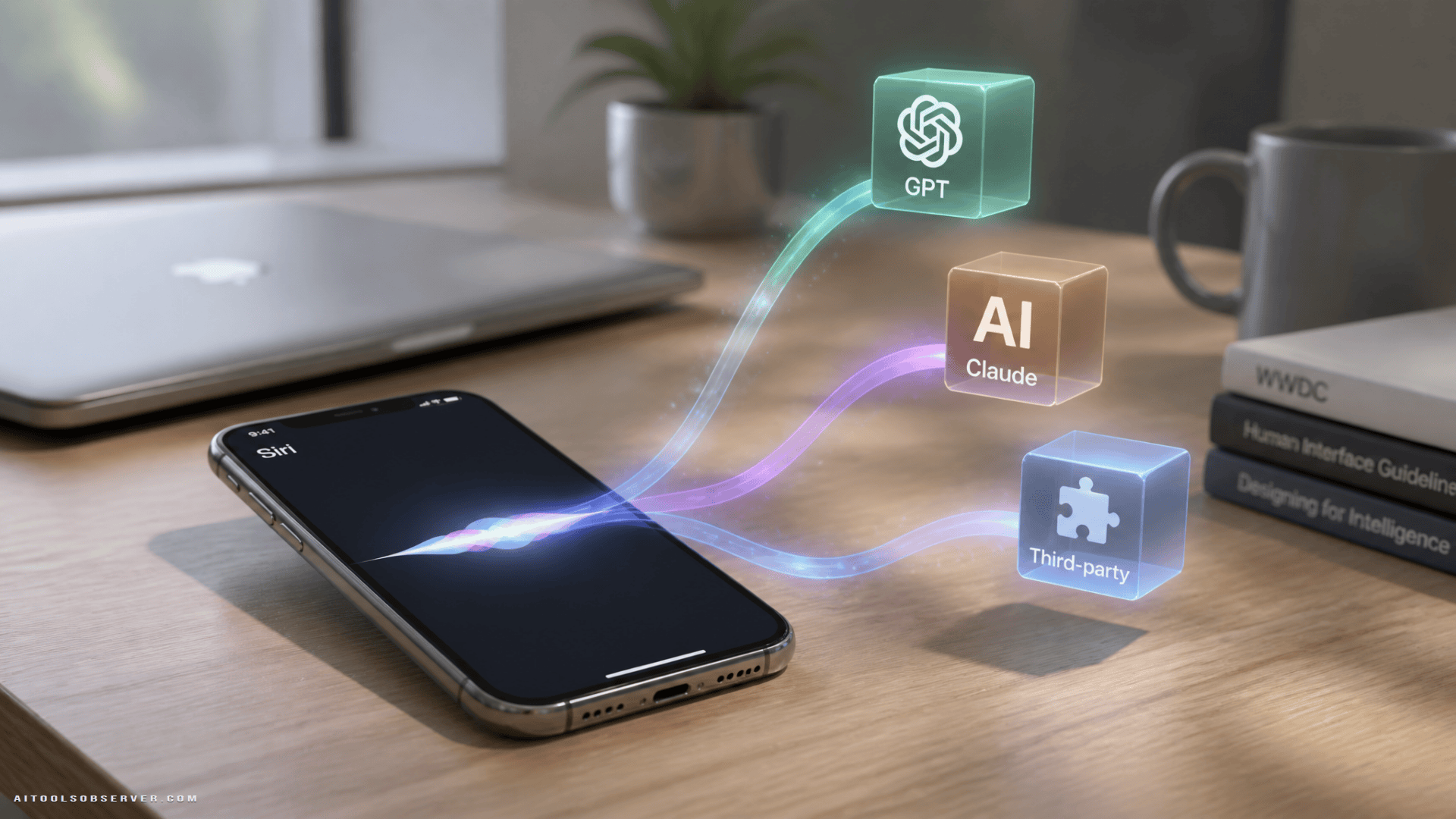
The first is called Model Delegation. It allows a third-party model like Claude to appear as a Siri extension — similar to how ChatGPT already integrates today. A user can invoke Claude via an “Ask…” contextual menu, direct it to handle a specific task, and Siri steps back in when system-level access is required.
In a demonstration shared on X by code researcher “pdfu,” Claude receives a natural language request to set a reminder. Claude interprets the request, then passes execution back to Siri, which creates the reminder in Apple’s Reminders app. In a separate example, Claude handles a CSV file creation request — something Siri itself cannot do — and returns the result directly.
The second mechanism goes considerably further. An inference provider within “Model Manager Services” appears to allow Apple’s own server-side Siri model to be replaced entirely by an external model. In the demonstration, GPT-5.6 receives Apple’s Siri planner prompt and tool definitions, enabling it to request system actions, access personal data, and formulate a response — which Siri then presents using its own interface and voice.
The practical implication: a user could ask the Siri app to find emails on a topic, summarize them, and send a follow-up message via the Messages app — with the underlying reasoning handled by ChatGPT rather than Apple’s own model.
Regulatory Context Is Hard to Ignore
The EU’s Digital Markets Act almost certainly shaped this architecture. The regulation requires Apple to give third parties effective access to iOS hardware and software features available to Apple’s own services. The European Commission has explicitly stated this principle extends to Siri.
Whether Apple designed this primarily to satisfy regulators or as a genuine product direction is an open question. The architecture, however, appears to go beyond the minimum required — particularly the inference provider mechanism, which grants external models a surprisingly deep level of access to Apple’s system context.
What’s Actually Available Now
It’s worth being precise about the current state:
- The “Ask…” menu in macOS Golden Gate’s Release Candidate currently supports only the ChatGPT extension. Claude is not yet available.
- The model delegation entitlement has not been opened to third parties and is not visible to end users.
- The frameworks exist in shipping code, but the full capability is not yet front-facing.
This is framework-level evidence of intent, not a product announcement. Apple has not confirmed any of this publicly.
Why This Matters for AI Tool Decisions
For anyone tracking the AI tools ecosystem, this development shifts a key assumption: that Apple’s platform would remain a closed, single-model environment.
If Model Delegation and the inference provider mechanism ship as functional, user-facing features, the choice of which AI model handles your daily tasks on Apple devices becomes a genuine user decision — not a default set by Apple. That changes the competitive dynamics for every model provider trying to reach iOS and macOS users.
The architecture also raises a practical question about data flow. When an external model like GPT-5.6 receives Apple’s Siri planner prompt and personal data to formulate a response, that data is logged on the provider’s platform — as the demonstration appears to confirm. Users choosing to route requests through third-party models will need to weigh capability against data handling.
For broader context, see Apple’s New Siri Resets the AI Race at WWDC.
The Useful Takeaway
Apple appears to be building Siri into a modular orchestration layer rather than a fixed AI endpoint. If that architecture opens up to third parties, the relevant question for users won’t be “is Siri good enough?” — it will be “which model do I trust with my Apple data, and for which tasks?” That’s a more useful question, and one worth thinking about before the feature ships.















Comments (0) No comments yet
Want to join this discussion? Login or Register.
No comments yet. Be the first to share your thoughts!