


What the System Actually Does
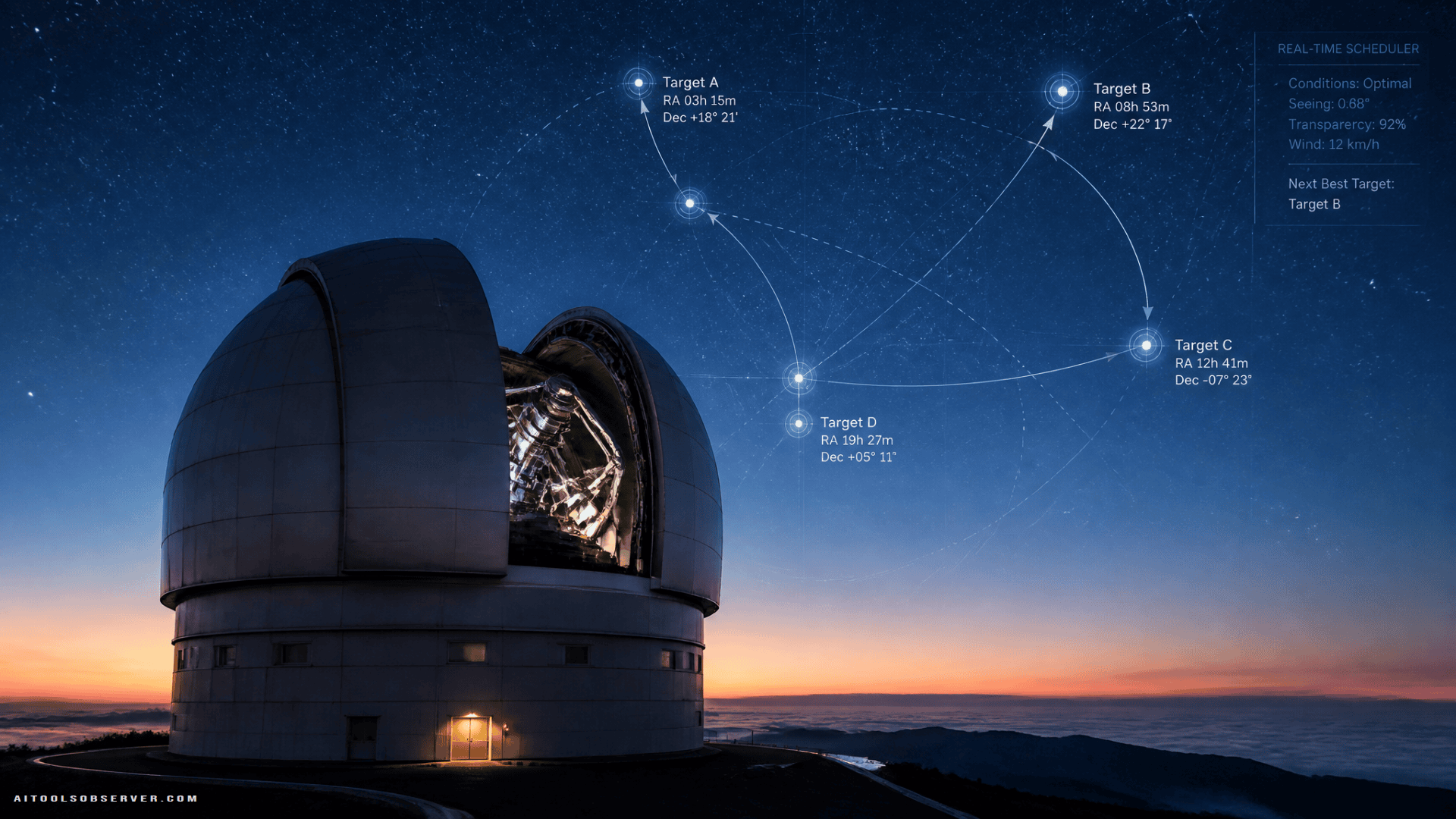
The AI scheduler doesn’t just generate a nightly plan and call it done. It watches conditions — weather, moonlight, atmospheric quality — and updates the observing schedule in real time as things change.
It was tested on the NSF Víctor M. Blanco 4-meter Telescope at Cerro Tololo Inter-American Observatory in Chile, using the 570-megapixel Dark Energy Camera (DECam). The system completed two live observing runs, making it one of the first AI schedulers deployed on a major national observatory facility.
How It Learned to Schedule
Rather than encoding decades of astronomer intuition into explicit rules, the team took a different approach: they let the model figure it out from historical data.
The training process was straightforward in concept, demanding in execution:
- Feed the model years of observations from the Dark Energy Survey
- Show it where the telescope was pointing at one moment
- Ask it to predict the next pointing decision
- Compare that prediction to what human astronomers actually did
- Correct the mistakes, repeat
Over many iterations, the model internalized the tradeoffs — moon brightness, atmospheric seeing, target priority — without being explicitly told how each factor works.
Where It Stands Now
Right now, the system performs at roughly human level. That’s the honest assessment from the project lead, and it’s also the point. Matching human performance on a live national observatory is the baseline, not the ceiling.
The next goal is to push past human decision-making — finding observing strategies that humans might overlook, especially under time pressure or rapidly shifting conditions.
Why This Matters Beyond One Telescope
Next-generation facilities like the Vera C. Rubin Observatory will generate data volumes that dwarf anything currently in operation. Intelligent scheduling systems could help companion telescopes respond faster and extract more science from every clear night.
There’s also a simpler benefit: if the operational logistics run themselves, astronomers get to spend more time on the science.
The Practical Takeaway
This isn’t a prototype demo — it ran on real hardware, under real sky conditions, at a real observatory. The infrastructure is in place. The model is learning. The gap between "comparable to a human" and "better than a human" is now the active research question.
For anyone tracking AI in scientific workflows, this is a useful case study in what deployment-first AI development looks like: train on historical data, test in production, measure against human baselines, then iterate.





Comments (0) No comments yet
Want to join this discussion? Login or Register.
No comments yet. Be the first to share your thoughts!