


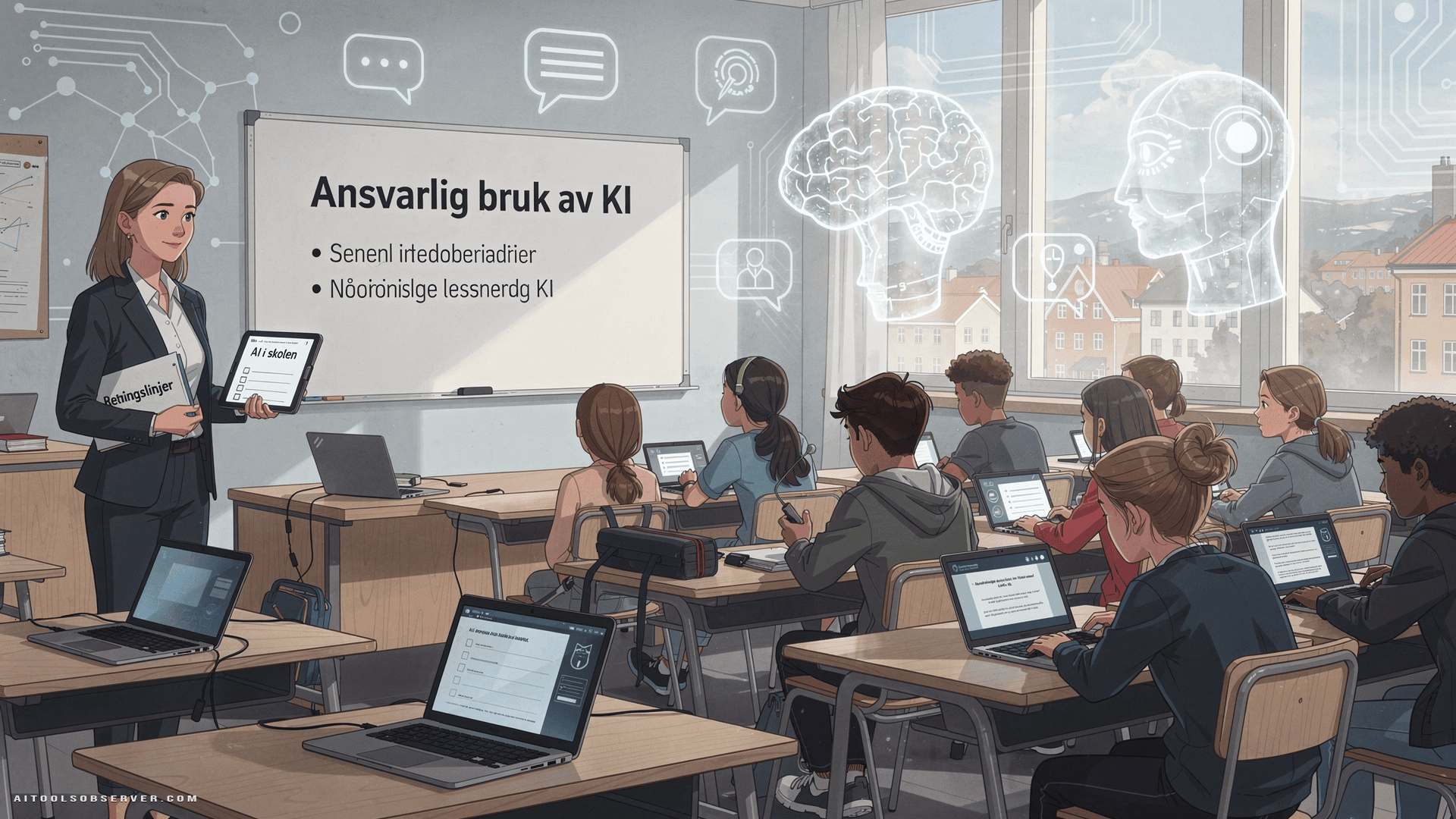
What Norway Actually Announced

The policy breaks down by age group, and the distinctions matter:
Grades 1–7 (ages 6–13): Generative AI tools are off the table as a general rule. No ChatGPT, no AI writing assistants, no AI-powered tutoring apps for young learners.
Lower secondary (ages 14–16): Cautious, supervised use is permitted — but only under direct teacher oversight. The emphasis is on control, not exploration.
Upper secondary (ages 17–19): Students are expected to learn how to use AI appropriately, with the goal of preparing them for higher education and the workforce.
The framing from Stoere was blunt: “The most important thing in school is that our children learn to read, write and do mathematics.”
The implication is clear — AI is getting in the way of that.
This Didn’t Come Out of Nowhere
Norway has been tightening its grip on technology in schools for a while now.
In 2024, the government banned smartphones from classrooms and restored disciplinary powers to teachers. That move was a direct response to declining test scores — a trend that’s been rattling education officials across Scandinavia and beyond.
Now, the government is also proposing legislation to fund more physical books in classrooms, explicitly reversing the tablet-first approach that took hold after the iPad launched in 2010. Norway was an early adopter of classroom tech. Now it’s course-correcting.
Add to that the April 2026 announcement of a planned social media ban for children under 16 — following Australia’s lead — and you see a consistent pattern: Norway is systematically rolling back digital access for minors across multiple fronts.
Why This Matters for AI Tools and EdTech
If you’re building, selling, or evaluating AI tools for education, this policy is a signal you can’t ignore.
The Regulatory Tide Is Turning

Norway isn’t an outlier. It’s a bellwether. Governments across Europe and beyond are increasingly skeptical of unchecked AI adoption in schools. The EU AI Act already classifies certain AI uses in education as high-risk. Norway’s move adds political momentum to that regulatory direction.
EdTech companies that built their growth strategies around K-12 AI adoption need to stress-test those assumptions now — not after the regulations land in their market.
Age-Gating Is Becoming a Compliance Requirement
The Norwegian framework essentially mandates age-gating for AI tools in educational settings. That’s not just a policy preference — it’s a product design challenge.
Tools that can’t demonstrate age-appropriate usage controls, teacher oversight features, and transparent data practices will struggle to pass procurement reviews in increasingly regulated markets. This is where responsible AI design stops being a marketing talking point and starts being a market access requirement.
The “AI Literacy” Window Is Narrowing for Younger Users
There’s a real tension in Norway’s policy. By restricting AI for ages 6–16, the government is protecting foundational learning skills. But it’s also delaying AI literacy development until upper secondary school.
For EdTech platforms targeting the 17–19 age bracket, this creates a concentrated opportunity — and a responsibility. Students arriving at upper secondary with zero AI experience will need structured, scaffolded onboarding. Tools that can deliver that will have a clear advantage.
The Broader Debate: Protection vs. Preparation
Critics will argue that shielding children from AI doesn’t prepare them for a world where AI is everywhere. Supporters will counter that you can’t build on a foundation that isn’t there — and that foundation is reading, writing, and numeracy.
Both sides have a point. The question is sequencing.
Norway’s bet is that getting the fundamentals right first produces better long-term outcomes, even if it means slower AI adoption in the short term. Whether the data bears that out will be worth watching closely over the next few years.
What AI Tool Builders and EdTech Buyers Should Do Now
If you’re building AI tools for education: Audit your product for age-appropriate design, teacher control features, and data transparency. These aren’t nice-to-haves in regulated markets — they’re table stakes.
If you’re evaluating EdTech tools for your school or district: Start asking vendors directly how they handle age restrictions and AI governance. Norway’s framework gives you a useful benchmark to pressure-test their answers.
If you’re tracking the AI tools market: Watch how other European governments respond to Norway’s move. Policy contagion is real. What starts in Oslo rarely stays there.
The Takeaway
Norway’s near ban on generative AI in schools is one of the most concrete government actions on AI in education we’ve seen to date. It’s not anti-technology — it’s a deliberate prioritization of foundational skills over digital convenience.
For the AI tools ecosystem, the message is straightforward: the era of frictionless EdTech adoption is over. Governance, age-appropriateness, and demonstrated learning outcomes are now part of the product conversation.
The tools that survive — and thrive — in this new environment will be the ones that were built with those constraints in mind from the start.












Comments (0) No comments yet
Want to join this discussion? Login or Register.
No comments yet. Be the first to share your thoughts!