


What Happened
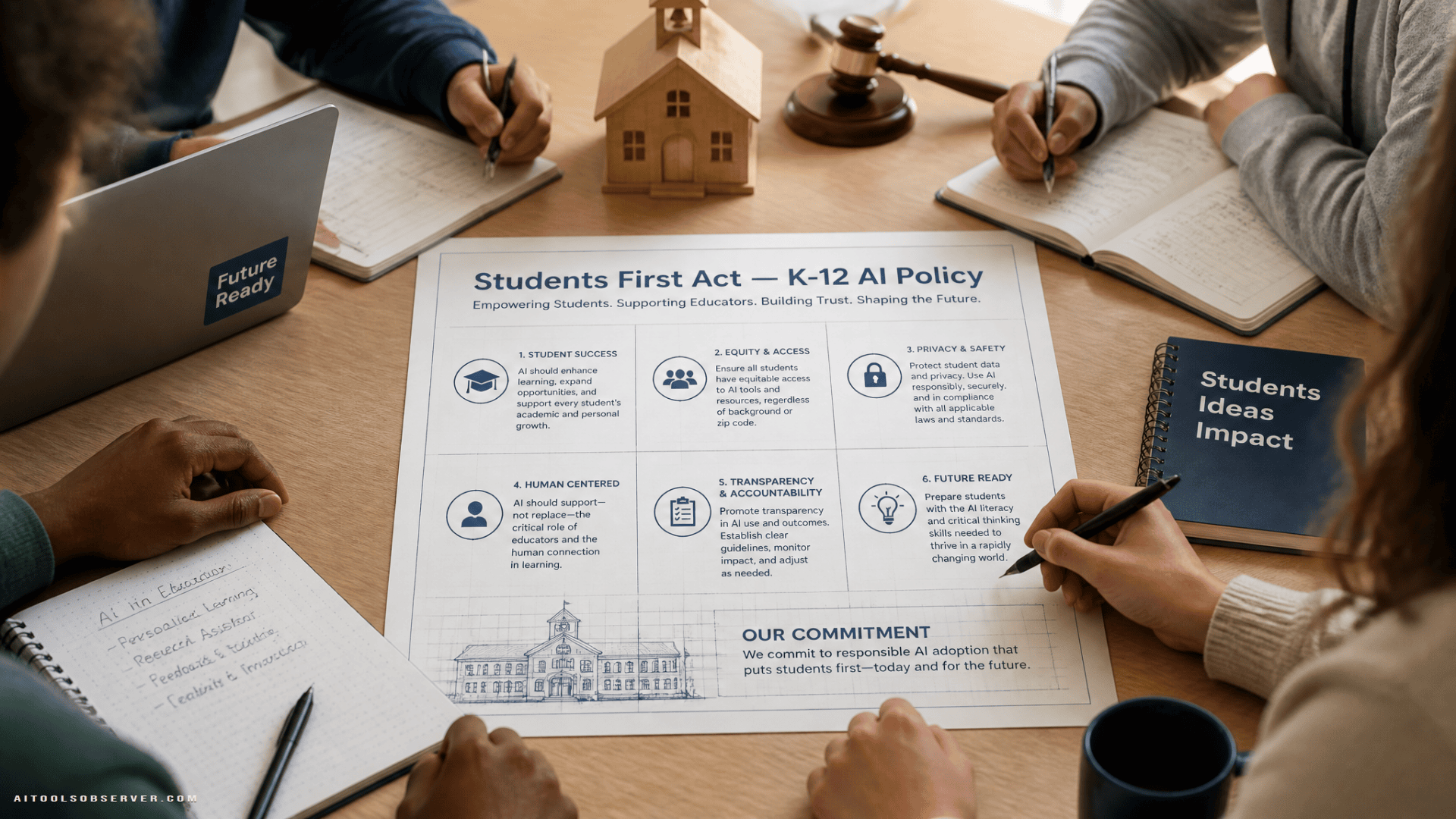
Last month, a student coalition convened in Boston at the Edward M. Kennedy Institute for the United States Senate, using the Institute’s full-scale replica of the Senate chamber to debate, amend, and vote on a formal AI policy document. The gathering was organized in partnership with AASA (the School Superintendents Association) and Day of AI, a nonprofit initiative from MIT’s RAISE AI literacy program.
The result is the Students First Act — a nine-page framework structured as a ready-to-use bill for state legislators and Congress.
What the Framework Actually Contains
The document is organized into three layers: overarching principles, student-specific rules, and teacher-specific rules. Each layer is concrete and enforceable, not aspirational.
Overarching Principles
The Act opens with a set of first principles that apply across all K-12 contexts:
- Human connection takes precedence — AI should not be used where educator-student relationships are central to learning.
- AI vendors must disclose known biases in their systems to institutional clients.
- Teachers retain full classroom authority; AI policy cannot override professional judgment.
- No teacher or administrator may be penalized for choosing not to use AI tools.
These principles are notable for what they protect: teacher autonomy and human relationships, not just data security.
Rules for Students
The student-facing rules draw a clear line between permitted and prohibited AI use.
Prohibited uses include submitting AI-generated original writing, inputting assignments directly into AI platforms, using AI on graded work, and using AI to complete artistic assignments.
Required safeguards include:
- Students must be allowed to refuse AI tools, with an alternative assignment provided.
- Students who use AI must cite how they used it and demonstrate subject mastery through discussions, handwritten tests, or oral defenses — a mechanism similar to the oral defense clause recently adopted by the University of Chicago Law School.
- Suspected misuse must be reviewed by two school officials, not AI detection software alone. The Act explicitly acknowledges that AI checkers can be unreliable.
- Students must be informed of all data collection, its purpose, and retain the right to refuse unnecessary data collection.
The plagiarism review clause is particularly well-considered. Over-reliance on automated detection tools has already produced documented false accusations against students. Requiring human review by two officials adds a meaningful procedural check.
Rules for Teachers
The teacher-facing rules are equally specific.
Permitted uses include lesson planning, drafting practice materials, providing feedback, and improving instruction.
Obligations include reviewing all AI-generated materials for accuracy, bias, and appropriateness before classroom use — and posting a clear, written AI usage policy each semester that specifies when AI is and is not allowed.
Prohibited uses include using AI as the sole basis for determining grades, assessing student conduct, or making other consequential decisions about a student’s education.
Why This Framework Stands Out
Several features distinguish this document from typical institutional AI policies.
First, it is symmetrical. Students and teachers are held to comparable transparency standards. If students must disclose AI use, so must teachers.
Second, it addresses the bias problem directly. Requiring AI vendors to inform institutional clients of known system biases is a practical demand that most school procurement processes currently ignore.
Third, it protects opt-out rights on both sides. Students can refuse AI tools without academic penalty. Teachers can decline to use AI without professional penalty. This is not a given in districts where AI adoption is being pushed from above.
The Practical Takeaway
The Students First Act is available as a full nine-page document, structured for direct legislative use. For school administrators, district technology officers, or state policymakers currently drafting AI governance frameworks, it offers a structured starting point that has already been debated and refined by the population it governs.
The framework does not resolve every tension in school AI use — questions around enforcement, vendor compliance, and implementation costs remain open. But as a baseline for what responsible K-12 AI governance should address, it is more complete than most of what currently exists at the policy level.









Comments (0) No comments yet
Want to join this discussion? Login or Register.
No comments yet. Be the first to share your thoughts!