


Why this matters now
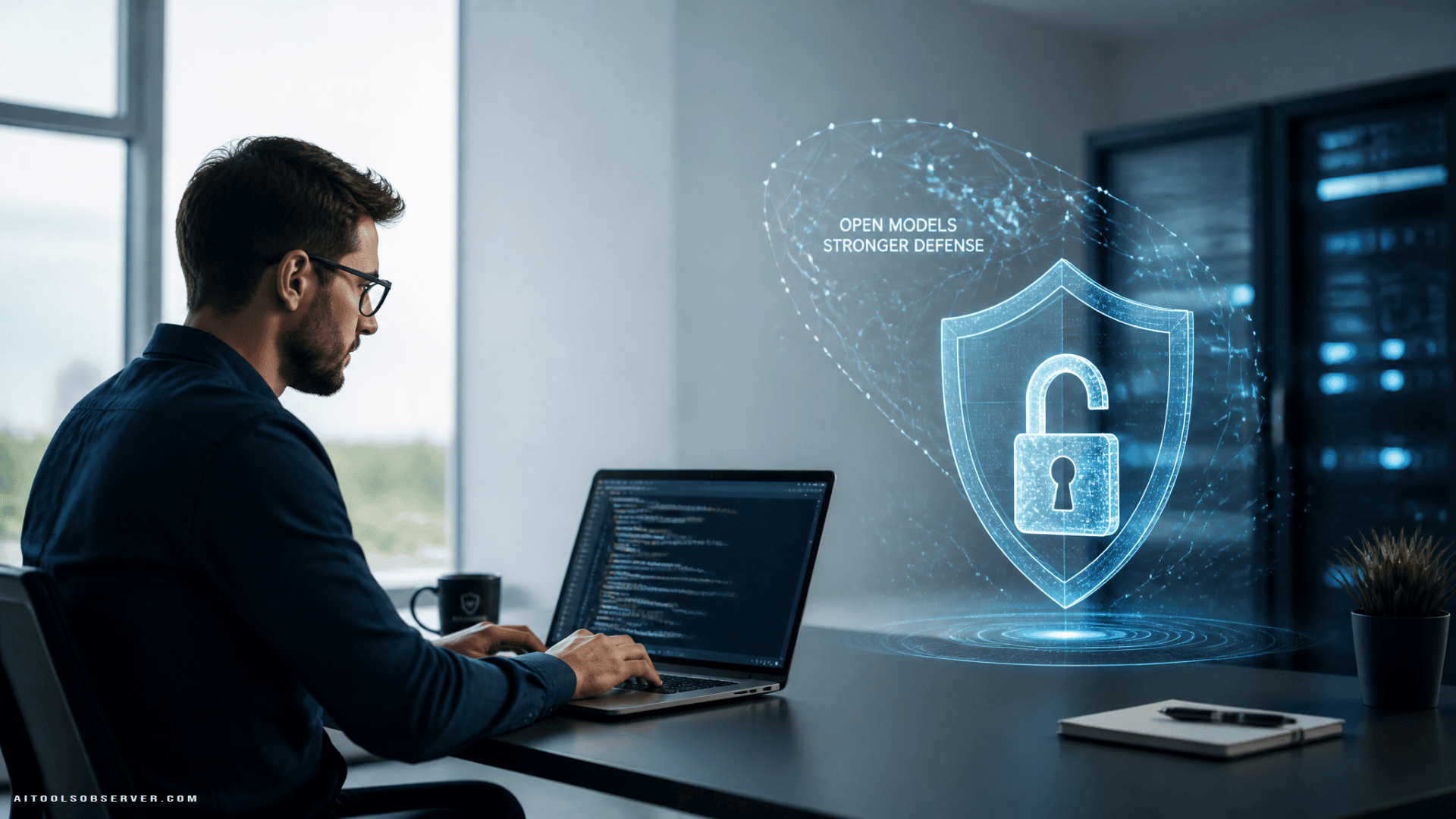
Nvidia, Microsoft, SpaceX, Palantir, and other companies are backing an initiative centered on open models and shared security tooling. The timing matters.
The launch appears to be a direct response to two pressures colliding at once:
- rising concern over AI-enabled cyberattacks
- growing calls in Washington to limit Chinese AI model adoption
That creates a difficult policy and product question. If some of the most capable open-weight models are also tied to Chinese companies, how do U.S. firms keep access to flexible defensive tools without deepening security and geopolitical risk?
The core argument behind the alliance
The alliance’s position is straightforward: defenders need AI they can inspect, modify, and run on their own infrastructure.
That is the practical advantage of open-weight models. Unlike closed systems accessed only through a provider’s platform or API, open models can be self-hosted and adapted for specific security workflows.
In a cyber defense setting, that can matter for a few reasons:
- teams may need lower-latency responses
- they may need to customize behavior for a specific environment
- they may need to inspect how the system works
- they may not be able to rely on external access during an active incident
This is less about ideology and more about operational control.
Open vs. closed is no longer just a developer preference
For a long time, the open-versus-closed model debate lived mostly in product, research, and cost discussions. Now it is moving into security planning.
Closed models still offer clear advantages. They are often easier to deploy, simpler to manage, and may come with stronger centralized safety controls. For many businesses, that convenience is the whole point.
But the Hugging Face fallout, as described in the context, exposed the downside of that structure in high-stakes scenarios. If a provider’s safeguards are too rigid, defenders may lose valuable time when they need the model to act more like a security operator than a general assistant.
That does not automatically make open models safer. It does make them more usable in certain defensive conditions.
Why policymakers are paying attention
The policy layer makes this story bigger than a standard industry alliance announcement.
Washington’s concern, based on the context provided, is not simply whether models are open or closed. It is whether Chinese AI companies should retain broad access to U.S. markets and infrastructure if they are seen as benefiting from IP extraction or distillation tactics.
That means any future restrictions could land in a narrow but important zone:
- access to Chinese model APIs
- hosting Chinese models on U.S. cloud infrastructure
- commercial inference built around those models
If that happens, the market could split in an awkward way. Companies may want open-weight flexibility for cybersecurity, but they may also face pressure to avoid some of the very models that currently offer that flexibility.
What this means for AI buyers and security teams
If you are evaluating AI tools, this update changes what “safe” should mean.
Safety is not only about reducing harmful outputs. It is also about whether a system can be used effectively for legitimate defense when things go wrong.
That shifts buyer questions in a more practical direction:
These questions matter for founders, enterprise IT leaders, and teams adopting agentic AI. A model that looks strong in demos may be much less useful in a real security event if you cannot control its environment or behavior.
Questions worth asking vendors
- Can the model be self-hosted?
- Can security teams inspect or adapt its behavior?
- What happens if guardrails block legitimate defensive use cases?
- Is the tool usable during a live incident without relying entirely on a third-party platform?
- Are there policy or jurisdiction risks tied to the model source?
The bigger signal for the AI tools market
This alliance also points to a broader market shift: AI infrastructure choices are becoming security choices.
That affects more than cybersecurity vendors. It touches any product team building with AI agents, workflow automation, code generation, or enterprise copilots. If the underlying model cannot be adapted for compliance, defense, or internal hosting, some buyers will start treating that as a product limitation rather than a feature tradeoff.
For AI tool discovery, this is an important filter. “Open” and “closed” are no longer just technical labels. They increasingly shape:
- deployment control
- risk management
- vendor dependency
- regulatory exposure
- incident response readiness
Where the tension goes next
Expect the next phase of this debate to focus on two competing goals.
The first is keeping advanced open-weight AI available for legitimate security and enterprise use. The second is limiting exposure to models tied to strategic or legal concerns, especially when national policy enters the picture.
Those goals can clash fast. If restrictions tighten before domestic or allied open alternatives are strong enough, companies may find themselves with fewer defensive options right when cyber risk is rising.
What to do with this update
If you are comparing AI platforms, do not stop at benchmarks or feature lists. Check whether the model can actually serve your team under pressure.
The useful takeaway is simple: in AI security, control is becoming part of safety. Tools that can be inspected, hosted, and adapted may matter more than tools that are only powerful when everything is calm.







Comments (0) No comments yet
Want to join this discussion? Login or Register.
No comments yet. Be the first to share your thoughts!