


What’s Actually Happening

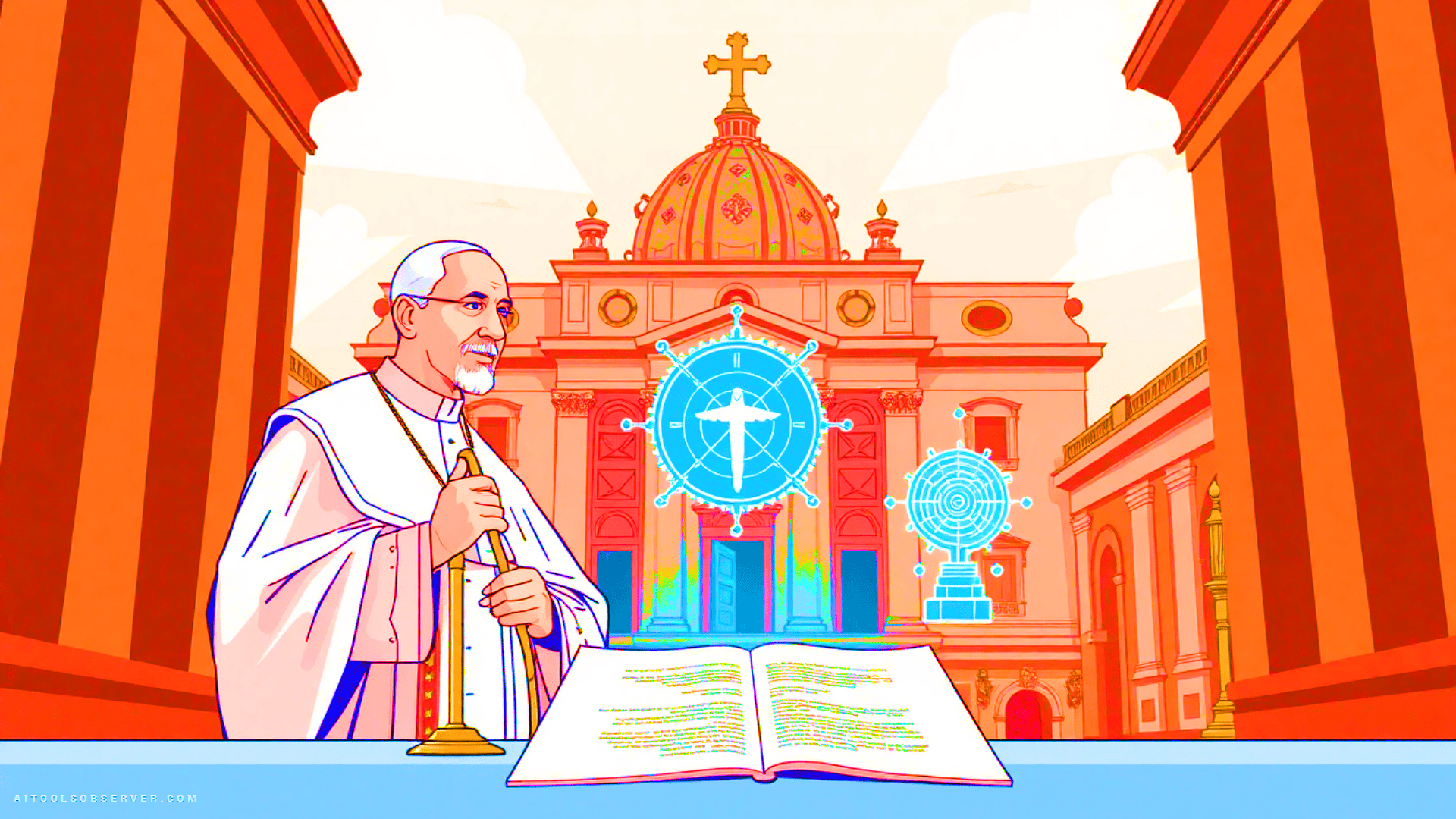
Leo XIV will unveil the encyclical alongside Chris Olah, co-founder of Anthropic — the company behind Claude — in Vatican City. It’s a striking pairing: the head of the world’s largest Christian institution standing next to one of Silicon Valley’s most philosophically serious AI builders.
The encyclical was signed on May 15, 2026 — deliberately chosen as the 135th anniversary of Rerum Novarum, Pope Leo XIII’s landmark 1891 letter on labor and the Industrial Revolution. The symbolism isn’t subtle. Leo XIV sees AI as this era’s Industrial Revolution, and he’s positioning the Church as a moral counterweight.
In an unusual move, the pope will also deliver a live address to accompany the document’s release.
What the Pope Actually Said
Leo didn’t wait for Monday to signal his direction. Speaking at a Vatican AI conference just days before the release, he was direct:
“We are truly experiencing an eclipse of the sense of what it means to be human.”
He called out the “unbridled promotion and implementation of technology at the expense of human dignity” — and specifically flagged chatbots exploiting human needs for connection. That’s not a vague philosophical concern. That’s a critique with a product category attached.
Why Anthropic Is in the Room

Anthropic’s presence at the unveiling is worth unpacking. The company has spent the past year quietly building bridges with religious communities — hosting Christian leaders at its headquarters in March and April to discuss the “spiritual development” of its AI systems.
Internally, Anthropic refers to Claude’s guiding document as a “soul document.” It’s a constitution that, in their words, “expresses and shapes who Claude is.” That framing — intentional or not — lands differently in a room full of theologians.
Chris Olah put it plainly on X last week: “The questions posed by AI are bigger than the AI community. We urgently need the world — religions, civil society, academics, governments — to participate in creating a positive outcome.”
That’s either genuine humility or very good optics. Possibly both.
Where the Skepticism Lives
Not everyone is moved by the interfaith outreach.
Will Jones of the Future of Life Institute noted that most people from Abrahamic faiths would firmly reject the idea that a system like Claude could ever have personhood. His framing of human dignity is instructive: it can’t be lost, but it absolutely can be desecrated, exploited, and abused.
Inside the Vatican, the resistance is even more pointed. Paolo Benanti, a Franciscan friar and one of Leo’s key AI advisers, argued in December that human intelligence is categorically different from anything a digital mind could produce. “These are qualities of the soul — the ‘divine spark’ — not the output of probabilistic computation.”
That’s a theological line in the sand. And it’s likely to echo throughout Magnifica Humanitas.
What to Expect From the Document

Charles Camosy, a moral theology professor at Catholic University of America, described the encyclical as “of two minds.” It will apply centuries of Catholic tradition to a new technological context — but it will also push into new territory with specific calls to action around AI.
The core tension: the very concept of what it means to be human is now contested terrain. The encyclical is expected to push back firmly against any framing that blurs the line between human persons and AI systems.
Leo also recently approved a new Vatican interdepartmental commission to monitor AI’s effects on humanity — so this isn’t a one-time statement. It’s the beginning of an institutional posture.
Why This Matters Beyond the Vatican

For AI builders, ethicists, and anyone tracking governance: a papal encyclical carries real weight. It reaches every Catholic bishop globally, shapes policy conversations in heavily Catholic nations, and adds a moral vocabulary to debates that have largely been dominated by technical and economic framing.
The fact that Anthropic — one of the most safety-focused frontier AI labs — chose to show up says something. Whether it’s strategic alignment or genuine shared concern, the AI industry is clearly watching how religious and civil institutions respond to its work.
When the most powerful religious institution on earth starts writing formal doctrine about your industry, you’re no longer just a tech story. Magnifica Humanitas won’t ship a product or change a model weight — but it might shift how billions of people think about what AI is allowed to be.















Comments (0) No comments yet
Want to join this discussion? Login or Register.
No comments yet. Be the first to share your thoughts!