


AI Has Moved Into the Daily Workflow

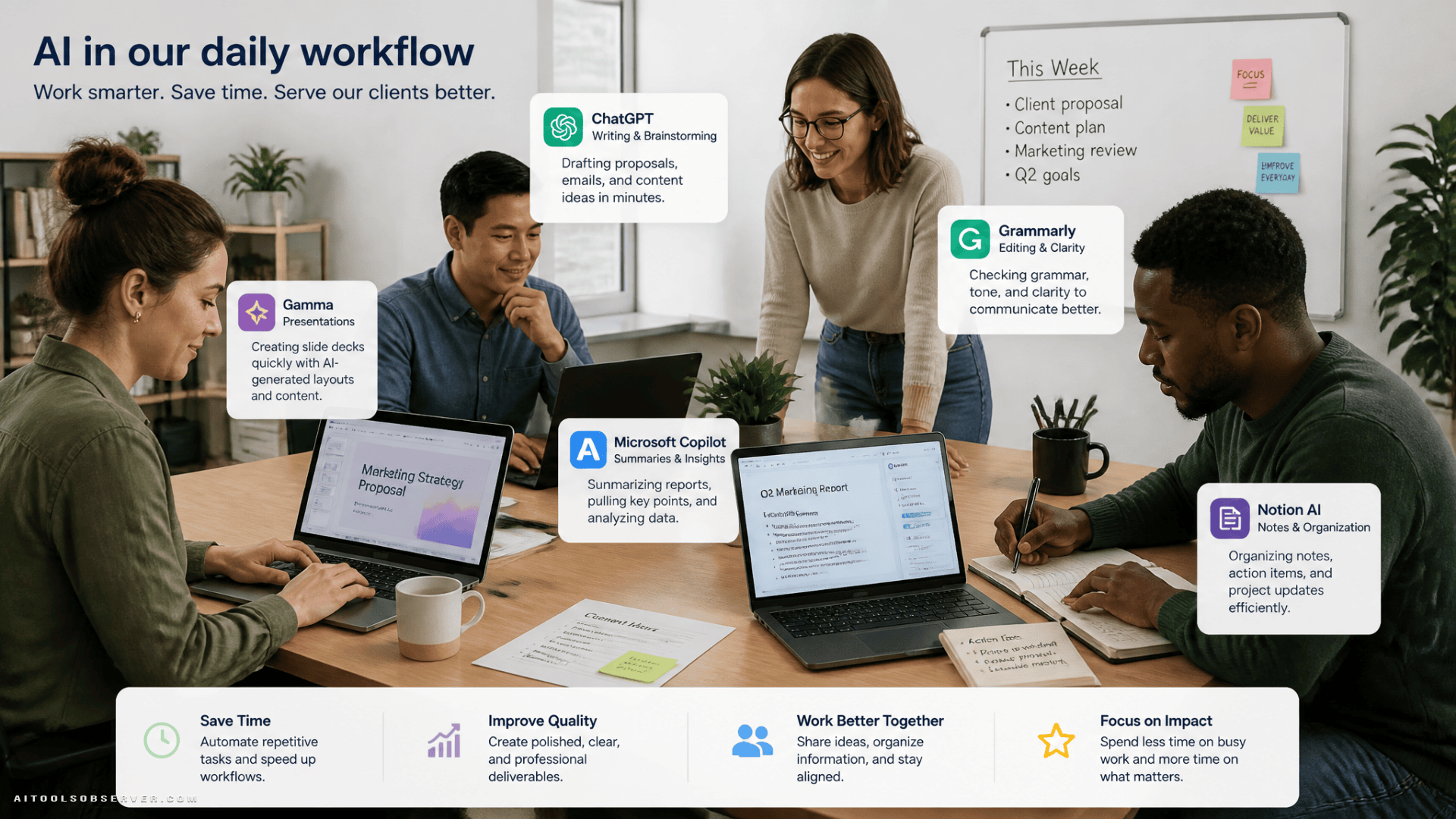
Small businesses aren’t using AI to rebuild their operations from scratch. They’re using it to get through the day faster.
The most common applications reported include drafting emails, creating marketing content, summarizing documents, conducting research, and handling administrative tasks. These aren’t glamorous use cases, but they’re high-frequency ones. That’s exactly where productivity gains compound over time.
The dominant motivation across survey respondents was productivity improvement—not headcount reduction. Workers are using AI as a workplace assistant, not a replacement. That framing matters, both for internal adoption and for how business owners communicate AI use to their teams.
The Adoption Gap Is Real—and It’s Concentrated at the Bottom

This is the most important finding in the report, and it deserves direct attention.
Among businesses with 2 to 9 employees, only 43% reported using AI for work tasks. Among businesses with 100 to 249 employees, that number jumps to 59%. That’s a 16-point gap between the smallest and the largest firms within the small business category alone.
The irony is sharp. The smallest firms often have the most to gain from AI-driven efficiency—they’re running lean, wearing multiple hats, and have limited time for anything that doesn’t directly move the business forward. Yet they’re the least likely to have adopted the tools that could help.
Why the Smallest Firms Are Falling Behind

The report points to three compounding constraints:
- Limited budgets make it harder to experiment with paid tools or absorb the cost of getting it wrong.
- Fewer technical resources mean there’s often no one on the team to evaluate, implement, or troubleshoot new software.
- Less time to research options, run trials, or sit through onboarding—even when the owner recognizes the potential value.
These aren’t excuses. They’re structural barriers that don’t disappear just because AI tools are getting cheaper and easier to use.
What Small Businesses Are Actually Getting From AI

Previous Chamber research found that businesses using AI frequently report improved efficiency, stronger growth, and greater confidence in expanding operations. The 2026 report reinforces that pattern while shifting focus from owners to employees.
Workers themselves are increasingly driving adoption. They’re finding tools that help them move faster on repetitive tasks, pull together information more quickly, and support everyday decisions without escalating every question up the chain.
That bottom-up adoption pattern is significant. It suggests AI integration in small businesses isn’t always a top-down strategic initiative—it’s often organic, task-level, and driven by individual employees discovering what works.
The Sectors Where AI Is Already Embedded

Generative AI has made the deepest inroads in four areas for small businesses: marketing, customer service, accounting, and business planning. These aren’t surprising categories—they’re the functions where small business owners most often feel stretched thin and where the output of AI tools is easiest to evaluate.
Marketing is particularly notable. Writing product descriptions, drafting social posts, generating ad copy, and building email sequences are all tasks where AI tools deliver fast, usable output. For a two-person operation without a dedicated marketing hire, that’s a meaningful capability shift.
The Employment Question Is Being Answered in Practice
Policymakers and economists are still debating AI’s long-term impact on jobs. Small businesses are already answering the question through behavior.
The survey data consistently shows AI being used as a complement to workers, not a substitute. Employees are completing routine tasks more efficiently and redirecting time toward higher-value work. That’s the productivity story, and it’s the one most small business owners are living right now.
Whether that holds as AI capabilities expand into customer engagement, operations, and decision-making is a legitimate open question. But for 2026, the displacement narrative doesn’t match what small businesses are actually reporting.
Closing the Gap Requires More Than Awareness

The Chamber of Commerce Foundation’s recommendation is practical: expand educational resources, practical training, and access to affordable tools. Increased familiarity reduces hesitation. Hesitation is currently one of the biggest barriers among owners who understand AI’s potential but haven’t acted on it.
That’s an actionable insight for anyone in the AI tools ecosystem—whether you’re building tools, advising businesses, or trying to figure out where to start.
What This Means If You’re a Small Business Owner Right Now

Don’t wait for a comprehensive AI strategy before you start. The businesses seeing gains aren’t running transformation programs—they’re solving specific, repetitive problems with specific tools.
Start with the tasks that eat the most time and require the least judgment: email drafts, content outlines, research summaries, meeting notes. Pick one tool, use it consistently for 30 days, and measure the time saved. That’s the adoption path that’s actually working for small businesses in 2026.
The gap between the smallest firms and their slightly larger counterparts isn’t about capability. It’s about access to the right guidance at the right moment. If you’re reading this, you’re already ahead of that curve.











Comments (0) No comments yet
Want to join this discussion? Login or Register.
No comments yet. Be the first to share your thoughts!