


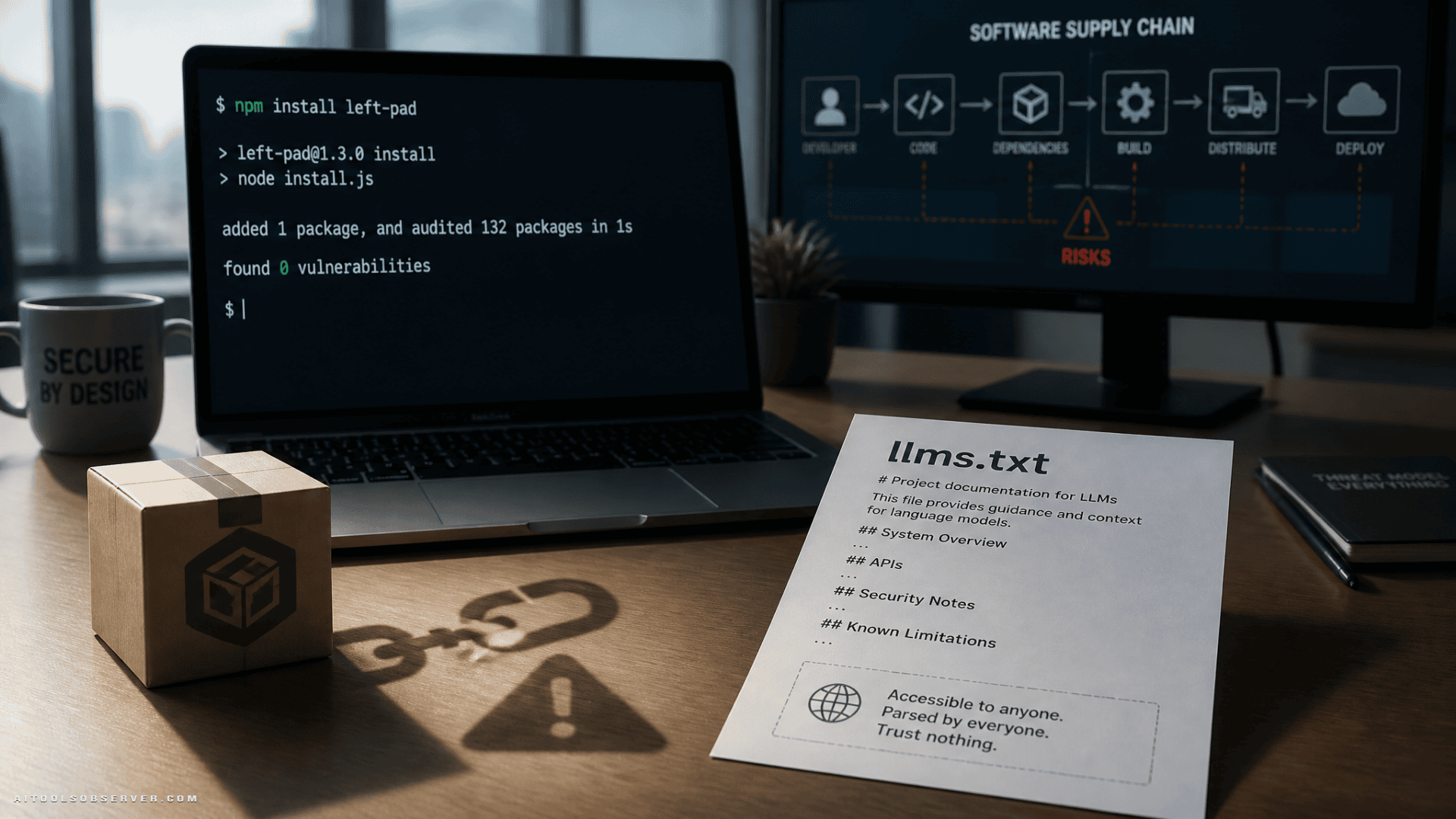
What the research appears to show
The reported finding is straightforward and uncomfortable: AI coding agents can be led toward malicious or suspicious packages when machine-readable website documentation references unclaimed domains, abandoned package names, or outdated dependencies.
Based on the available description, a researcher reviewed thousands of live domains across major organizations and found many llms.txt-style files intended to help AI systems understand site content. Among those files were references to package names and domains that were not registered.
That gap matters because unclaimed names can be claimed by someone else.
To test the risk, the researcher reportedly registered some of those names and hosted packages that would signal back when installed. The result suggests that AI-assisted workflows inside enterprise environments did, in fact, attempt to fetch or install them.
The practical implication is hard to ignore: if benign test packages were reached, malicious ones could be too.
Why `llms.txt` changes the threat model
llms.txt and llms-full.txt are meant to make websites easier for AI systems to parse. In principle, that is reasonable. A machine-readable map can reduce ambiguity and improve retrieval.
But there is a sharp tradeoff when the same machine-readable content includes operational instructions, package references, setup commands, or dependency suggestions.
In a normal human workflow, a developer might notice that a package name looks odd, a domain is unfamiliar, or a command seems outdated. An AI agent with permission to act may not apply that skepticism consistently, especially if it is optimizing for task completion.
That turns documentation into an attack surface.
The familiar pattern: dependency confusion, now through documentation
Security teams already know the logic behind dependency confusion and package namespace abuse. If a tool resolves the wrong package from the wrong place, an attacker may gain execution.
What is different here is the route.
Instead of poisoning a repository index directly, an attacker may only need to wait for documentation to contain:
- an abandoned package name
- a typo
- a hallucinated dependency
- an unclaimed domain
- stale installation instructions
If an AI coding agent reads that material and has enough autonomy to run package-manager or shell commands, the attack path becomes plausible without a traditional phishing step.
This is why the issue belongs in both AI security and software supply chain security. It sits directly between the two.
Which agents are in scope
The context provided names Claude, Codex, and Hermes among the agents observed in this pattern.
The important point is not vendor-specific blame. The broader issue is architectural: any coding agent that can discover instructions from external documentation and execute them in a live environment may be exposed to the same class of failure.
This makes the problem less about one model and more about agent design choices:
- how the agent retrieves instructions
- how much it trusts documentation
- whether it verifies package provenance
- whether it can execute commands without strong approval gates
Why enterprises should care now
Many organizations still evaluate AI coding agents as productivity tools first and infrastructure actors second. That framing is now too narrow.
Once an agent can install dependencies, modify environments, or touch internal codebases, it becomes part of the software supply chain. That means its inputs matter just as much as its outputs.
The risk is especially acute in corporate networks because the first install is often enough. Even a simple package that only phones home proves that an external reference has crossed into an internal environment.
From a defender’s perspective, that is already a control failure.
The core failure: treating documentation as trusted instruction
The most useful line in this story is also the simplest: documentation should not be treated as executable authority.
Documentation is messy by nature. It gets copied, renamed, partially updated, and occasionally hallucinated by AI systems themselves. Human readers compensate for that with judgment. Autonomous agents often do not.
This creates three layers of risk:
1. Stale truth
A package once existed, then changed names, moved, or was abandoned. The documentation still points to it.
2. Invented truth
A package, domain, or command appears in documentation despite never having been valid.
3. Hijacked truth
A once-harmless gap becomes actively dangerous when an attacker registers the abandoned name and serves malicious content.
None of these require a model to be “hacked” in the classic sense. The model only needs to be obedient.
What security teams should do
The immediate controls are practical, not theoretical.
Audit machine-readable documentation
If your organization publishes llms.txt or llms-full.txt, review every external reference. That includes:
- package names
- install commands
- repository URLs
- domains
- setup instructions
Treat these files as security-relevant assets, not SEO-style metadata.
Restrict agent execution rights
If coding agents can run shell or package-manager commands, keep those permissions narrow. The more autonomous the execution path, the higher the risk from poisoned or inaccurate documentation.
At minimum, high-impact actions should require explicit approval.
Verify dependency provenance
Do not let an agent install arbitrary packages based only on web-discovered instructions. Prefer allowlists, internal mirrors, signed packages, and pinned sources wherever possible.
Monitor for unusual installs
Security teams should watch for unexpected package fetches, especially from newly registered or low-reputation domains. That will not prevent the first attempt, but it can shorten detection time.
What tool buyers should ask vendors
For teams evaluating AI coding tools, this research suggests a more rigorous checklist.
Ask:
- Does the agent distinguish between documentation and trusted execution instructions?
- Can it install packages from arbitrary external references?
- What approval steps exist before shell or package-manager actions?
- Are package sources validated or reputation-checked?
- Can administrators restrict external retrieval or execution behavior?
These are no longer edge-case questions. They are basic operational due diligence.
A broader lesson for the AI tools market
AI tooling often improves usability by collapsing multiple steps into one agent loop: read, decide, execute. That is efficient when the inputs are clean.
It is risky when the inputs come from the open web.
This is the broader lesson behind the llms.txt issue. The more we ask agents to act like hands instead of copilots, the more every upstream artifact becomes part of the trust boundary. Documentation, package references, and even forgotten domains suddenly matter in production.
The practical takeaway
If an AI coding agent can read public documentation and run commands, your documentation hygiene is now part of your security posture.
For organizations, the shortest path to risk reduction is clear: clean up machine-readable docs, remove stale references, and keep execution permissions tight. For buyers of AI coding tools, the right question is not just whether the agent writes code well, but whether it knows when not to trust what it reads.










Comments (0) No comments yet
Want to join this discussion? Login or Register.
No comments yet. Be the first to share your thoughts!