


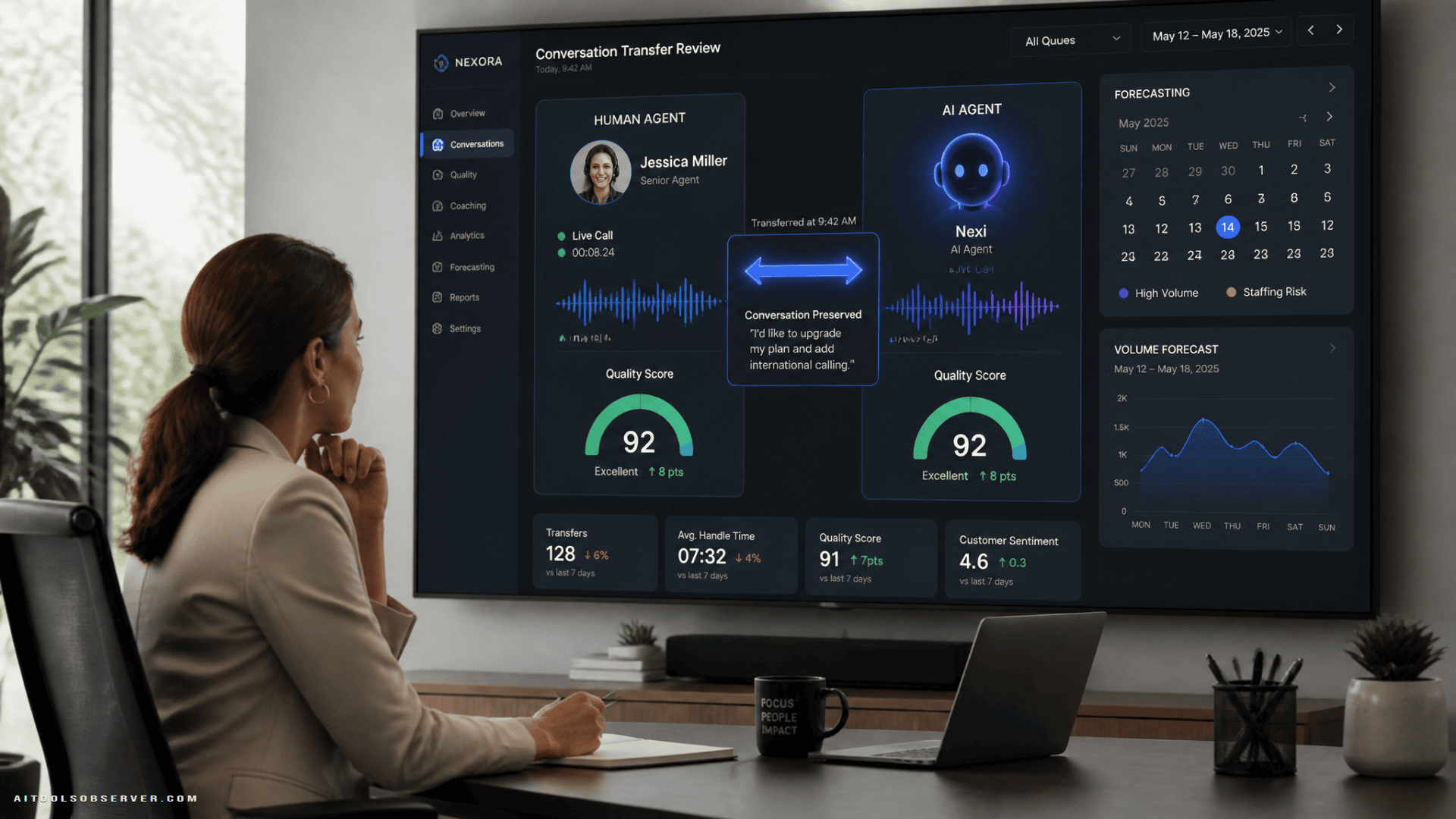
One Dashboard to Rule Them All
The core of the update is a unified live view. Supervisors can now monitor AI-handled and human-handled interactions side by side, in real time, without toggling between systems.
That single view extends to quality scoring—AI interactions are evaluated against the same rubric used for human agents. It also covers customer journey tracking, so managers can see how a conversation moved between automated and human support, and where things went sideways.
Workforce forecasting gets the same treatment. Planners can now schedule AI and human capacity together, which matters when you’re trying to decide whether to staff up for peak season or just let the AI handle the overflow.
The Handoff Problem
One of the messier parts of mixed AI-human contact centers is the moment a bot passes a call to a person. Customers end up repeating themselves. Agents start cold. Everyone’s frustrated.
RingCX now supports bidirectional transfers between AI and human agents with context preserved. The idea is that when a query escalates—or de-escalates back to automation—the conversation history travels with it.
This also creates a useful signal for quality teams: if certain call types consistently transfer from AI to human, that’s a flag to reroute those interactions to humans from the start.
What’s Actually New
Here’s a quick scan of the additions:
- Live unified monitoring across AI and human agents
- Quality scoring applied consistently to both
- Customer journey analysis across automated and human touchpoints
- AI + human workforce forecasting in one planning view
- Context-preserving handoffs in both directions
- AI Onboarding — describe a setup in plain language, and the system generates, configures, and validates routing automatically
- Mobile support for RingCX via the RingCentral app
- Microsoft Teams integration for managing contact center interactions inside Teams
Why This Matters Beyond the Feature List
The contact center market has quietly shifted from “AI handles simple stuff” to “AI is part of the workforce.” That shift creates a management gap—most oversight tools were built for humans.
RingCentral’s framing here is less about AI replacing agents and more about giving supervisors the controls they’d expect for any team member. Whether an AI agent resolved a claim correctly, whether sentiment dropped during a handover, whether the customer had to call back—these are operational questions that didn’t have clean answers before.
The EVP Eyecare example in the announcement is telling: the problem wasn’t that AI failed, it was that the failure was invisible until the patient called back frustrated. Visibility is the actual product being sold here.
The Takeaway
If your organization is running or planning a mixed AI-human contact center, the practical question isn’t just “can AI handle this call type?” It’s “can we see what happened, score it, and improve it?” RingCX is positioning itself as the answer to that second question. Whether the execution holds up at scale is worth watching—but the framing is the right one.









Comments (0) No comments yet
Want to join this discussion? Login or Register.
No comments yet. Be the first to share your thoughts!