


The Exposure Is Structural, Not Incidental
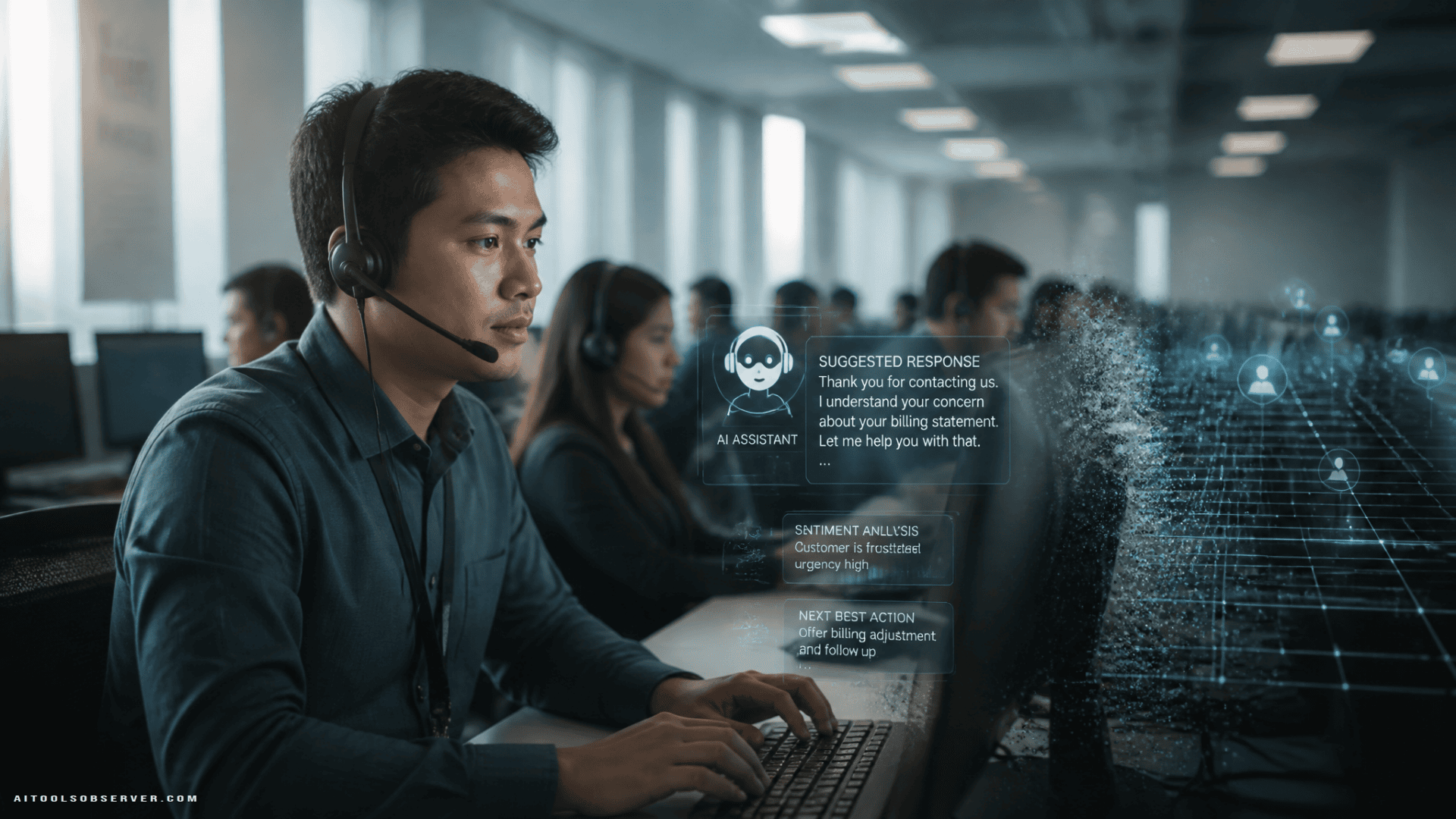
The International Labour Organization has estimated that more than 12.7 million Filipino workers—over one in four—are employed in occupations with meaningful exposure to generative AI. That figure is the highest share in Southeast Asia. The concentration of the workforce in text-based, process-driven, and voice-based service roles is precisely what made the Philippines attractive to multinational clients. It is also precisely what makes those roles automatable.
Call center operations, content writing, data processing, marketing copy, and back-office functions are not peripheral to the BPO sector. They are the BPO sector. When generative AI can produce first drafts, handle routine customer interactions, and process structured data at scale, the labor arbitrage that underpinned the industry’s growth weakens.
More than two-thirds of members of the IT and Business Process Association of the Philippines (IBPAP) are already running AI pilots. Agentic AI—systems capable of executing multi-step tasks autonomously—is accelerating that timeline further.
What Displacement Actually Looks Like
The human cost is not abstract. Content writers describe being asked to edit AI-generated material, then discovering their editing work was used to train the same models that later replaced them. One former employee summarized it plainly: “I feel like I dug my own grave. We were the ones who trained the artificial intelligence that replaced us.”
This pattern—using existing workers to refine AI outputs before eliminating those workers—is not unique to the Philippines. But it is particularly consequential in a sector where employment contracts are often short-term, workplaces are non-unionized, and confidentiality agreements limit workers’ ability to speak publicly about their experiences.
Several former BPO employees reported that AI integration created more work before it created fewer jobs. Fact-checking AI outputs, correcting inaccuracies, and maintaining quality standards added responsibilities without adding compensation. Redundancies followed regardless.
The Pressure Is Coming from Clients, Not Just Technology
Philippine outsourcing companies do not operate in isolation. They compete directly with firms in India and elsewhere for contracts from multinational corporations. Increasingly, those clients expect AI integration as a baseline requirement—not a premium offering.
This creates a structural bind. Filipino managers may want to slow adoption to protect their workforce. But foreign clients are applying pressure to cut costs and automate processes. The companies caught in the middle have limited leverage to resist.
There is also a measurement problem. Despite significant global investment in AI tools, credible evidence on actual productivity gains in outsourcing contexts remains limited. Some redundancies attributed to AI may reflect weaker global demand or cost-cutting decisions that predate AI adoption. Framing restructuring as technological progress can obscure what is, in some cases, a response to slower economic conditions.
Reskilling: Necessary, but Not Yet Sufficient
The major outsourcing operators—Teleperformance, Accenture, Concentrix—have each made public commitments to retrain workers and position AI as augmentation rather than replacement. The Philippine government has committed to upskilling more than 300,000 outsourcing workers.
These commitments are real. Whether they are sufficient is a separate question.
Reskilling programs take time to design, fund, and deliver at scale. The workers most at risk—those in routine content and voice roles—may not have the runway to transition before their positions are eliminated or significantly reduced. The gap between the pace of AI adoption and the pace of workforce retraining is a genuine policy risk, not a hypothetical one.
The government has acknowledged this directly. Officials have stated that the Philippines is “slightly behind” competitors like India and Singapore in preparing its workforce for AI-integrated work, and that the country needs to “double its efforts.”
A Model Under Revision, Not Collapse
It would be inaccurate to describe the Philippine BPO sector as facing imminent collapse. The industry remains large, revenue-generating, and deeply embedded in the country’s economic infrastructure. AI is more likely to reshape the composition of work than to eliminate the sector entirely.
The more precise framing is this: the roles that are easiest to automate are also the roles that employ the most people. Higher-value functions—complex customer escalations, AI oversight, process design, specialized analytics—will likely grow. But those roles require different skills, different training pipelines, and often different educational backgrounds than the ones currently held by the workers most at risk.
The government’s stated ambition to build home-grown AI companies and reduce dependence on foreign direct investment reflects a recognition that the existing model has limits. Whether that ambition translates into policy at the speed required is the central question.
What This Means for the AI Tools Ecosystem
For teams evaluating AI tools in customer service, content operations, or back-office automation, the Philippine BPO situation is a useful reference point—not as a cautionary tale, but as a real-world stress test of what AI adoption looks like at scale.
A few observations worth carrying forward:
- Automation exposure is role-specific, not sector-wide. Routine, high-volume, text or voice-based tasks face the most immediate pressure. Complex judgment-intensive work is more durable.
- The transition cost is real and often underestimated. AI integration creates new work (editing, fact-checking, oversight) before it reduces headcount. That interim period has costs that don’t always appear in productivity projections.
- Client pressure drives adoption faster than internal readiness. Organizations adopting AI tools because competitors or clients expect it—rather than because they have a clear implementation plan—are more likely to create disruption without capturing the expected gains.
- Reskilling timelines matter as much as reskilling commitments. A training program that takes 18 months to deliver at scale offers limited protection to workers whose roles are being automated now.
The Philippines is not a peripheral case study. It is one of the clearest available examples of what happens when AI adoption intersects with a large, structured workforce in a cost-sensitive, client-driven industry. The dynamics playing out there will appear, in different forms, across many other sectors and geographies.











Comments (0) No comments yet
Want to join this discussion? Login or Register.
No comments yet. Be the first to share your thoughts!