


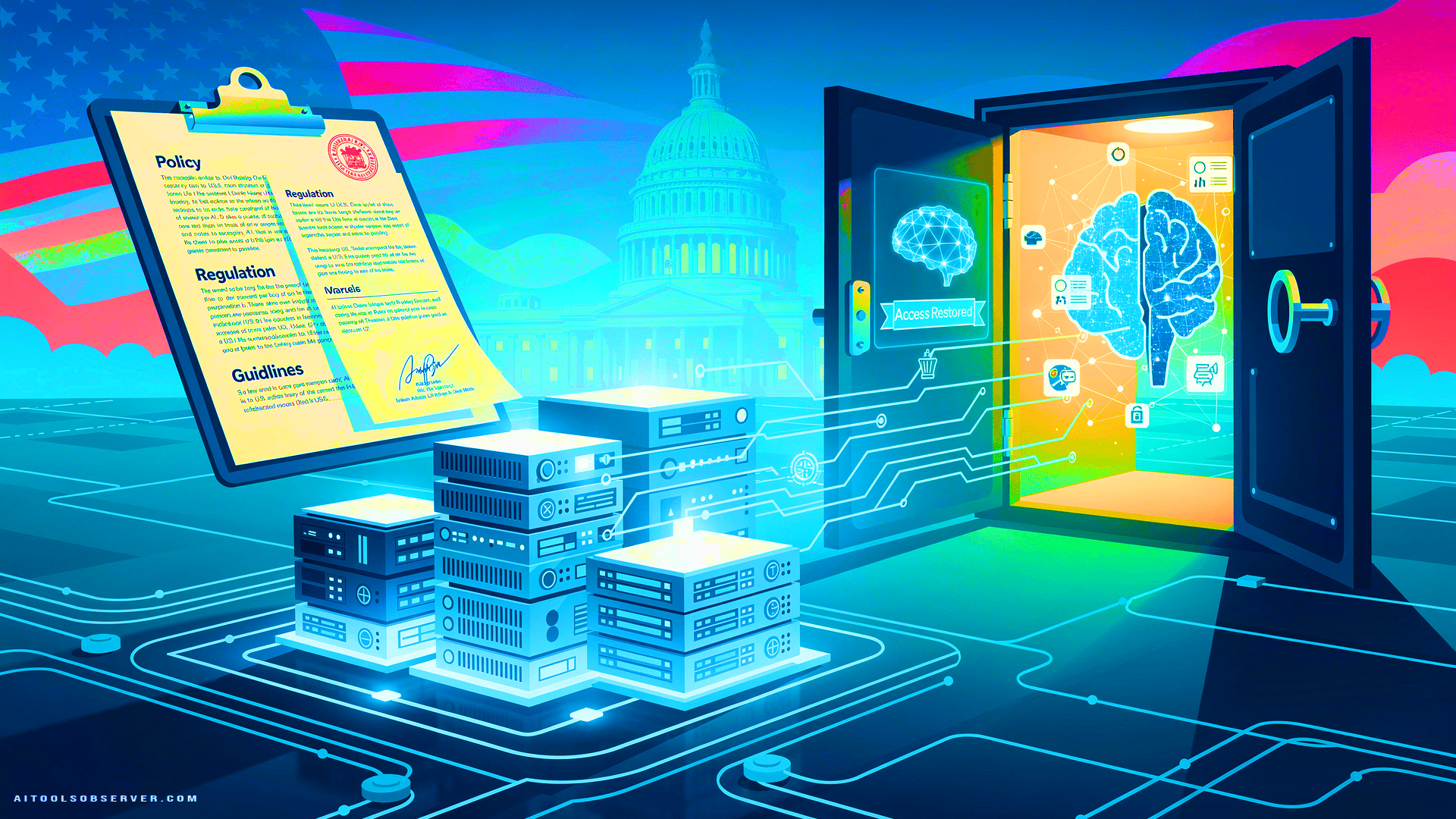
What Changed and Why It Matters

Commerce Secretary Howard Lutnick notified Anthropic in a formal letter that the company no longer requires an export license for its products. The condition: Anthropic must proactively detect and address security risks, coordinate with the government on protocols for future model releases, and report any malicious activity identified within its systems.
In response, Anthropic confirmed it will restore global access to Fable 5 starting Wednesday across its own platforms, with re-enablement on Amazon AWS and Google Cloud to follow as quickly as operationally possible. Access to the more powerful Mythos 5 model will remain restricted to select partners in the U.S. and internationally — a tiered approach that reflects the model’s significantly higher capability ceiling.
The original export controls were imposed on June 12, covering both models entirely. A partial lift on Mythos followed late Friday, June 27. Negotiations over Fable 5 continued through the weekend before reaching resolution Tuesday evening.
The Technical Commitments Behind the Deal

The agreement is not a simple regulatory rollback. Anthropic has implemented additional technical measures to prevent users from bypassing Fable 5’s cyber guardrails — a direct response to administration concerns that the model could be weaponized to facilitate cyberattacks.
Beyond the immediate fixes, both parties have discussed developing a standardized technical assessment framework to evaluate cybersecurity risks posed by future frontier models. Anthropic framed this in its blog post as the foundation for a broader, consensus-driven industry framework — one it hopes will eventually govern how all frontier AI releases are handled across the sector.
“We’re also strengthening our level of collaboration with the US government on new pre-release testing, information sharing, and research collaboration,” the company wrote.
The ambition is clear: transform a reactive, case-by-case negotiation into a systematic process with defined rules.
A Pattern Forming Across the Industry
Anthropic is not the only frontier AI company navigating this terrain. Last week, OpenAI agreed under White House pressure to limit the rollout of its ChatGPT-5.6 model, releasing it initially to a small group at the request of the Office of Science and Technology Policy and the Office of the National Cyber Director. OpenAI CEO Sam Altman publicly noted this was not the company’s preferred release approach.
The parallel situations reveal a pattern: the administration is engaging with frontier AI releases on an ad hoc, model-by-model basis rather than through a codified regulatory framework. White House chief of staff Susie Wiles sought to reassure the industry Tuesday night, pointing to a June 2 executive order emphasizing voluntary federal reviews. But the reassurance has done little to settle industry anxiety.
Dean Ball, former AI adviser in the Trump White House and incoming head of strategic futures at OpenAI, captured the uncertainty precisely: “We have no idea what Anthropic did to make the models ‘safe,’ what commitments Anthropic have made going forward, and whether or how any of this applies to other frontier models in the government’s licensing queue.”
The Export Control Debate: Innovation vs. Security
The episode has reignited a structural debate about whether export controls are an effective tool for managing AI risk — or whether they primarily disadvantage U.S. companies without meaningfully containing the technology.
Glenn Gerstell, former NSA General Counsel and senior adviser at the Center for Strategic and International Studies, was direct in his assessment: “We’re not going to maintain our lead over China in cutting-edge AI simply by slapping export controls on the latest innovation.”
Allied governments in Europe had been particularly vocal about the disruption. Several had been actively seeking access to Anthropic’s models specifically to identify and patch vulnerabilities in their own networks — a defensive cybersecurity use case that the export controls inadvertently blocked.
Joe Hoefer, chief AI officer at Monument Advocacy, described the resolution as “more of a ceasefire than a full resolution.” His warning is worth noting: without a codified process with defined triggers and an evidentiary standard, every future frontier model launch carries the risk of a repeat.
What This Means for AI Tool Buyers and Platform Operators
For teams and organizations that depend on Anthropic’s models through AWS, Google Cloud, or Anthropic’s own API, the immediate takeaway is straightforward — access is being restored. However, the broader governance uncertainty warrants attention.
Three practical considerations stand out:
-
Tiered access is now the operational reality. Fable 5 returns to general availability globally. Mythos 5 remains gated to select partners. Organizations requiring Mythos-level capability should begin formal partner qualification processes now rather than waiting for broader access.
-
Pre-release coordination is becoming standard. Anthropic’s commitment to pre-release testing and government information sharing signals that future model launches will involve longer lead times and more structured review cycles. Procurement and integration timelines should account for this.
-
The regulatory framework is still being written. The current agreement is company-specific, not industry-wide. As Paul Lekas of the Software & Information Industry Association noted, “there remains a real need for a consistent process and framework for frontier model assessment.” Decisions made now about which models to build on carry regulatory exposure that did not exist six months ago.
The Bigger Picture
What the Fable 5 and Mythos 5 episode ultimately reveals is a governance system under construction in real time. The administration is attempting to balance legitimate national security concerns against the competitive imperative to keep U.S. AI development ahead of China — and doing so without a stable institutional framework to guide those decisions.
The outcome for Anthropic is favorable in the short term. But the precedent set — that frontier model access can be restricted and restored through direct negotiation rather than transparent process — introduces a new category of risk for the entire AI industry.
For anyone choosing AI tools at the frontier, the technical capabilities of a model are no longer the only variable that matters. Regulatory resilience and governance clarity are now part of the evaluation.














Comments (0) No comments yet
Want to join this discussion? Login or Register.
No comments yet. Be the first to share your thoughts!