



What Cortex Is, Precisely

Cortex functions as an intelligence layer within the Trunk Tools platform. Its core capability is reading construction drawings the way an experienced project engineer would: understanding not just the geometry, but the annotations, revision clouds, detail callouts, and cross-references that give drawings their meaning on a job site.
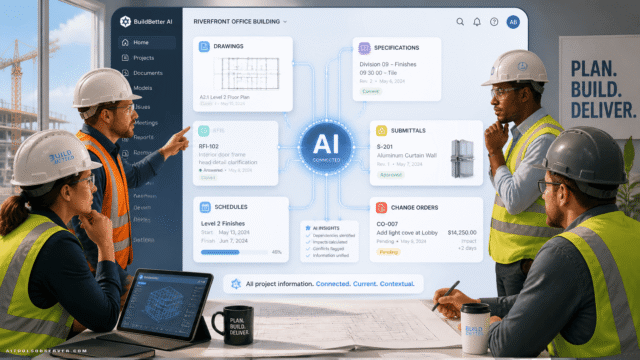
From that foundation, the platform connects drawings to specifications, RFIs, submittals, schedules, and change orders. The goal is to eliminate the manual lookup work that consumes significant time on complex projects—finding which spec section governs a particular detail, tracing which submittal corresponds to a drawing revision, or identifying which RFI affects a scheduled activity.
The platform currently powers seven AI workflow agents, each designed to handle a specific document-intensive task within the project workflow. Trunk Tools has not published a full breakdown of all seven agents, but the architecture signals a deliberate, modular approach rather than a single monolithic AI assistant.
Why Construction Drawings Are a Hard Problem
Most document AI tools handle text well. Construction drawings are a different challenge entirely. They combine graphical elements, symbolic conventions, layered annotations, and cross-referencing systems that vary by discipline, firm, and project phase.
Training a model to interpret a structural drawing, a mechanical plan, and an architectural detail—and then link each to the correct specification section or submittal package—requires domain-specific training data at scale. Trunk Tools claims four years of development alongside major general contractors as the source of that training depth. That timeline and those partnerships matter: they suggest the model has been exposed to real project complexity, not sanitized sample documents.
The Workflow Agents: Automation Where It Counts

The seven AI workflow agents represent the practical delivery mechanism for Cortex’s capabilities. In construction, the highest-friction document tasks are not random—they cluster around RFI generation and response, submittal review, specification cross-referencing, and change order documentation. Workflow agents targeting these specific bottlenecks can produce measurable time savings on projects where document cycles routinely delay field work.
The agent architecture also suggests scalability. Rather than requiring a project team to learn a new interface for every task, agents can operate within existing workflows—surfacing answers, flagging conflicts, and drafting responses where the work actually happens.
Who This Is Built For
Cortex is positioned for general contractors managing large, document-intensive projects. The development partnership with firms of Gilbane’s scale indicates the platform is calibrated for complexity: multi-discipline coordination, high RFI volumes, and submittal packages that span hundreds of items.
Project engineers and document control managers are the most direct beneficiaries. They carry the burden of cross-referencing documents manually and bear the consequences when something is missed. For owners and construction managers seeking tighter schedule control, a platform that connects drawing revisions to schedule impacts in real time addresses a genuine operational gap.
Smaller firms or projects with simpler document structures may find the platform’s depth exceeds their immediate needs—though the modular agent approach could allow selective adoption.
Signals Worth Watching
Trunk Tools has not publicly disclosed pricing for Cortex, which is typical for enterprise construction technology at launch. The emphasis on major general contractor partnerships suggests an enterprise sales motion rather than a self-serve model.
The four-year development timeline is a meaningful signal in a market crowded with AI tools built on general-purpose models with thin domain adaptation. It implies proprietary training data, iterative refinement against real project feedback, and a defensible technical position that is not easily replicated by a competitor fine-tuning a foundation model over a few months.
The construction technology sector has seen significant AI investment in recent years, but most tools have addressed peripheral workflows—meeting transcription, progress photo analysis, or basic document search. A platform that reads drawings and connects them to the full document chain sits closer to the core of how construction projects are actually managed.
The Takeaway
Cortex is a technically serious attempt to solve one of construction’s most persistent productivity problems: the disconnection between drawings and the documents that govern, respond to, and schedule the work they represent. Four years of domain-specific development and partnerships with major general contractors give it credibility that generic AI tools cannot claim.
Whether the platform delivers on that promise at scale will depend on how well the workflow agents perform under real project conditions—and how quickly Trunk Tools can demonstrate measurable outcomes in RFI cycle times, submittal throughput, and document conflict detection. The construction industry is a demanding proving ground. Cortex has the right problem in its sights.












Comments (0) No comments yet
Want to join this discussion? Login or Register.
No comments yet. Be the first to share your thoughts!