


The Compute Era Is Not Over—It’s Just No Longer Enough
Let’s be clear: GPUs are not going away. Demand for inference compute is growing at a scale that is genuinely hard to comprehend. Research from Tirias Research projects annual LLM inference growing from 990 trillion tokens in 2024 to more than one quintillion tokens by 2030. That is not a rounding error. That is a structural shift in global compute demand.
And yet, even under conservative projections, practical infrastructure deployment begins falling behind projected demand around 2028. The gap is not something you can close by building more data centers alone. Real estate, power, and cooling all have hard limits.
So the industry faces a compounding problem. Demand is accelerating. Supply has a ceiling. And the workloads themselves are getting dramatically more complex.
That last point is where the real story begins.
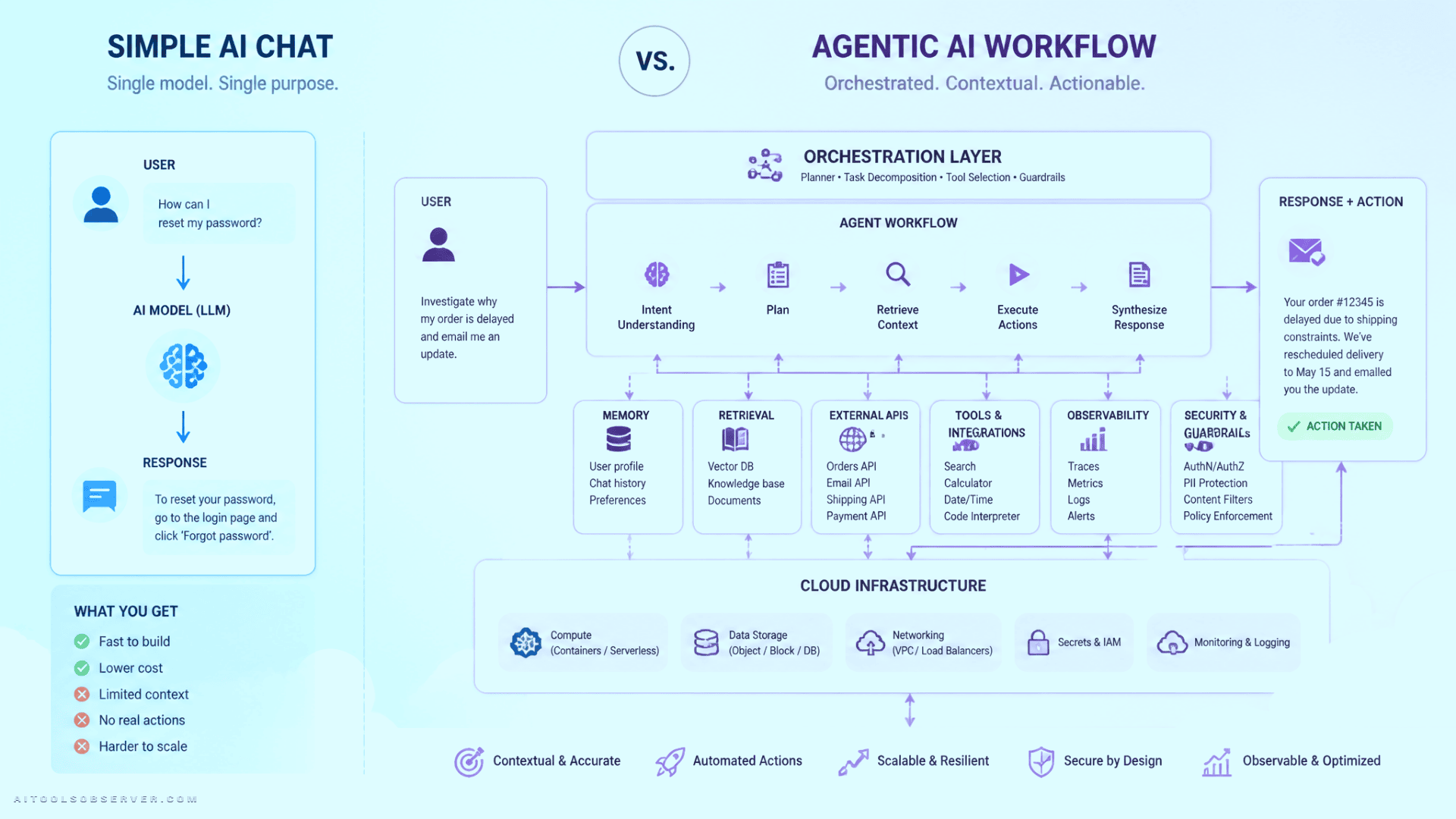
Running a Model Is a Compute Problem. Running an Agent Is a Systems Problem.
This distinction matters more than most people currently appreciate.
A Wave 1 AI user asks a question and gets an answer. The interaction is discrete, stateless, and relatively cheap to serve. A Wave 2 agentic user deploys an autonomous agent that reasons across steps, maintains memory, calls external tools, interacts with APIs, and executes multi-step tasks with minimal human intervention.
Tirias Research estimates the average Wave 2 user consumes 40 times as many tokens as a traditional chat user. Technical users running asynchronous agents consume orders of magnitude more than that.
But token volume is only part of the challenge. Agents expose every gap in the stack. They require orchestration layers, retrieval systems, vector databases, observability tools, evaluation frameworks, security controls, and third-party integrations—all working together reliably, at scale, continuously.
Infrastructure was never designed to close those gaps on its own.
A Familiar Pattern From Computing History
This transition has happened before. Every major era of computing has been defined by a shift in abstraction.
Operating systems removed the need to understand hardware. Virtualization eliminated physical server management. Cloud computing made data centers optional. Serverless took infrastructure deployment off the table entirely.
Each step moved users further from the underlying technology and closer to the outcomes they actually cared about.
AI is following the same arc. Most organizations still approach it from the bottom up—selecting models, provisioning infrastructure, configuring frameworks, connecting APIs, and assembling workflows piece by piece. It is a significant amount of work before anything useful gets built.
What customers increasingly want is to start with the problem they are trying to solve and have the platform handle the rest.
The Rise of Workflow-Centric AI Cloud
This is where the current generation of AI cloud providers becomes genuinely interesting to watch.
Most still describe themselves as infrastructure companies. But the more revealing signal is not how they describe themselves—it is what their customers are actually using them for. Customer stories increasingly focus on orchestration, retrieval, observability, evaluation, and deployment. The emphasis is on reducing the complexity of building reliable AI systems, not on exposing more infrastructure components.
The pattern points toward a meaningful shift: AI cloud platforms are beginning to package their capabilities around customer workflows rather than around raw infrastructure primitives.
Historically, technology vendors built products and expected customers to adapt their workflows accordingly. The emerging model reverses that relationship. Customer workflows are becoming the product requirements.
When Workflows Become Reusable Products
One of the clearest illustrations of this shift is the emergence of AI blueprints—reusable workflow patterns that package entire AI systems, including models, retrieval systems, orchestration frameworks, observability tools, and supporting services, into deployable templates.
The concept borrows from Infrastructure-as-Code tools like Terraform, which made it possible to define and deploy infrastructure consistently. Blueprints extend that idea beyond infrastructure to the full AI workflow layer.
A customer support agent, a research assistant, a document search application—these stop being unique integration projects and start being reusable implementation patterns. Each deployment builds on the experience of the last. Organizations start from a working system rather than assembling one from scratch.
During the cloud era, infrastructure became a service. In the agentic AI era, workflows themselves are becoming the product.
From Self-Service Infrastructure to Self-Service Outcomes
Cloud computing transformed software development by eliminating friction. A developer could provision resources and start building in minutes. No procurement cycles. No hardware purchases. No operational overhead.
AI cloud providers are extending that concept one level further.
The first generation delivered self-service infrastructure. The next generation is delivering self-service outcomes. Rather than requiring customers to manually configure models, inference endpoints, observability systems, security controls, and orchestration frameworks, the platform increasingly takes responsibility for assembling those components.
The customer describes the desired result. The platform manages execution. Infrastructure remains essential but becomes the foundation—not the destination.
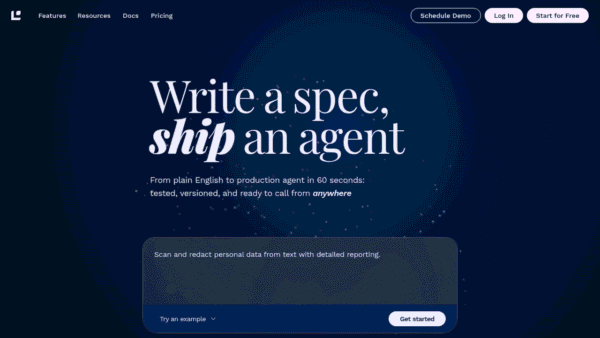
This is not a distant vision. Early implementations of intent-driven cloud interfaces are already appearing, where natural language interaction replaces manual API configuration and the platform can inspect resources, explain services, and perform operations with appropriate user approval.
The direction is clear: the platform learns to consume customer intent so the customer does not have to think about infrastructure at all.
What This Means for the AI Tools Ecosystem
If you are evaluating AI cloud platforms today, the GPU count is the wrong primary metric.
The more useful questions are:
- Does this platform reduce the complexity of building and operating agentic workflows, or does it just expose more infrastructure primitives?
- Does it offer reusable workflow patterns that accelerate deployment?
- How well does it handle orchestration, memory, tool use, and observability as first-class concerns?
- Does the platform evolve based on how customers actually build AI systems, or based on what the vendor wants to sell next?
These questions matter because the bottleneck has moved. Raw compute access is increasingly commoditized. The scarce resource is now the expertise required to assemble everything around the compute into a system that actually works.
Platforms that abstract that complexity will win enterprise adoption. Platforms that require customers to manage it themselves will lose ground as agentic workloads scale.
The Real Inflection Point
Jensen Huang has described the industry as reaching an inflection point driven by agentic AI. An inflection point is not just faster growth—it is a change in trajectory.
The trajectory changing here is not about more GPUs. It is about where value is created in the AI stack.
As Tirias Research analyst Kevin Hein frames it: the most successful AI cloud platforms will not be those that expose the most technology. They will be the platforms that allow customers to think about technology the least.
That is a precise description of what every successful platform transition in computing history has looked like. The cloud era taught organizations how to consume infrastructure. The next phase is teaching infrastructure providers how to consume customer intent.
The platforms that figure that out first will not just win enterprise AI deployments. They will define what AI cloud means for the next decade.
The takeaway for anyone choosing AI tools right now: stop evaluating platforms purely on compute specs and model availability. Start evaluating them on how much complexity they remove from your workflow. That gap—between raw infrastructure and working AI systems—is where the next generation of winners will be built.











Comments (0) No comments yet
Want to join this discussion? Login or Register.
No comments yet. Be the first to share your thoughts!