



What UmanWrite Actually Does
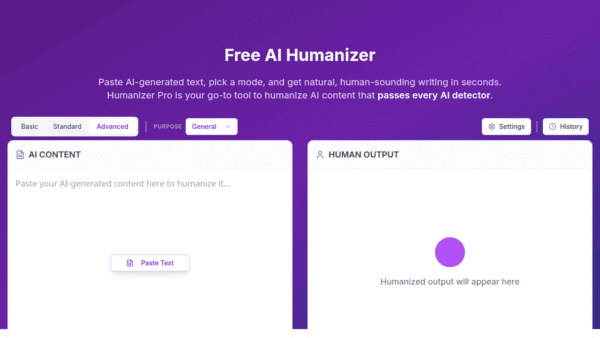
At its core, UmanWrite is an AI humanizer. It takes text generated by tools like ChatGPT or Claude and rewrites it to sound more like a real person wrote it. That’s the primary job, and the platform builds several supporting tools around that single function.
Here’s what’s included in the platform:
- AI Humanizer — Rewrites machine-generated text into more natural, readable prose
- AI Detector — Scans drafts for patterns that AI detection algorithms flag before you publish
- Grammar Checker — Cleans up errors and improves clarity in the same pass
- Voice Profiles — Trains on samples of your own writing to match your tone and vocabulary
The combination matters. Most writers currently juggle three or four separate tools to accomplish what UmanWrite appears to handle in one place.
The Voice Profile Feature Is Worth Paying Attention To
Most AI humanizers apply a generic “sounds more human” filter. The result is writing that sounds like a human, just not any particular human.
UmanWrite’s Voice Profiles take a different approach. You feed the platform samples of your existing writing, and it trains on your specific tone, vocabulary, and style. From that point forward, humanized drafts are shaped around how you write, not some averaged-out version of natural language.
You can create an unlimited number of Voice Profiles. That’s a practical detail for freelancers managing multiple clients or marketers running content across different brands. Each profile stays separate, and every edit you make continues to refine it over time.
The AI Detector Is a Practical Safety Net
Publishing AI-generated content without checking it first is a real risk, whether you’re worried about Google’s content quality signals, academic integrity policies, or just reader trust.
The built-in AI Detector scans each draft for the patterns that AI detection tools look for. These aren’t always obvious to a human reader, but they’re consistent enough that automated systems can flag them. Having the detector built into the same workflow means you’re not copying and pasting between tools to run a check before publishing.
Pricing: The Lifetime Deal Framing
The headline number here is $79 for a lifetime subscription, listed as a discount from a $1,799 regular price. The unlimited plan covers unlimited monthly words with individual requests up to 2,500 words at a time, and there’s no recurring fee.
For context, most AI writing tools charge monthly. If you’re using a humanizer regularly, even a $20/month tool costs $240 a year. At $79 one-time, the math on a lifetime deal is straightforward if the tool fits your workflow.
The 2,500-word-per-request cap is worth noting. For most blog posts, emails, and marketing copy, that’s sufficient. For longer documents, you’d need to work in sections.
Who This Is Actually For
UmanWrite is positioned for people who already use AI writing tools and want better output without heavy manual editing. The most obvious use cases:
- Freelance writers who use AI for drafts but need the final copy to sound like their own voice
- Content marketers producing high volumes of blog posts, emails, or social copy
- Students who use AI for research and drafting but need submissions to read naturally
- Small business owners writing their own content without a dedicated copywriter
It’s less relevant if you’re writing everything from scratch or if you’re already happy with the output quality from your current AI tools.
Tradeoffs to Consider
No tool is a perfect fit for every workflow. A few things worth weighing:
The 2,500-word request limit means longer pieces need to be broken up. That adds a small amount of friction for long-form content.
Voice Profile quality depends on your input samples. The more writing you feed it, the better it learns your style. If you’re starting without much existing content, the early results will be more generic.
Lifetime deals carry inherent uncertainty. The pricing is compelling, but any tool’s long-term development depends on the company behind it. That’s a standard caveat for any lifetime software purchase, not specific to UmanWrite.
How It Compares to the Alternatives
The main alternatives in this space are tools like Quillbot, Undetectable AI, and manual editing. Quillbot focuses more on paraphrasing and grammar. Undetectable AI is specifically built around bypassing AI detectors. Neither combines humanizing, detection, grammar checking, and voice matching in a single platform the way UmanWrite appears to.
The closest comparison is probably running two or three separate tools in sequence. UmanWrite’s value proposition is consolidating that into one workflow at a one-time price.
Bottom Line
If you’re regularly editing AI output to make it sound more natural, UmanWrite addresses a real and specific pain point. The Voice Profile feature is the most differentiated part of the platform — it’s the difference between generic humanization and writing that actually sounds like you.
At $79 lifetime with unlimited words, the pricing is low enough that the risk of trying it is minimal. The more relevant question is whether the output quality matches your standards for the content you’re producing. For writers and marketers who rely heavily on AI drafts, it’s worth testing against your actual workflow before committing to a monthly tool at a higher ongoing cost.












Comments (0) No comments yet
Want to join this discussion? Login or Register.
No comments yet. Be the first to share your thoughts!