


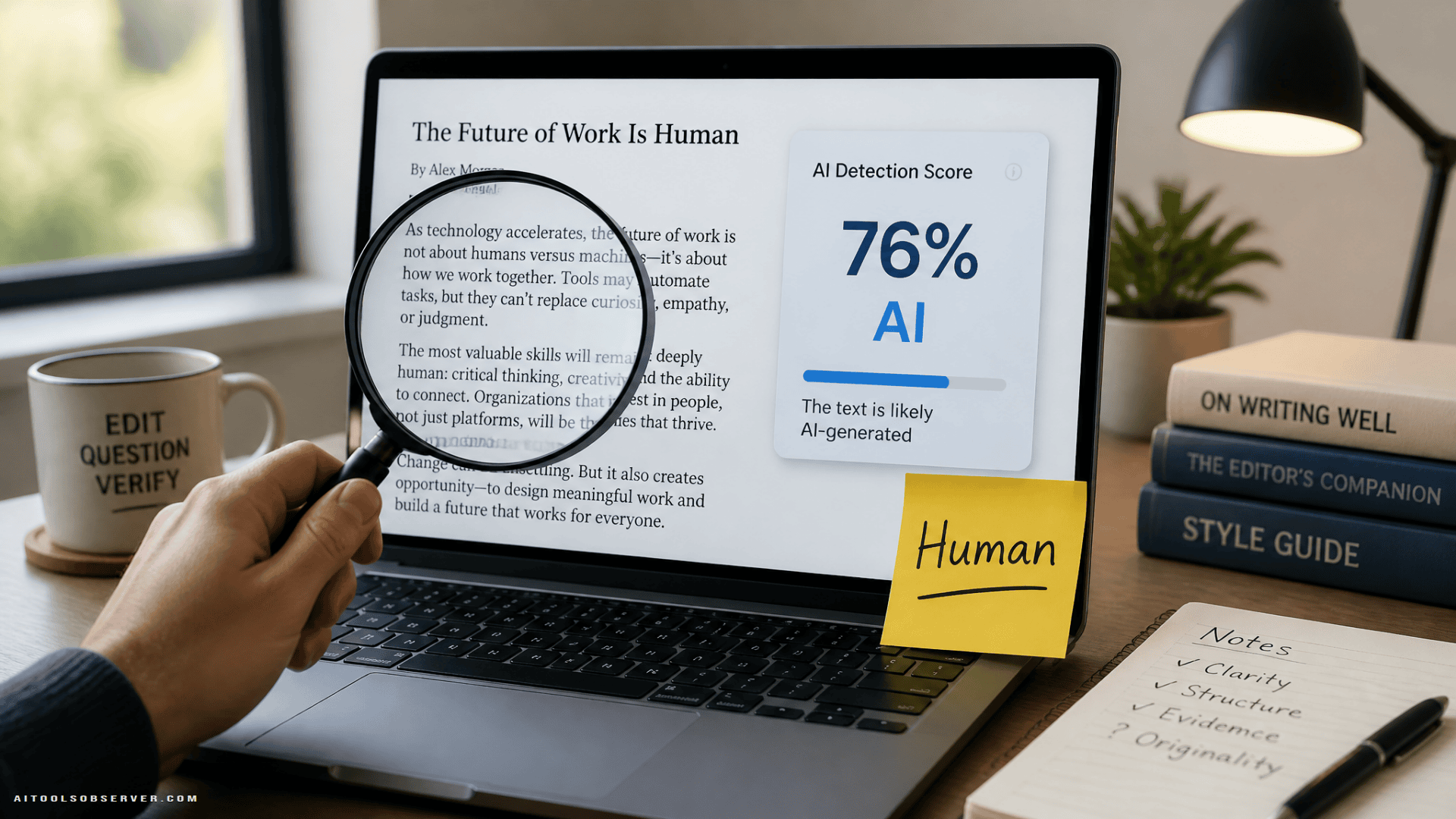
The false positive problem is not a side issue
A false positive is simple: a human wrote it, but the detector says AI.
That sounds like a technical glitch. It is actually a trust problem.
If a detector flags polished writing, predictable structure, or clean grammar as suspicious, then strong writers can end up looking guilty for the crime of being readable. That’s not a minor bug. That’s the whole use case wobbling.
In the editorial example behind this discussion, different detector tools gave sharply different answers on writing from multiple humans. Even the same human-written passage could produce conflicting results across tools. One detector says “mostly AI.” Another says “human.” Same paragraphs. Very dramatic. Very unhelpful.
Why results conflict so much
AI detectors are trying to identify patterns that look machine-generated. The catch is obvious once you say it out loud: AI models were trained on huge amounts of human writing.
So detectors are not comparing “human language” to some alien dialect from Mars. They’re looking for traits in text that may overlap with both competent human writing and AI-generated writing:
- smooth sentence flow
- common phrasing
- consistent tone
- predictable structure
- low variation in style
That overlap makes certainty hard.
A detector may interpret clarity as suspicious. It may read formal writing as machine-like. It may penalize a writer for sounding too clean, too balanced, or too edited. Which is awkward, because those are usually the things editors ask for.
The percentage trap
The most misleading feature in many AI detection tools is not the model. It’s the number.
A result like “76% AI” feels scientific. It looks precise. It invites people to treat it like a lab test.
But in practice, those numbers can create more confidence than the situation deserves. If two detectors disagree wildly, the percentage is not a verdict. It’s a signal of uncertainty dressed up as math.
This is where people get into trouble. They see a number and stop asking questions.
“Most accurate” is not the same as trustworthy
Nearly every detector markets itself as highly accurate. Of course it does.
But broad accuracy claims do not answer the question users actually care about: what happens when the tool is wrong about a specific person, paper, or article?
That’s the real standard. Not whether a landing page sounds convincing. Not whether the dashboard uses reassuring shades of blue.
A tool can appear impressive in aggregate and still be risky in real-world judgment calls, especially when the consequences fall on the accused.
Schools are in a particularly bad spot
Education may be the clearest example of why caution matters.
Teachers need ways to respond to low-effort AI-assisted assignments. That part is understandable. The problem starts when a detector score becomes evidence on its own.
Students can be flagged because they write in a straightforward, formulaic, school-friendly way. English learners may also be vulnerable if their writing patterns trigger simplistic detection logic. And once a tool says “likely AI,” the burden can quietly shift onto the student to prove a negative.
That is not a great standard for academic integrity.
If the tool is unreliable, using it as a disciplinary shortcut creates a new problem while trying to solve another.
It also raises the risk of rewarding compliance over understanding, the kind of artificial understanding that educators are trying to avoid.
Editors have a different version of the same problem
In publishing, the issue is less about grades and more about credibility.
Editors already deal with recycled submissions, templated letters, ghostwritten opinion pieces, and low-effort content. AI adds another layer to that mess. So yes, the desire for a quick screening tool makes sense.
But editors should be careful not to confuse detection with verification.
A detector might be one input. It should not be the deciding one. Good editorial judgment still comes from context:
- Does the submission match the writer’s known voice?
- Are there signs of copied material?
- Are claims sourced?
- Does the author respond clearly when asked about process or revisions?
- Does the piece show real familiarity with the topic?
Those questions are slower than pressing “scan.” They are also more useful.
Style tells you less than people think
A lot of amateur AI policing now happens by vibes.
People point to em dashes, tidy paragraphing, certain stock phrases, or a polished cadence and declare the text machine-made. That logic falls apart quickly. Humans used these features long before ChatGPT arrived.
Bad evidence spreads fast because it feels intuitive. The result is a weird culture of literary phrenology, where everyone becomes a detective and nobody has to prove much.
That’s how innocent writers get treated like suspects, especially in environments already anxious about what counts as authentic versus inauthentic content.
What AI detectors are better used for
If these tools have a role, it is probably narrower than their marketing suggests.
They may be somewhat useful for:
- prompting a closer review
- identifying passages that feel generic or overly uniform
- supporting, but not replacing, human investigation
- flagging cases where other evidence already raises concern
They are much less useful as stand-alone proof.
Think smoke alarm, not judge and jury.
A better standard for decisions
If the stakes are real, the standard should be real too.
That means treating AI detection outputs as weak evidence unless backed by stronger signals. It means giving people a chance to explain drafts, notes, revision history, or source use. And it means remembering a dull but essential rule: the burden of proof belongs to the accuser, not the accused.
This is not about giving obvious spam or synthetic slop a free pass. It is about avoiding lazy certainty.
When institutions use a detector as a disciplinary shortcut, they risk creating new failures while trying to solve existing ones.
The practical takeaway
Use AI detectors the way you’d use a horoscope written by a statistician: maybe interesting, definitely not a verdict.
For schools, editors, and teams managing content authenticity, the safer move is simple. Don’t outsource judgment to a percentage score. Use detectors as one clue, verify with context, and assume false positives are possible every single time.
Because when a tool can confidently mislabel a human writer, the real detection problem is not the text. It’s misplaced trust.










Comments (0) No comments yet
Want to join this discussion? Login or Register.
No comments yet. Be the first to share your thoughts!