


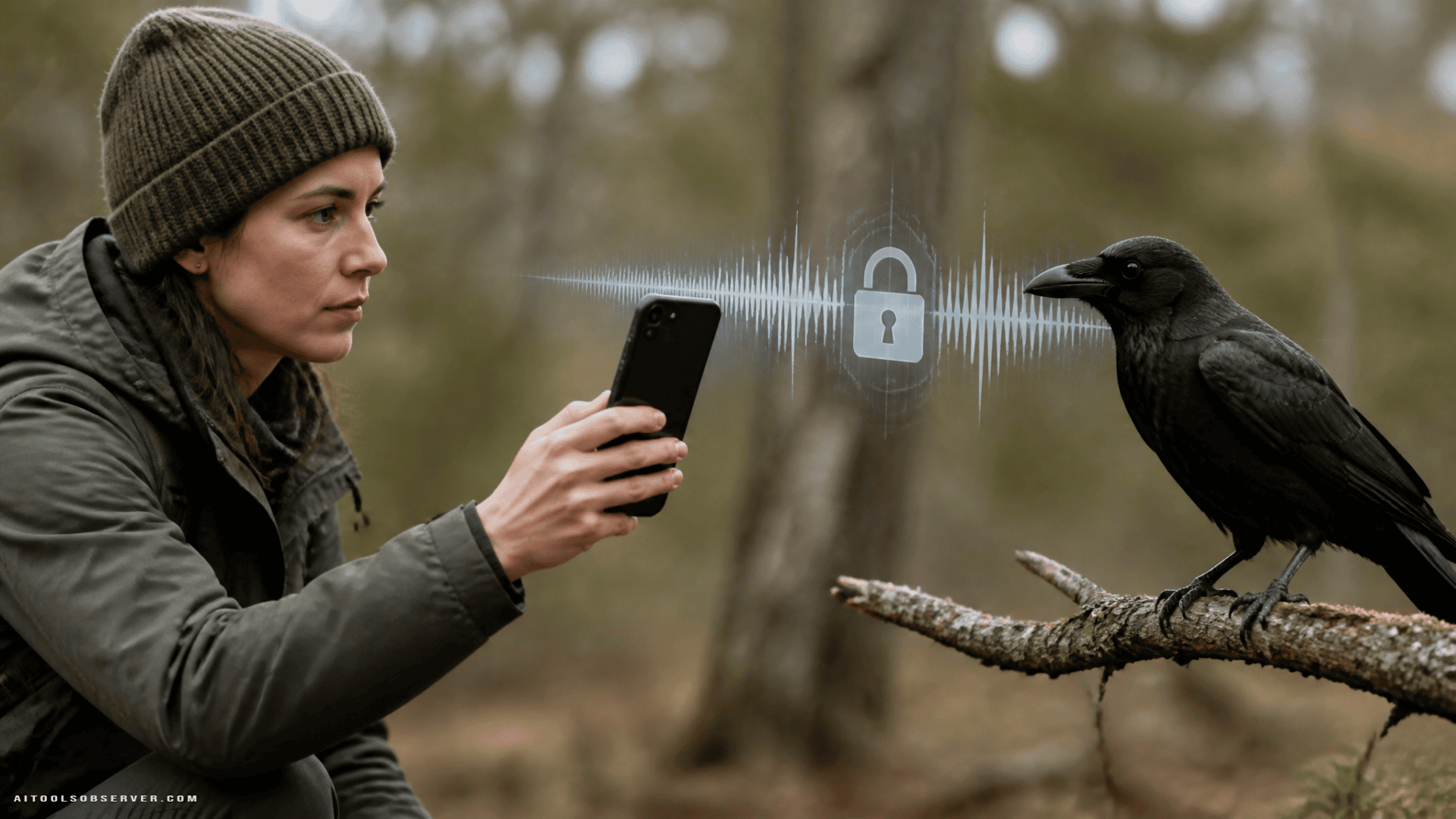
The Tech Is Moving Faster Than the Ethics
Machine learning models can now sort through thousands of animal calls, identify patterns, and flag specific vocalizations with meanings researchers have spent careers trying to decode manually.
Biologist Vittorio Baglione, who has spent years cataloguing carrion crow calls, found that AI could do in minutes what took him years — including identifying a specific cry that roughly translates to “come help defend the nest.” Useful for science. Potentially useful for hunters, too.
That’s the core tension: the same tool that helps a researcher understand crow social dynamics could help someone lure those crows into a trap.
What “Playback” Actually Means in the Wild
The controversy centers on a practice called playback — broadcasting recorded animal calls back into the wild to observe or influence behavior.
It sounds benign. It isn’t always.
- Animals respond to calls based on trust — they assume the sound is real and act accordingly.
- Playback can trigger stress responses, disrupt social hierarchies, and provoke conflict between animals.
- A 2007 incident involving an elephant and a recording of a deceased family member’s voice caused visible distress to the animal.
As biologist Baglione put it: “You can stress the animals. You can disrupt their social environment. You can pose conflicts between them, especially if you don’t really understand the meaning of the call.”
Now imagine that capability scaled, automated, and available to anyone with a smartphone app.
Animals May Have a Privacy Interest Worth Taking Seriously
This is where the conversation gets philosophically uncomfortable — and worth sitting with.
Researchers publishing in Springer Nature have argued that collecting data on animal vocalizations and movements may constitute a privacy violation. The reasoning: animals with complex social lives have an interest in controlling how they appear to others. That’s not a trivial claim.
César Rodríguez-Garavito, director of the More-Than-Human Life program at NYU, has flagged that AI animal communication tools could expose wildlife to “mobs of people wanting to chat” — or worse, be weaponized outright.
The field doesn’t yet have a research ethics framework that accounts for this. Most animal study ethics focus on physical harm. Informational harm — surveillance, mimicry, behavioral manipulation — is largely unaddressed, echoing privacy debates around human data.
The Race Isn’t Slowing Down
Private equity billionaire Jeremy Coller funds the Coller Doolittle Challenge, which offers a $10 million prize for establishing two-way communication with an animal — without the animal realizing it’s not talking to another of its kind.
Coller has publicly stated he believes this will happen by 2030, citing AI’s speed as the deciding factor.
That’s a tight timeline for a field that hasn’t yet agreed on whether animals deserve privacy protections in the first place.
What This Means for the AI Tools Ecosystem
Animal communication AI sits at an unusual intersection: it’s part wildlife biology, part surveillance tech, part ethics minefield. For anyone tracking where AI is heading, a few things stand out.
The data collection problem is structural. Training these models requires massive vocalization datasets. Every recording is a data point extracted from an animal that didn’t consent and can’t opt out. The same dynamics that created privacy debates around human data are arriving in the nonhuman world — just without the legal infrastructure to handle them.
Misuse doesn’t require malice. A curious hobbyist using a playback app in a national park isn’t trying to harm wildlife. But the outcome can be the same as deliberate disruption. Accessibility and intent don’t always align.
Regulation is lagging, as usual. There’s no equivalent of GDPR for animal vocalizations. Research ethics boards aren’t consistently applying a research ethics framework to nonhuman subjects. The tools will arrive before the guardrails do.
The Useful Takeaway
The question isn’t whether AI animal communication research should happen — it probably will, prize money or not. The question is whether the field builds ethical frameworks before the tools are widely deployed, or scrambles to retrofit them after the damage is done.
If you’re watching the AI tools space, this is a useful case study in a pattern that repeats: capability outpaces governance, early adopters define norms by default, and the costs land on whoever can’t advocate for themselves.
In this case, that’s the animals. They won’t be filing complaints.














Comments (0) No comments yet
Want to join this discussion? Login or Register.
No comments yet. Be the first to share your thoughts!