


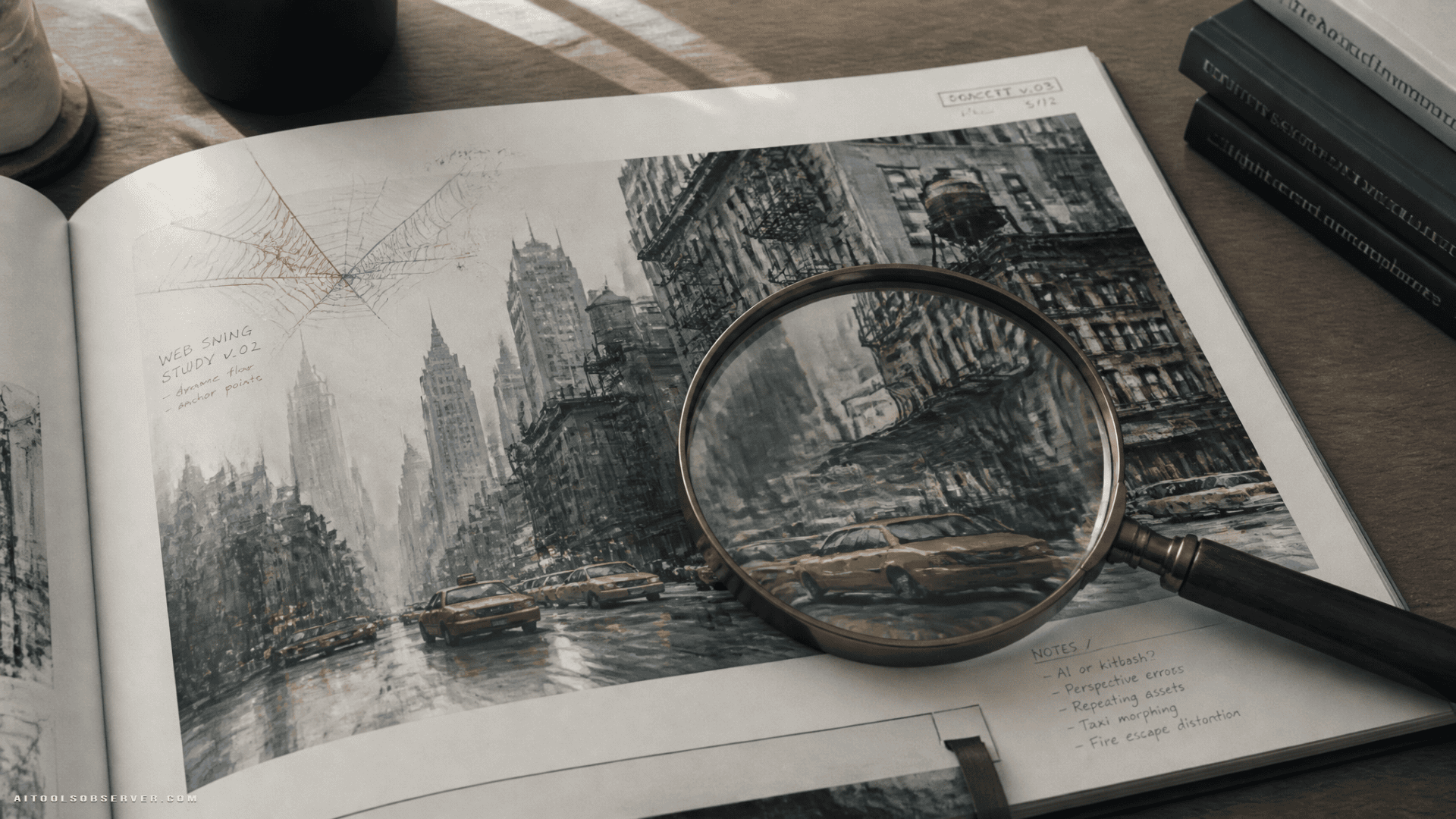
What Fans Actually Spotted
The giveaways were subtle but familiar to anyone who’s spent time around generative AI outputs:
- Buildings with warped, distorted geometry
- Taxis that appear to be merging into each other
- Fire escape stairways with strange pixel artifacts and inconsistent shaping
These are classic signs of an AI system struggling to fill in spatial logic — the kind of glitches that show up when a model guesses at pixels it can’t quite resolve.
Importantly, the rest of the art book appears clean. “Big City, Little Spider” seems to be the only piece raising flags.
Not a Closed Case
To be fair, there’s a plausible non-AI explanation. Photobashing — a legitimate concept art technique that layers and blends multiple reference images — can produce similar visual artifacts. Combine that with Photoshop’s Content-Aware Fill, which attempts to intelligently patch gaps in imagery, and you have a reasonable alternative theory.
McInnes is an experienced concept artist with credits across Guardians of the Galaxy, The Fantastic Four: First Steps, Barbie, Andor, and Gladiator 2. Nothing in his track record suggests carelessness. The ambiguity here is real.
Why It Landed So Hard
Context matters. Marvel Studios has been navigating AI-related friction since 2023, when Secret Invasion debuted with an AI-generated title sequence on Disney+. More recently, the studio faced backlash over significant layoffs in its visual development team — concept artists, illustrators, and designers — with fans drawing their own conclusions about the cause.
When the Russo Brothers publicly described AI as a “potentially valuable tool” for filmmaking, and when ILM’s Chief Creative Officer gave a broadly optimistic TED Talk about AI handling repetitive production tasks, the industry’s direction started to feel less ambiguous.
Then DC Studios accidentally surfaced AI-generated concept art of Jason Momoa as Lobo in a Supergirl behind-the-scenes featurette. The pattern is hard to ignore.
The Actual Problem With the Art Book
If AI-assisted tools were used at the concept stage, that’s a different conversation than AI replacing finished creative work. Concept art is exploratory by nature — rough, iterative, internal.
The issue is that this work ended up in a collector’s art book sold to fans for nearly $50. Whatever the intent, the audience for that product expects human craft. Accidentally publishing what appears to be AI-assisted work in a premium physical product is a credibility problem, regardless of where it sits in the production pipeline.
What This Signals
Hollywood’s AI debate isn’t abstract anymore. The 2023 SAG-AFTRA and WGA strikes produced real contractual guardrails for actors and writers. Visual artists haven’t had the same protection — and that gap is showing.
The takeaway isn’t that Marvel is running an AI sweatshop. It’s that the line between “useful tool” and “replacement” is getting blurry fast, and the industry hasn’t figured out how to be transparent about where that line sits.
One warped taxi in a concept art book probably won’t define the conversation. But it’s a useful reminder to watch the details — because that’s usually where the real story is.









Comments (0) No comments yet
Want to join this discussion? Login or Register.
No comments yet. Be the first to share your thoughts!