



What Kurzweil Means by the Singularity
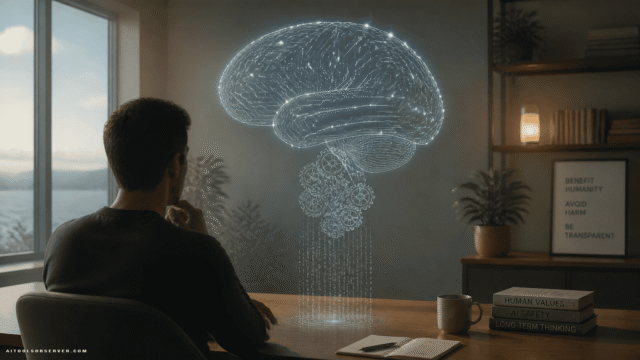
In Kurzweil’s framing, the singularity is the point where human intelligence and machine intelligence merge so deeply that the boundary between them starts to break down. This is not just smarter software. It is a structural shift in what intelligence is and how humans use it.
That idea usually includes three linked claims:
- Artificial general intelligence becomes possible
- Humans increasingly integrate with machine systems
- Intelligence scales far beyond normal biological limits
The dramatic part of the prediction is not just AGI. It is the belief that human capability itself could be expanded through a direct human-AI merger, including brain-computer interfaces and even more speculative ideas like nanobot-assisted neural integration.
Why This Prediction Is Getting More Attention Again
A few years ago, singularity talk often felt like science-fiction branding. Today, it lands differently because AI systems are improving in visible, commercial ways.
People can now see machine intelligence moving from narrow task automation into more flexible reasoning, multimodal interaction, coding assistance, research support, and workflow orchestration. That does not prove AGI is here. But it does make older predictions about accelerating capability feel less easy to dismiss.
This is why Kurzweil’s timeline keeps drawing attention. Even if the exact dates remain uncertain, the broader pattern he emphasized—rapid compounding progress in computing and AI—has become a serious part of mainstream discussion.
The 2029 AGI Milestone and the 2045 Singularity Timeline
Kurzweil has long argued that AGI could emerge around 2029, followed by a singularity-style transformation around 2045. The dates matter because they compress what used to sound like distant theory into planning horizons that affect current businesses and institutions.
If you are building products, choosing AI vendors, or redesigning workflows, a 20-year horizon is not “far future” anymore. It influences:
- Long-term product strategy
- Workforce planning
- Education and skills investments
- Regulation and governance discussions
- Decisions around infrastructure and interface design
Still, there is a big gap between “highly capable AI systems” and “full human-machine merger.” That gap is where most of the uncertainty lives.
AGI: The Most Important Piece of the Puzzle
AGI sits at the center of the singularity conversation because without it, the rest of the vision weakens. If AI remains powerful but narrow, then human augmentation may still grow, but the idea of a merged intelligence explosion looks less likely.
In practical terms, AGI usually refers to AI that can perform across a wide range of cognitive tasks with flexibility closer to human general reasoning. That is different from a tool that writes copy well, analyzes documents well, or generates code well.
For AI tool buyers, this distinction matters. Many products are marketed with language that implies broad intelligence, but most tools today still deliver value through narrower strengths:
- Faster content generation
- Better summarization
- Pattern recognition in data
- Customer support automation
- Code assistance
- Research and knowledge retrieval
That does not diminish their usefulness. It simply means the market often mixes real workflow gains with bigger philosophical claims that are not yet settled.
Human-AI Merger: What It Could Actually Look Like
When people hear “human-AI merger,” they often imagine a sudden cybernetic leap. In reality, if a merger happens, it will likely unfold in stages.
The first stage is already familiar. Humans rely on AI as an external cognitive layer: copilots, recommendation systems, assistants, search tools, memory aids, and automated decision support.
The second stage is tighter integration. This could include more persistent AI companions, personalized knowledge systems, wearable interfaces, ambient assistants, and tools that anticipate intent rather than waiting for prompts.
The third stage is direct neural integration. This is where brain-computer interfaces enter the conversation. It is also where speculation increases sharply.
So when Kurzweil talks about man and machine merging, the useful takeaway is not just the far edge of the idea. It is the gradual trend toward hybrid intelligence, where human thinking is increasingly scaffolded by machine systems.
Brain-Computer Interfaces and the Nanobot Question
Brain-computer interfaces are one of the clearest bridges between current research and singularity-style thinking. The core idea is straightforward: create a communication channel between the brain and machines.
That could eventually help with medical restoration, accessibility, communication, memory support, or cognitive augmentation. Those are serious and meaningful directions on their own.
Kurzweil’s more expansive view includes noninvasive nanobot-based interfaces traveling through capillaries to connect human brains with digital systems. This is where the concept becomes far more ambitious than today’s mainstream AI product landscape.
It is worth separating three things:
- Brain-computer interfaces as a real area of development
- Cognitive augmentation as a plausible long-term goal
- Specific singularity mechanisms, like nanobot-driven mass neural integration, as highly uncertain
That distinction helps cut through hype. Not every interface breakthrough points directly to a 2045 human-machine fusion.
Hybrid Intelligence Is Already a Trend
Even without invasive tech, hybrid intelligence is becoming a practical market trend. The most useful AI systems today do not replace people outright. They combine machine speed with human judgment.
You can see this in several categories:
AI copilots
These tools accelerate writing, coding, analysis, design, and customer communication. The human remains in the loop, but the loop moves faster.
Decision-support systems
These systems surface options, insights, and risk signals. They do not always make final decisions, but they influence how decisions get made.
AI knowledge layers
Teams increasingly use AI to search internal documents, summarize meetings, connect fragmented context, and retrieve expertise on demand. This effectively extends organizational memory.
Personalized AI workflows
Users are stitching together multiple tools to create their own external cognitive stack. In practice, this can function like an early, low-stakes form of human-AI merging.
This trend matters more for the near term than the most dramatic singularity claims. It is where product adoption and economic change are happening now.
What the Singularity Debate Means for Jobs
One reason singularity predictions draw so much attention is that they force an uncomfortable labor question. If intelligence becomes abundant, what happens to work built around knowledge, routine analysis, and decision support?
The short answer is that some jobs will be reshaped long before any full singularity arrives. Many tasks are already being broken apart into:
- Tasks AI can automate
- Tasks AI can accelerate
- Tasks humans still need to own
- Tasks that become newly valuable because AI exists
This creates both pressure and opportunity. The pressure is obvious: roles built on repeatable cognitive output face the fastest disruption. The opportunity is that humans may shift toward orchestration, taste, trust, judgment, relationship-building, and high-context problem framing.
For businesses evaluating AI tools, this changes the buying lens. The best tool is not always the one that promises replacement. Often it is the one that improves throughput while preserving accountability and quality.
The Ethics Problem Gets Bigger as Integration Deepens
If AI becomes more integrated into human cognition, the ethical stakes rise fast. A chatbot making occasional errors is one kind of problem. A machine layer shaping perception, memory, attention, or decision-making is a much bigger one.
Key concerns include:
- Who controls the interface between humans and AI
- How consent works in deeply embedded systems
- What privacy means when cognition becomes partially digitized
- Whether augmentation becomes unequal and stratified
- How bias or manipulation could scale inside cognitive systems
This is why singularity talk should not be treated as only a technology story. It is also a governance story, an identity story, and a power story.
The closer AI moves toward direct human integration, the less useful it becomes to discuss progress only in terms of capability.
Longevity, Medicine, and the Expansion of Human Potential
Kurzweil also ties the singularity to medicine and longevity. The logic is that if intelligence, computation, and biotech advance together, health interventions could improve much faster than historical norms.
This idea appeals to people because it connects AI not just to productivity, but to survival, aging, and the limits of the body. It also expands the singularity from a software forecast into a broader human enhancement thesis.
For trend analysis, the important point is not whether extreme longevity arrives on a specific schedule. It is that AI is increasingly viewed as part of a wider stack that includes biology, neuroscience, diagnostics, and human performance.
That convergence could become one of the most important AI-adjacent markets to watch.
What’s Credible, What’s Uncertain
Kurzweil’s forecast blends visible trends with highly speculative extensions. That is exactly why it remains influential and controversial at the same time.
Here is the practical split.
More credible near-term trends
- AI becomes a standard cognitive layer in work
- Human-AI collaboration deepens across most knowledge tasks
- Brain-computer interfaces continue developing, especially for medical use
- AI reshapes labor markets, education, and software design
- Hybrid intelligence becomes a useful framing for product strategy
More uncertain long-term claims
- AGI arriving on a specific date
- A true singularity by 2045
- Millionfold intelligence expansion
- Seamless human-machine neural merger at population scale
- Radical longevity outcomes on a predictable timeline
This is the balanced reading. The direction of travel may be real even if the final destination, speed, and mechanism remain unclear.
What Founders and AI Adopters Should Watch Now
If you run a business or choose AI tools, singularity predictions are most useful when they sharpen your attention to real signals.
Watch for these shifts:
- Tools moving from prompt-response systems to persistent collaborators
- AI products that integrate memory, context, and personalization
- More multimodal interfaces, including voice and visual interaction
- Greater overlap between AI software, wearables, and health technologies
- New regulatory pressure around safety, transparency, and autonomy
- Rising demand for tools that augment experts rather than replace them blindly
These are practical signals of a hybrid-intelligence market. You do not need to believe in full singularity timelines to benefit from tracking them.
How to Think About the 2045 Prediction Without Getting Lost in Hype
The smartest way to read Kurzweil is neither blind belief nor easy dismissal. His predictions are useful because they force a longer horizon than most product cycles allow.
But in the AI tools ecosystem, long-horizon thinking works best when paired with present-day discipline. Ask simple questions:
- Does this tool expand human capability or just market itself that way?
- Does it reduce friction in real workflows?
- Does it improve judgment, speed, or access to knowledge?
- Does it create new dependency risks?
- Is the human still able to verify, steer, and override?
Those questions matter whether we are heading toward AGI, hybrid intelligence, or just a much more AI-saturated version of ordinary work.
The Practical Takeaway
Kurzweil’s 2045 singularity prediction matters less as a countdown clock and more as a framework for spotting where AI is headed. The boldest claims—AGI on schedule, neural merging, millionfold intelligence—remain uncertain. The underlying trend toward human-AI hybridization is already visible.
So the useful move is not to plan for science fiction. It is to track which AI tools genuinely extend human capability, which ones merely automate narrow tasks, and which emerging interfaces could change how people think, work, and decide. That is how you observe AI and choose smarter.











Comments (0) No comments yet
Want to join this discussion? Login or Register.
No comments yet. Be the first to share your thoughts!