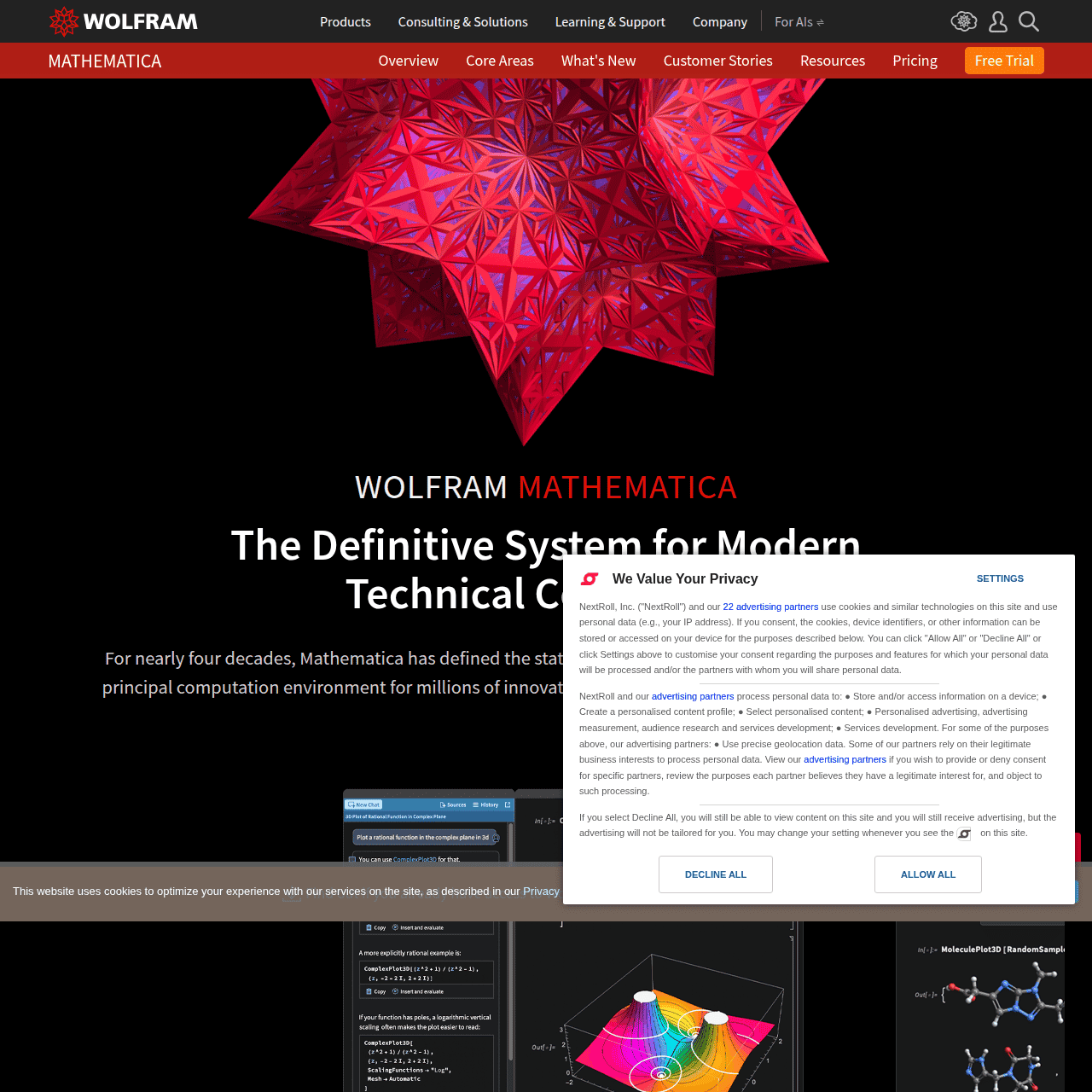
Wolfram Mathematica
The definitive system for modern technical computing

What Is Wolfram Mathematica?
Wolfram Mathematica is a high-level technical computing platform that unifies symbolic and numeric computation, curated data, visualization, and development tools within the Wolfram Language. It offers thousands of built-in functions for data science, modeling, algorithm development, and interactive visualization, all accessible through an intuitive notebook interface.
Supporting both desktop and cloud workflows, Mathematica helps users create, document, and deploy models, applications, and reproducible analyses at scale. It is widely used in science, engineering, finance, education, and technology for tasks ranging from quick exploratory calculations to production-grade computation.
By integrating computation and knowledge in one environment, Mathematica enables users to move rapidly from ideas to shareable, repeatable results.
Quick Snapshot
Wolfram Mathematica combines symbolic and numeric computation, visualization, and programming in a single coherent environment, shortening the path from concept to implementation. It lets you prototype, analyze, and deploy advanced models and applications without stitching together multiple tools.
- Works on
-
- Web
- Mac
- Linux
- API
- Other
- Pricing Model
- Subscription — Mathematica is available via commercial, academic, and other licenses for desktop and online access, with a free trial and distinct editions for individuals, organizations, and education. Exact starting prices vary by region, edition, and license type.
- Fits on
- Affiliate Program
- We could not identify an affiliate program.
- API Availability
- Wolfram Mathematica has an API available.
- Key Features
-
- Unify symbolic and numeric computation in one place
- Build reproducible models and analyses at scale
- Create interactive visualizations and deployable notebooks
- Audience
-
- scientists
- engineers
- data scientists
- quantitative analysts
- researchers
- educators
- students
- software developers
Screenshot

Key Features of Wolfram Mathematica
Symbolic computation
Perform exact algebraic manipulations, calculus, equation solving, and symbolic modeling directly in the Wolfram Language.
Numeric computation
Run high-performance numeric calculations, optimization, and simulations for large-scale or precision-demanding problems.
Interactive visualization
Create rich 2D and 3D graphics and interactive visualizations to explore data, functions, and models.
Notebook interface
Use an interactive notebook environment to mix code, text, graphics, and results in a single, reproducible document.
Unified Wolfram Language
Access thousands of built-in functions and curated knowledge through a consistent, high-level programming language.
Desktop and cloud workflows
Work locally or in the cloud, and easily share, deploy, or scale your computations and applications.
Deployment and integration
Turn notebooks and code into deployable applications, reports, and services, integrating with broader workflows and systems.
Use Cases for Wolfram Mathematica
Scientific research
Model complex systems, run symbolic and numeric experiments, and document analyses in reproducible notebooks that can be shared or published.
Data science workflows
Ingest, clean, analyze, and visualize data using thousands of built-in functions, then build end-to-end pipelines in a single environment.
Engineering simulation
Develop and test computational models for engineering problems, combining symbolic derivations with high-performance numeric computation.
Quantitative finance
Prototype trading strategies, risk models, and pricing algorithms with rich mathematical libraries and integrated visualization.
STEM education
Create interactive notebooks and demonstrations that help students explore mathematics, physics, and other STEM subjects in a hands-on way.
Algorithm development
Rapidly design, test, and refine algorithms using high-level Wolfram Language constructs and built-in computational tools.
Frequently Asked Questions
What is Wolfram Mathematica used for?
Wolfram Mathematica is used for technical computing tasks such as symbolic and numeric mathematics, data analysis, modeling, visualization, and algorithm development across science, engineering, finance, and education.
Is Wolfram Mathematica suitable for data science?
Yes, Mathematica provides extensive data manipulation, analysis, and visualization capabilities, along with thousands of built-in functions in the Wolfram Language, making it well suited for end-to-end data science workflows.
Can I use Wolfram Mathematica in the cloud?
Yes, Mathematica supports cloud-based workflows, allowing you to create, run, and share notebooks and applications online in addition to desktop installations.
Does Wolfram Mathematica require programming experience?
Basic familiarity with programming concepts is helpful, but the Wolfram Language is designed to be high-level and expressive, enabling users to start with simple expressions and grow into more advanced workflows.
Is there a free trial for Wolfram Mathematica?
Yes, Wolfram offers a free trial of Mathematica, allowing you to explore its features before choosing a commercial, academic, or other license.
Who should use Wolfram Mathematica?
Mathematica is aimed at scientists, engineers, data scientists, quantitative analysts, researchers, educators, students, and developers who need a unified environment for advanced computation and modeling.
Wolfram Mathematica · Our Verdict
Wolfram Mathematica stands out as one of the most integrated environments for advanced technical computing, especially when projects span symbolic math, numerics, and visualization. Its notebook-driven workflow and deep Wolfram Language ecosystem make it particularly strong for research, education, and data-heavy experimentation where reproducibility and rapid iteration matter.
Wolfram Mathematica ·
-
 Freemium
 Kurby
AI-powered neighborhood intelligence for real estate
Market Research & Analysis - Custom
mia
Turn every market signal into revenue decisions
Business & Finance AI - Free Premium
PDF Summarizer
Free AI PDF summaries in seconds, no signup
Summarization & Paraphrasing -
Lxi.ai
A collaborative canvas to work better with AI.
Knowledge Management - Freemium Featured
Atlas
The AI GIS where modern teams bring maps to life
Data Visualization - Your Ad Here
- Freemium
Labophase
Ask once, get answers from multiple AIs
AI Assistants & Chatbots - Subscription
GPTHumanizer AI
Transform AI text into natural, human writing
Text & Writing AI