


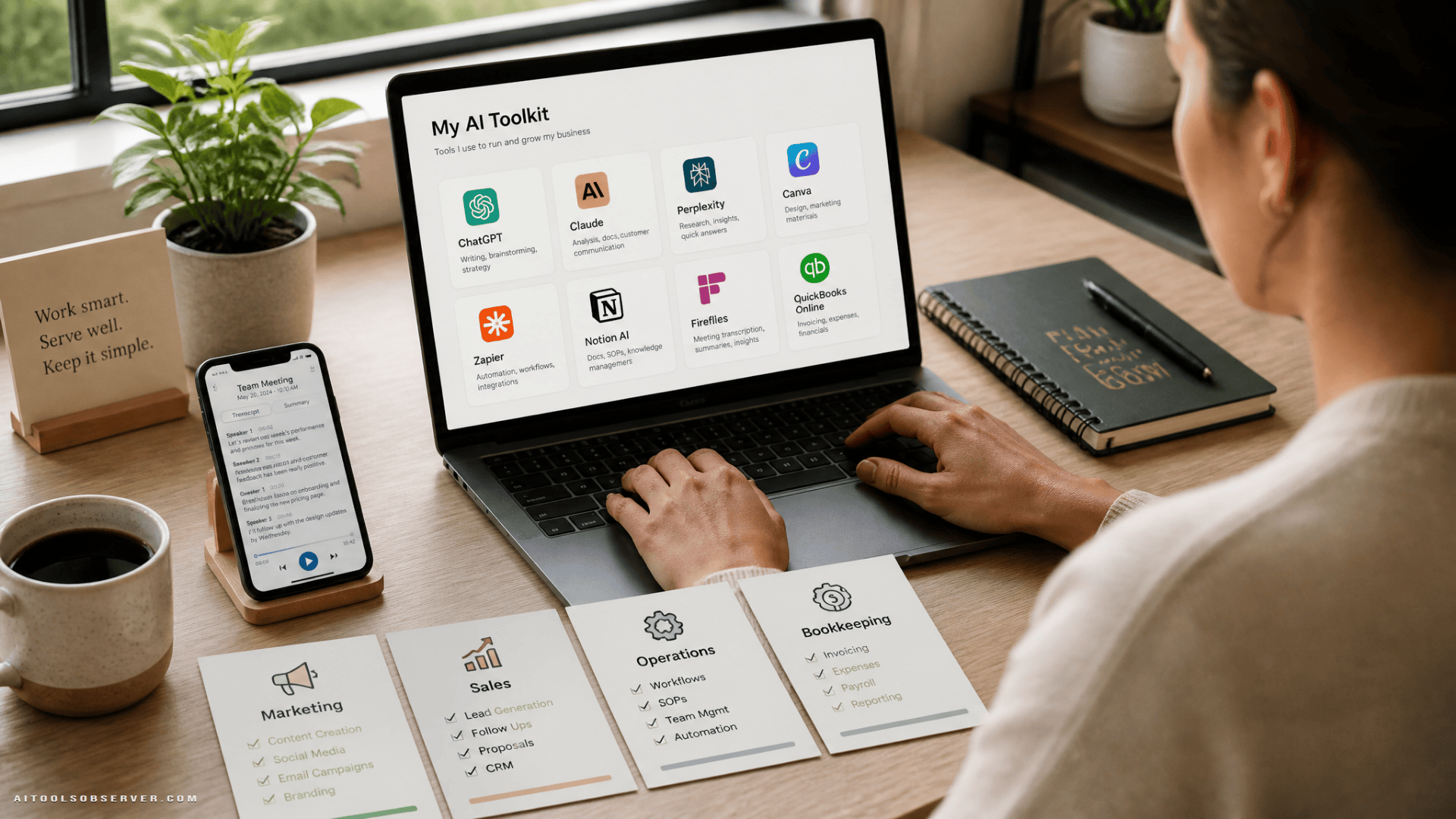
Marketing and Content
Marketing is the most common entry point for AI among small businesses, and it’s easy to see why. Content production, scheduling, and email optimization are time-intensive, repetitive, and well-suited to automation.
Canva
Canva is an online design tool that has grown into a capable AI-assisted content platform. Its Magic Write feature generates on-brand copy, Magic Design builds templates from a text prompt, and background removal works in a single click. For a business without a design budget, it replaces work that would otherwise require a freelancer or agency retainer.
- Free plan: Available
- Pro plan: Approximately $13–$15 per month
Mailchimp
Mailchimp’s built-in AI layer, Intuit Assist, handles subject line generation and send-time optimization. Email remains one of the highest-return digital channels available to small businesses, and the AI features are designed to extract more of that return without requiring additional staff time.
- Free plan: Available with basic AI-assisted features
- Paid plans: Start around $13 per month for more advanced capabilities
Buffer
Buffer is a social media scheduling tool with an AI Assistant that stands out for one specific capability: paste a blog post link, and it generates platform-specific captions for Instagram, LinkedIn, X, and Facebook simultaneously. That single feature can eliminate a meaningful chunk of weekly content work.
- Free plan: Available
- Paid plans: Start at $6 per connected social channel per month; AI Assistant included
Surfer SEO
Surfer SEO’s content editor scores writing in real time against the top-ranking pages for a target keyword. Rather than guessing what to cover or how to structure an article, owners get a clear, data-driven target. It’s a more disciplined approach to content than most small businesses currently use.
- Free trial: Available
- Paid plans: Start around $89 per month
Sales and Customer Relationships
Sales and customer relations are where AI touches revenue most directly. The tools in this category help manage leads, automate follow-up, and handle routine customer interactions without adding headcount.
HubSpot
HubSpot’s core CRM is genuinely free, and it now includes AI features for lead scoring, follow-up suggestions, and pipeline management. For a small business without a dedicated sales team, the ability to automatically flag warm leads and suggest when to act on them is a meaningful operational advantage.
- Free CRM: Available
- Paid plans: Add more advanced marketing and sales automation features
Tidio
Tidio is an AI-powered live chat and chatbot tool built for small business websites. It handles a large share of routine customer questions automatically, which frees up the owner or staff to focus on the issues that actually require a human response. The tradeoff is that chatbot quality depends on how well it’s configured—setup time matters here.
- Free tier: Available
- Paid plans: Start around $29 per month
Operations and Finance
Some of the most significant time savings from AI come from back-office work: connecting systems, automating data movement, and keeping financial records current. These aren’t visible to customers, but they reduce the operational drag that consumes owner time.
Zapier
Zapier connects thousands of applications and uses AI to build automation workflows from plain-English descriptions. Instead of manually moving data between a website form, an email platform, and a spreadsheet, an owner describes the workflow once and Zapier handles the execution. The free tier covers approximately 100 tasks per month, which is sufficient for testing and light use.
- Free tier: ~100 tasks per month
- Paid plans: Start around $19.99 per month
Zoho Books
Zoho Books is a full accounting platform with an AI assistant, Zia, included at no additional cost. It handles invoicing, bank reconciliation, and basic financial reporting. The free plan is available to eligible solopreneurs and microbusinesses, making it one of the more accessible entry points for AI-assisted bookkeeping.
- Free plan: Available for qualifying businesses
- Paid plans: Start at $15 per month billed annually, or $20 per month billed monthly
Research and Productivity
Information and time are the two resources small business owners are most consistently short on. These tools address both.
Productivity and research tools can help compress routine work and information gathering.
Perplexity
Perplexity is an AI-powered search engine that returns sourced, cited answers rather than a list of links to evaluate. For tasks like researching competitor pricing, tracking industry trends, reviewing regulatory updates, or comparing suppliers, it compresses hours of manual searching into minutes. The free tier covers most small business research needs.
- Free tier: Available
- Pro plan: Around $20 per month
Otter.ai
Otter.ai transcribes and summarizes meetings in real time. For a solo owner or a small team without a dedicated notetaker, it converts client calls and internal meetings into a searchable, shareable record without anyone having to type a word. The free tier is functional for regular use.
- Free tier: Available
- Paid plans: Start around $8.33 per month
How to Build the Stack Without Overcomplicating It
Ten tools is a list, not a mandate. The more useful approach is to identify the single function that consumes the most time or creates the most friction, and start there. Most of these tools are designed to show value quickly—within days, not weeks.
The businesses that are pulling ahead aren’t necessarily spending the most on AI. They’re the ones that started with a specific problem, chose a tool that addressed it, and built the habit before adding the next layer. That sequence—problem first, tool second—is what separates a useful stack from a collection of subscriptions that never get used.
Pick one. Get comfortable with it. Then add the next. For more on reducing small business admin time, see the related guide.












Comments (0) No comments yet
Want to join this discussion? Login or Register.
No comments yet. Be the first to share your thoughts!