



What Recent Graduates Are Experiencing
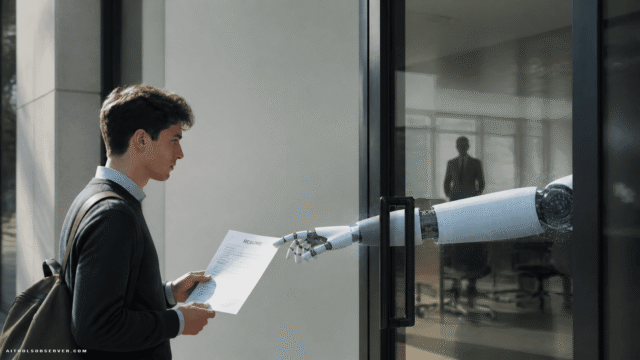
The anecdotal evidence is hard to dismiss. Graduates with engineering degrees from Georgia Tech and communications master’s degrees from Florida State are submitting hundreds of applications—450, 500—and receiving a handful of interviews, no offers. These are not underprepared candidates. They networked. They interned. They applied early.
In a 2026 ZipRecruiter survey, 47% of recent graduates said AI had already affected hiring in their field. That perception is widespread and, for the people living it, entirely reasonable. Entry-level work has historically meant applying codified, textbook knowledge to structured problems—exactly what large language models do efficiently.
The Case That AI Is a Factor
Stanford economist Erik Brynjolfsson makes the clearest argument for AI’s role. Using payroll data, his research found that since late 2022—when large language models became widely available—early-career workers aged 22 to 25 in AI-exposed roles such as software development and marketing experienced a 16% relative employment decline.
Older workers in the same AI-exposed fields did not see comparable declines. Neither did workers in roles that are difficult to automate, such as home health aides or construction workers.
Brynjolfsson identifies two mechanisms:
- Cyclical vulnerability: Junior roles are typically the first cut when companies reduce headcount or slow hiring.
- Knowledge overlap: Large language models are trained on codified, documented knowledge—the same type of knowledge that entry-level workers bring to their first jobs. Senior workers carry tacit, experiential knowledge that AI models cannot replicate as easily.
The implication is not that AI is eliminating these roles outright, but that it is reducing the marginal value of hiring someone with no experience to do work that a model can approximate.
For broader context, see AI Job Risk in 2026.
The Case That Remote Work Is the Bigger Driver
Harvard economist David Deming is not convinced AI is the primary cause—and his reasoning is grounded in timing.
The decline in junior hiring, he argues, began roughly six months before ChatGPT’s public release. That sequence matters. If AI were the primary driver, you would expect the decline to follow adoption, not precede it.
Deming points instead to remote work. A New York Fed analysis found that companies are significantly less likely to hire recent graduates into remote-eligible roles. As remote work expanded following the pandemic, unemployment among younger college graduates rose in parallel. The same analysis found that AI did not statistically explain the rise in youth unemployment, while remote work did.
The logic is straightforward: training an entry-level employee requires investment—time, supervision, feedback. That investment is harder to deliver remotely. When a company can hire a more experienced worker who needs less onboarding, and can recruit from a national talent pool because the role is remote, the calculus shifts against the junior candidate.
What the Firm-Level Data Shows
University of Chicago economist Anders Humlum adds a counterintuitive data point. If AI were actively replacing entry-level workers, companies with the heaviest AI investment should be hiring fewer people. A study by Ramp and Revelio Labs, examining AI spending and headcount across more than 21,000 U.S. firms from early 2021 to early 2026, found the opposite.
At companies making the largest AI investments, entry-level headcount grew by 12% in the two years following AI adoption.
Humlum’s interpretation: the firms paying the most to Anthropic and OpenAI are hiring more, not less. That does not mean AI has no labor market effects—but it complicates the narrative that AI spending directly translates to fewer junior hires.
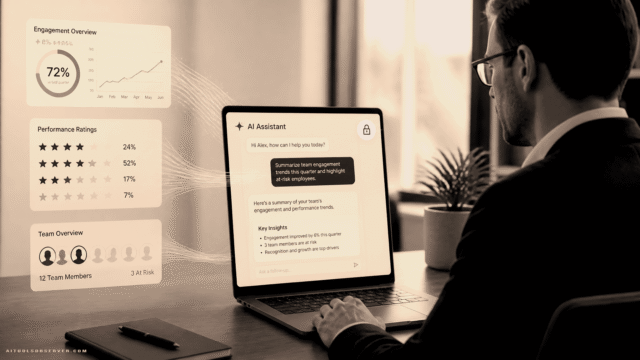
This is especially notable given how AI investment is rising across organizations.
Where the Economists Agree
Despite their disagreements on causation, Brynjolfsson, Deming, and Humlum share a broader view: a significant employment shift is underway, and it will accelerate.
All three were among the economists and researchers who signed an open letter warning that AI could produce an economic transformation larger than the Industrial Revolution, with potential for widespread job displacement. Yet all three expressed measured optimism about long-term outcomes.
The consensus position, stated plainly: AI is not yet the dominant force reshaping entry-level hiring, but it will become one. The current difficulty for graduates is real, the causes are multiple, and the trajectory points toward more disruption, not less.
What This Means for Graduates and Hiring Observers
For recent graduates, the practical picture is this: the job market is genuinely harder, the causes are structural rather than personal, and the difficulty is likely to persist through the near term. Remote work has reduced the incentive to hire inexperienced candidates. AI is beginning to compress the value of codified, entry-level knowledge. Both forces are operating simultaneously.
For anyone tracking AI adoption and its labor market effects, the firm-level data from Humlum’s research is worth holding onto. AI investment and junior hiring are currently moving in the same direction at the companies deploying AI most aggressively. That relationship may not hold as models improve—but it is the current state of the data.
The honest takeaway: the entry-level job market is under real pressure, AI is a contributing factor but not yet the dominant one, and the economists who study this most carefully are telling graduates to expect turbulence rather than a clean recovery. Readers following broader labor market effects can place this evidence in a wider context.












Comments (0) No comments yet
Want to join this discussion? Login or Register.
No comments yet. Be the first to share your thoughts!