


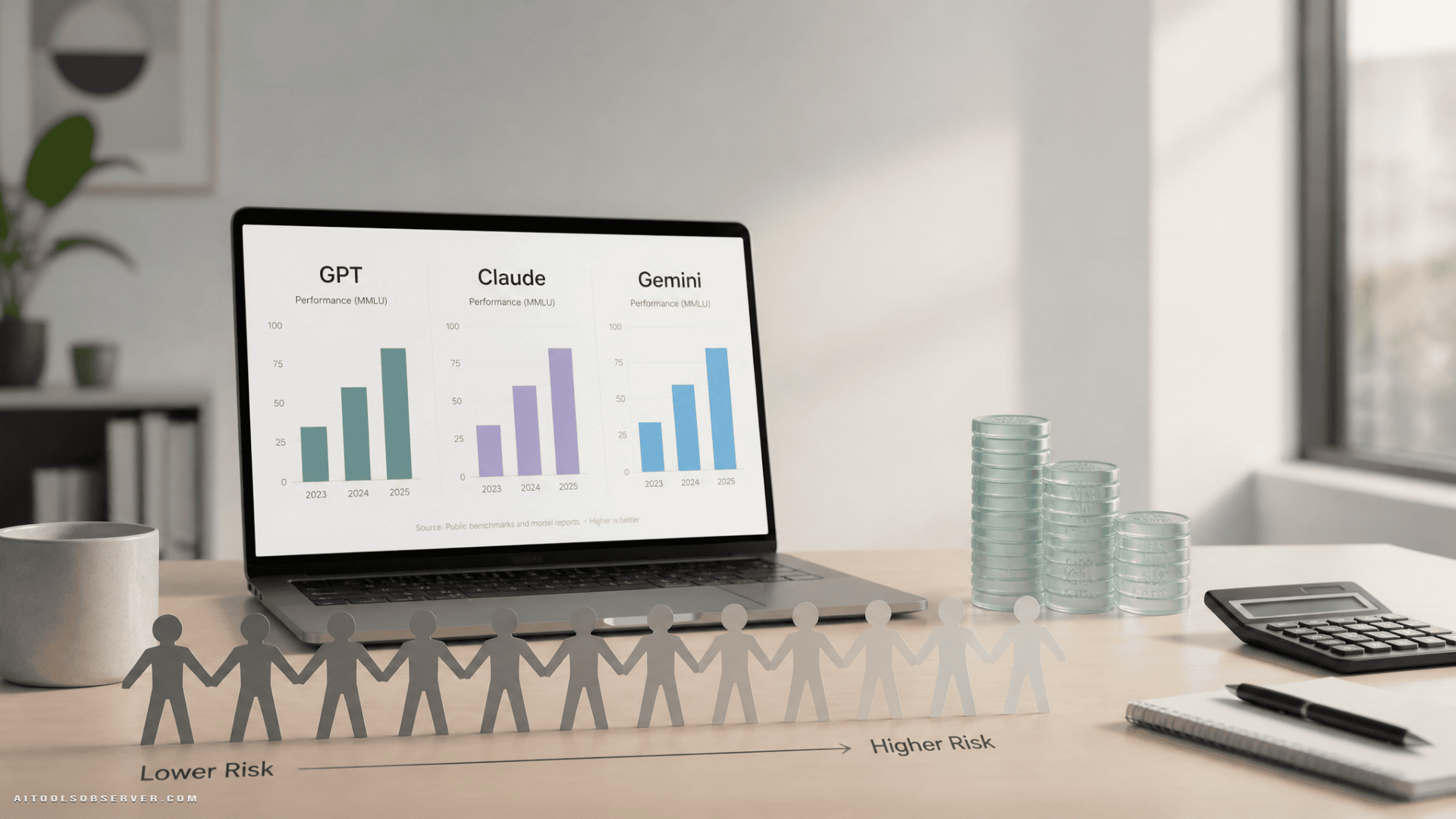
The signal in the benchmarks
A practical way to read recent model progress is by task duration. Earlier large language models were mostly reliable on work that a skilled human could finish in seconds or a few minutes. Newer models appear able to complete a larger share of tasks that would take a human expert much longer, including work stretching into the one-hour range.
That matters because many knowledge jobs are made up of exactly these chunks: debugging a module, drafting a first-pass financial memo, summarizing a legal file, or producing a workable creative draft. As models move from short tasks to multi-step tasks, the automation discussion shifts from “assistant” to “partial substitute.”
In software engineering, this pattern is easiest to see. Benchmarks described in the available context track more than 200 tasks, from basic coding exercises to more complex machine learning projects. The notable change is not just better performance on easy tasks. It is a wider ability to finish harder tasks at a level counted as reliable.
This does not mean all software work is automatable. It means the boundary has moved.
What benchmark gains do and do not mean
Benchmarks are useful, but they need careful interpretation.
A model that can complete a task in a controlled benchmark is not automatically ready to replace a worker in a messy production environment. Real jobs involve unclear requirements, changing objectives, internal politics, compliance constraints, review cycles, and accountability when things go wrong.
So the benchmark story is best read in three layers:
- Capability: Can the model produce a technically acceptable result?
- Reliability: Can it do so consistently enough for operational use?
- Integration: Can a company redesign workflow, oversight, and incentives around that capability?
Automation risk rises only when all three line up.
Why software, finance, and creative work are exposed first
The context points to software engineering, finance, early legal work, and some creative roles as the most exposed categories. That pattern is logical.
These jobs often share four traits:
- high volumes of digital text or code
- repeatable first-draft or analysis work
- measurable outputs
- workflows that can be broken into modular steps
This is where current models are strongest. They do not need to replicate all human judgment to disrupt labor demand. They only need to handle enough of the workflow to reduce the need for junior staff, contractors, or support layers.
Software engineering
Software remains the clearest case because tasks are already digital, testable, and decomposable. If a model can reliably write, review, refactor, and debug code for bounded tasks, then some entry-level and mid-level work becomes easier to automate or consolidate.
The labor implication is subtle but important. Senior engineers may become more productive, while junior hiring becomes harder to justify. A company that once needed several developers for implementation-heavy work may now need fewer, with more emphasis on architecture, review, and integration.
Finance
In finance, AI is well suited to structured document work, first-pass analysis, model support, and reporting tasks. That does not eliminate the need for human judgment. It changes where that judgment is applied.
The pressure is likely to fall first on repetitive analyst work rather than high-trust decision-making. If AI can produce faster drafts, comparisons, and summaries, firms may trim the number of people needed for the lower end of the value chain.
Creative work
Creative roles are often discussed as if they are either fully safe or fully doomed. Neither is precise.
The more exposed layer is entry-level production: variants, adaptations, first drafts, formatting, concept generation, and routine asset creation. The less exposed layer is taste, brand accountability, narrative coherence, stakeholder management, and original direction under uncertainty.
That means AI may reduce demand for some creative labor while increasing demand for people who can direct, edit, and integrate machine-generated output into actual campaigns and products.
The early labor market evidence: meaningful, but not clean
Employment effects are harder to interpret than model benchmarks because labor markets are noisy. Interest rates, taxes, macro weakness, and hiring cycles all distort the picture.
Still, the context includes one notable pattern: an observed hit to employment among younger workers in more AI-exposed occupations, with stronger effects in sectors such as finance, software, and creative industries. Even if economists debate the exact magnitude, the directional signal deserves attention.
The most plausible interpretation is not sudden mass unemployment. It is pressure at the margin:
- fewer entry-level openings
- slower hiring in exposed roles
- more output expected per employee
- rising skill thresholds for jobs that still exist
This is exactly how automation often arrives. Not with immediate replacement of the whole profession, but with fewer rungs on the ladder.
The real bottleneck: token economics
Capability is rising. Cost discipline is rising too.
That tension may be the most important constraint on automation in 2026. AI systems consume tokens, and large-scale agentic use can generate enormous volume. Even if per-token costs decline, total usage can rise much faster. In practice, that can produce surprisingly large bills.
This is not a side issue. It directly shapes which tasks get automated.
If an AI workflow requires long context windows, repeated tool calls, multiple iterations, and constant verification, then its economic case may weaken fast. A virtual worker that is technically capable but expensive to run at scale may not replace a human worker after all.
This creates a more grounded framework for automation risk:
- High risk: tasks that are digital, repeatable, low-error-tolerance but easily checked, and cheap to process
- Medium risk: tasks where AI can do most of the work but still needs human review or costly iteration
- Lower near-term risk: tasks that require physical presence, trust, contextual judgment, or expensive multi-step AI orchestration
token economics matter because cost can be the difference between a benchmark success and a workflow that never becomes routine.
Why some firms are rationing advanced model use
The context suggests that some companies pushed aggressive internal AI adoption, even using productivity targets tied to token consumption. That makes sense in an experimental phase. If employees use more capable models, firms can learn where the productivity gains are real.
But once costs scale up, finance teams intervene. Rationing is a predictable next step.
This has two consequences.
First, it slows full automation in areas where models need many passes to get acceptable results. Second, it favors narrower, cheaper deployments over open-ended AI usage. In other words, firms may automate specific workflows before they automate general roles.
That is a key distinction for workers. The threat is often not “AI takes your whole job tomorrow.” It is “AI takes 30% of your task stack, and your employer adjusts headcount over time.”
Cheaper models change the equation
One major uncertainty is substitution between premium and cheaper AI models. If firms can switch to lower-cost alternatives for acceptable performance, automation risk broadens.
This matters because labor economics is sensitive to relative cost. A workflow that fails the business case on a costly frontier model may become viable on a cheaper one, even with slightly lower quality. Many companies do not need maximum capability. They need acceptable output at manageable cost.
That suggests a moving frontier:
- frontier models expand what is technically possible
- cheaper models determine what becomes economically routine
The job impact comes from the second category more often than the first.
Replacement versus augmentation: the wrong binary
The debate is often framed as if every role falls neatly into one of two boxes. In practice, most jobs split into tasks that can be automated, tasks that can be accelerated, and tasks that remain stubbornly human.
A better way to think about 2026 is by task mix.
A software engineer may see automation in testing, boilerplate generation, debugging assistance, and documentation, while retaining responsibility for architecture, tradeoff decisions, and production accountability. A financial analyst may lose time spent on first-pass summaries and gain time for interpretation and client-facing decisions. A designer may automate variations but remain responsible for selection, refinement, and brand coherence.
So augmentation is real. But it is not always benign. If one worker, equipped with AI, can do what two workers previously handled, augmentation at the individual level can still mean displacement at the team level.
Who is most vulnerable
The exposure pattern is not random.
Workers are more vulnerable when they are:
- early in their career
- concentrated in digital, document-heavy work
- doing standardized output rather than judgment-heavy work
- easy to evaluate on speed and volume alone
That helps explain why younger workers may face sharper effects first. Entry-level positions often exist to handle repeatable tasks while learning the trade. If those tasks are increasingly automated, the traditional path into the profession narrows.
This is one of the more serious second-order risks. Even if senior roles remain protected for now, the pipeline that creates future seniors may weaken.
What employers should actually watch
For companies, the smartest question is not “Can AI do this job?” It is “Which workflows produce durable gains after error handling, oversight, and cost are included?”
The highest-value signals to monitor are simple:
- task completion reliability on bounded workflows
- review burden after AI output
- cost per completed task, not cost per token alone
- effects on junior hiring and team composition
- whether gains persist outside pilot conditions
This approach avoids both extremes: blind enthusiasm and reflexive dismissal.
What workers should do with this
Workers in exposed sectors do not need abstract advice about “embracing AI.” They need a sharper strategy.
Focus on becoming harder to substitute in the parts of work that models still handle poorly:
- problem framing
- cross-functional communication
- final accountability
- quality control
- domain judgment
- workflow design around AI tools
At the same time, learn how the models perform on the repetitive layers of your own role. The fastest way to misread automation risk is to assume your job is one indivisible block. It is not. It is a portfolio of tasks, and that portfolio is being repriced.
The likely 2026 reality
The benchmark story for GPT, Claude, and Gemini points in one direction: more complex knowledge work is becoming automatable in narrower, but increasingly useful, slices.
The labor market story is less dramatic but more consequential. Exposed sectors may not collapse, yet they can hire fewer juniors, raise expectations for each employee, and gradually redesign teams around AI-assisted output. The cost story adds an important limit: not every technically possible workflow is economically worth automating, especially when token usage explodes.
That leaves a clear practical conclusion. The near-term risk is not universal replacement. It is selective compression of white-collar work where task structure, model reliability, and cost efficiency align. If you want to judge your own exposure, start there: not with headlines, but with the tasks in front of you, the economics behind them, and the workflows your employer can realistically change.














Comments (0) No comments yet
Want to join this discussion? Login or Register.
No comments yet. Be the first to share your thoughts!