


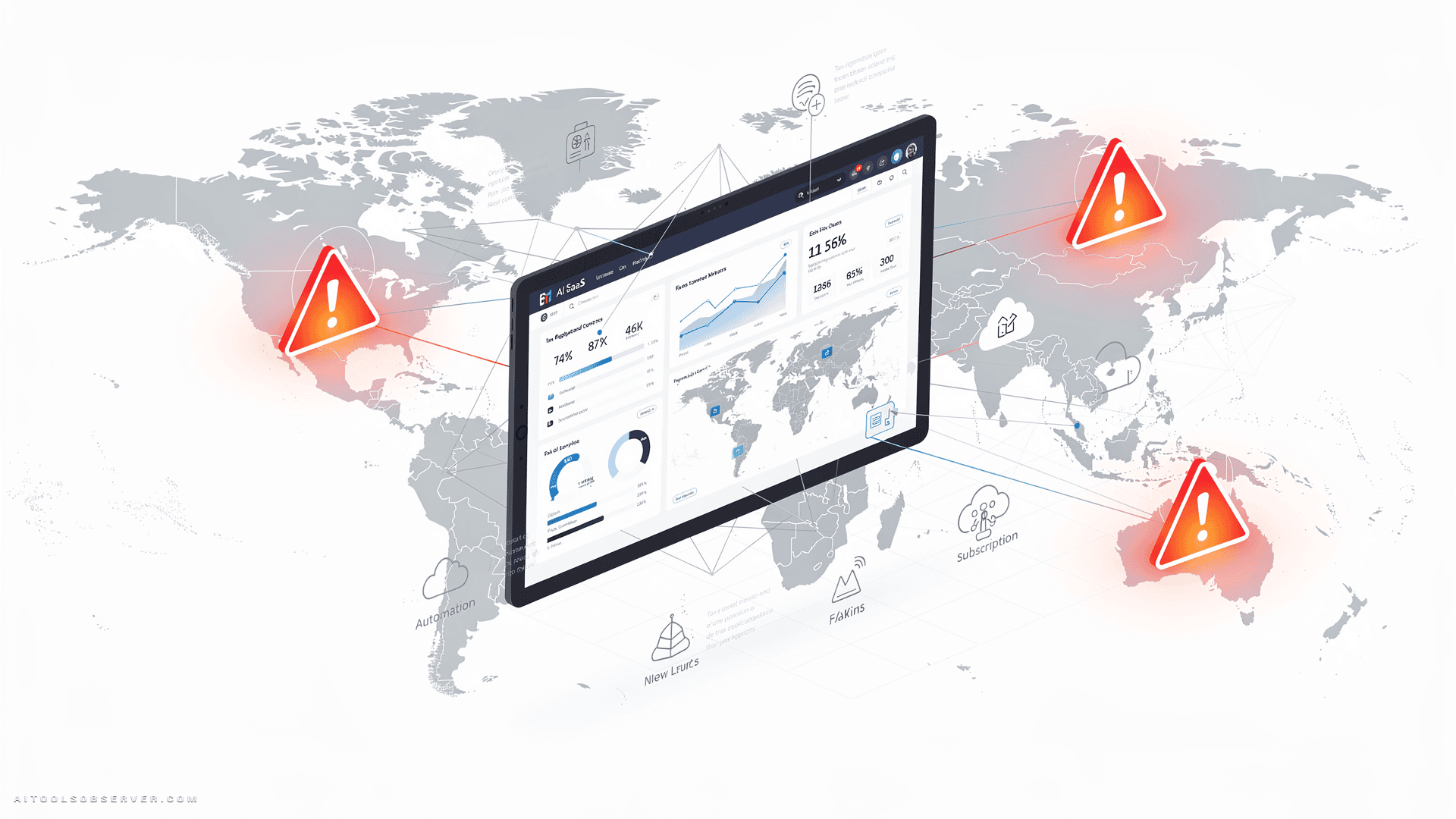
The Subtle Tax Shift Nobody Talks About
More than 100 jurisdictions require nonresident digital services providers to register for and collect VAT. That’s not a niche regulatory footnote. That’s a global compliance landscape that most U.S.-based AI founders are completely unprepared for.
Here’s why it catches people off guard: VAT exposure doesn’t always arrive with a product launch. It can accumulate gradually as AI features deepen and human involvement fades. A service that was never classified as “digital” under VAT law can quietly become one as automation takes over the delivery.
The VAT position you established at launch may no longer reflect how your product actually operates today.
When AI moves from a background feature to the primary source of value — when users get results from a self-service interface with no human in the loop — tax authorities in dozens of countries may reclassify what you’re selling. And that reclassification has real financial consequences.
What “Digital Service” Actually Means for VAT Purposes

Most VAT frameworks define digital services as those delivered over the internet, largely or entirely automated, and requiring minimal human involvement. Sound familiar? That’s a description of most modern AI products.
Under these rules, the place of taxation typically shifts to where the customer is located — not where your company is based. A sale from a U.S. startup to a consumer in France, Singapore, or South Africa may require you to charge and remit local VAT, even if you have no office, no employees, and no physical presence in those countries.
The average standard VAT rate globally sits around 19%, according to OECD Consumption Tax Trends data. On a $50/month subscription, that’s nearly $10 per customer per month in potential tax liability you may not be collecting. Multiply that across hundreds of international users and extend it back over months or years of noncompliance — the numbers get uncomfortable fast.
Definitions and thresholds vary by jurisdiction. Some countries tax from the very first transaction. Others apply low revenue thresholds. Customer location is determined differently depending on the country — billing address, IP address, payment data, or some combination. Without systems built to handle these rules, even a handful of early cross-border sales can create unexpected obligations.
Scenario 1 — The AI Design Startup That Didn’t Know It Had a VAT Problem
Consider a startup — call it BlackAI — that offers a subscription app using AI to generate custom marketing graphics. A user types a prompt or uploads a sketch. The AI produces a polished design in seconds. No human designers are involved. The service is fully automated.
BlackAI is based in the United States. But the internet doesn’t care about geography, and neither does VAT law.
The moment BlackAI starts selling to customers in the EU, UK, Singapore, or South Africa, it likely falls under those countries’ digital services VAT rules. It must charge local VAT, remit it to the relevant tax authority, and issue compliant invoices — all without any physical presence in those markets.
For an early-stage startup, this creates immediate operational pressure. You need to correctly identify customer location and status. You need to apply the right VAT rate. You need invoicing systems that reflect local requirements. Get it wrong and you’re exposed to penalties, audits, and back-tax assessments — often with extended statutes of limitation in cases of noncompliance.
VAT compliance rarely makes the early-stage priority list. But exposure builds quietly, and remediation is always more expensive than prevention.
Scenario 2 — The “Modest Upgrade” That Rewrote a Company’s Tax Profile
This one is more instructive, because it shows how a business that was already operating globally can suddenly find itself in new VAT territory without changing markets, legal structure, or pricing.
TutorCo is a U.S. company offering live, one-on-one online language lessons. Human tutors. Video calls. Personal educational service. Under most VAT frameworks, this wasn’t classified as a digital service — it was taxed where the supplier is located. TutorCo operated globally without engaging foreign VAT systems.
Then TutorCo launched an AI-powered learning portal. An interactive chatbot for automated conversation practice and feedback. Offered as a standalone subscription and bundled with live tutoring.
From a product perspective, this was a modest enhancement. From a VAT perspective, it was a fundamental shift.
Why the AI Portal Changed Everything
The chatbot delivers language practice over the internet with minimal human involvement. In most jurisdictions, that’s a digital service. And for consumer transactions, digital services are taxed where the customer is located.
A student in the UK using TutorCo’s AI portal is likely receiving a taxable service in the UK — even though TutorCo is based in the United States. TutorCo may now need to register for VAT in multiple jurisdictions, update its invoicing systems, and apply local VAT rates to the AI component.
There’s another layer of complexity: some jurisdictions exempt educational services from VAT. TutorCo may have previously benefited from those exemptions. But the introduction of AI could be enough to disqualify the service from that exemption — because it no longer fits the specific definition of an exempt educational supply.
The Bundling Problem
When TutorCo sells the AI portal and live tutoring as a package, it faces a bundled supply question. Does the bundle constitute a single supply? If so, which component is predominant? If the AI chatbot is deemed the primary element, tax authorities may subject the entire bundle to VAT.
If TutorCo misallocates value between components, it risks over- or undercollecting VAT. Both outcomes create compliance exposure.
Business vs. Consumer Customers
TutorCo also needs to distinguish between individual consumers and business customers. If a corporate client or language school provides a valid VAT number, TutorCo may not need to charge VAT — the business customer self-assesses instead. This requires TutorCo to validate VAT numbers and issue invoices that correctly state the customer’s tax responsibility.
The Quiet Accumulation of Exposure
TutorCo’s VAT exposure likely started the day the AI portal launched. But because the shift was subtle — a feature addition, not a new product — the company may not have recognized it. Every month without compliance added unpaid VAT, penalties, and interest to the liability.
Tax authorities could also reassess TutorCo’s overall offering if the AI portal becomes central to the customer experience. At that point, even the live tutoring component could be reclassified as part of a digital service.
A modest upgrade. A fundamentally different tax profile. That’s the risk hiding inside every AI feature launch.
Where Automation Is Taking VAT Law Next

Current VAT frameworks weren’t designed for AI agents, autonomous transactions, or data-as-payment models. But those are exactly the patterns emerging as AI capabilities expand.
Agentic AI and the Supplier Question
AI agents that act on behalf of users — initiating purchases, completing transactions, matching parties — challenge the basic VAT assumption that there’s a clear supplier and a clear customer. When an AI tool starts to intermediate between parties, it may trigger marketplace-style VAT responsibilities: collecting tax on underlying transactions, complying with platform reporting requirements, or creating exposure to digital services tax regimes.
These outcomes aren’t inevitable, but the uncertainty is real. Businesses building agentic AI tools should be asking these questions now, not after regulators do.
Data as Consideration
Some AI applications offer free access in exchange for users allowing their interactions to be used as training data. This raises a direct VAT question: does data constitute consideration for VAT purposes? If it does, how is it valued? These questions don’t have settled answers yet, but they’re coming.
Infrastructure and Establishment
Where AI models are hosted may also affect VAT outcomes in jurisdictions that treat server location as relevant to establishment. Infrastructure decisions that look purely technical can have tax implications.
Automated Enforcement
Tax authorities aren’t standing still. Real-time reporting systems and AI-driven analytics are giving regulators the ability to identify mismatches between how a service operates and how it’s reported for VAT. As enforcement becomes more automated, the window for undetected noncompliance is shrinking.
Policymakers are also beginning to discuss AI-specific taxation — including usage-based levies tied to token consumption — as a way to offset payroll tax losses from automation. The tax landscape in an AI-driven economy may look substantially different within the next decade.
Practical Steps to Manage Your VAT Exposure
You don’t need to be a tax lawyer to start managing this risk. You need to build VAT thinking into your product and go-to-market process.
Audit your service classification before you launch internationally. Ask whether your product is delivered automatically over the internet with minimal human involvement. If yes, assume it may qualify as a digital service in most markets.
Map your customer base by jurisdiction. Know where your users are located, not just where they sign up from. Build systems that capture billing address, IP data, and payment information consistently.
Identify registration thresholds early. Some countries tax from the first transaction. Others have revenue thresholds. Know which markets you’re approaching and what triggers an obligation.
Reassess your VAT position every time you add AI features. A new chatbot, an automated recommendation engine, a self-service portal — each of these can shift your service classification. Don’t assume your original analysis still holds.
Separate your bundled offerings clearly. If you sell AI and human services together, document the value allocation. Understand how each component is treated in your key markets.
Validate business customer VAT numbers. If you’re selling to companies, build VAT number validation into your checkout and invoicing workflow. This affects whether you charge VAT or shift the obligation to the customer.
Bring tax into product planning, not just product launch. VAT belongs in the conversation when you’re designing pricing, customer experience, and international rollout — not after the fact.
The Cost of Getting This Wrong Is Not Theoretical
Back taxes. Penalties. Extended statutes of limitation for noncompliance. Reputational risk with enterprise customers who expect clean invoicing. These aren’t hypothetical outcomes — they’re what happens when AI-driven businesses discover their VAT exposure late.
The companies that manage this well aren’t necessarily the ones with the biggest legal budgets. They’re the ones that recognized early that AI doesn’t just change their product — it changes their regulatory profile.
Build that awareness into how you ship. The automation that makes your product powerful is the same automation that puts you on the radar of tax authorities in 100+ countries. Observe that reality clearly, and you’ll be in a far better position to choose the right compliance path before it chooses you.

















Comments (0) No comments yet
Want to join this discussion? Login or Register.
No comments yet. Be the first to share your thoughts!