


The Real Problem With Most Biotech Resumes
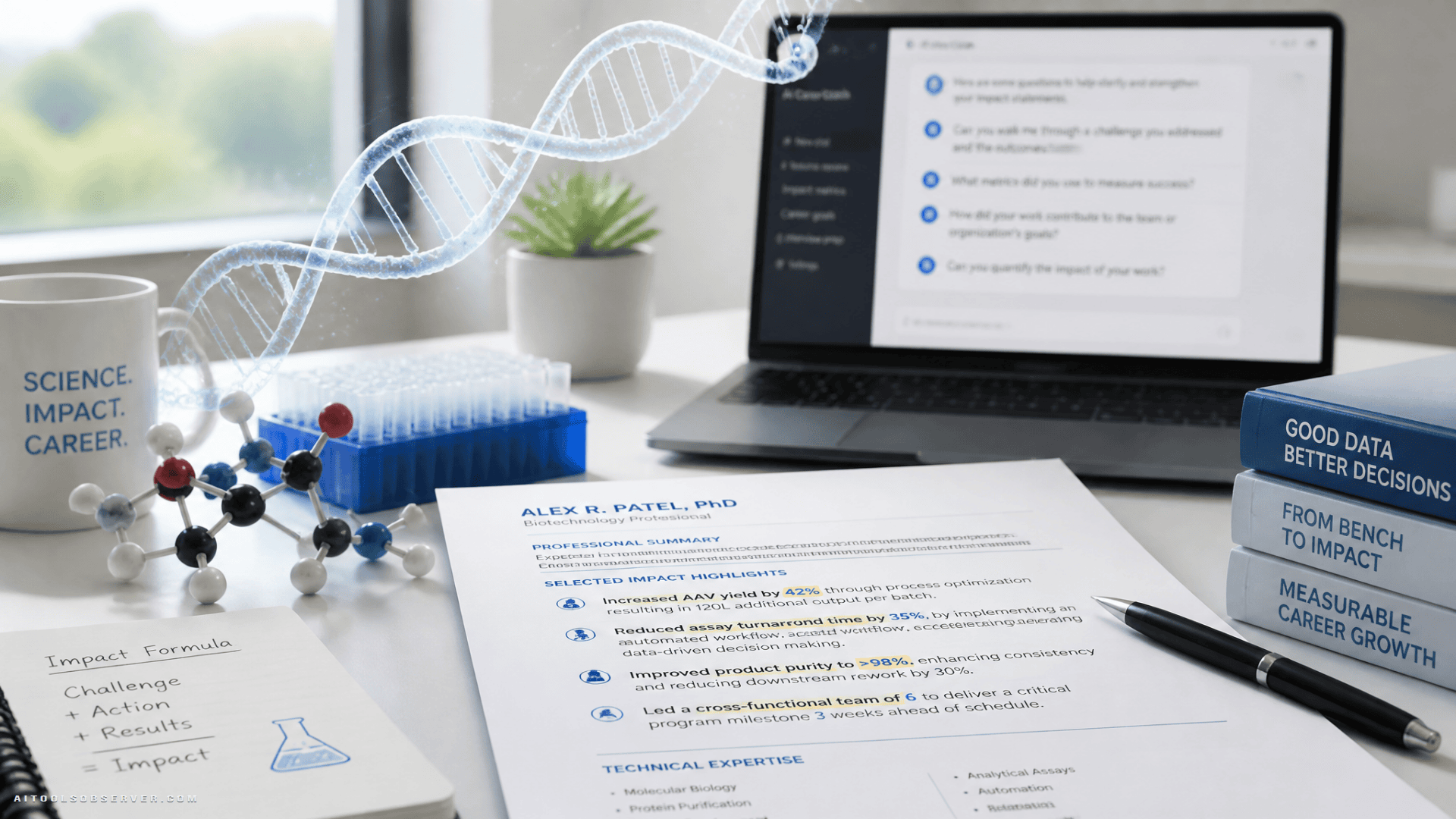
Most biopharma professionals list what they did. They don’t show what changed because of what they did.
“Managed quality assurance processes” tells a hiring manager nothing. “Reduced deviation rates by streamlining audit protocols across three clinical sites” tells a story. The second version gets callbacks. The first gets skipped.
The challenge is that most scientists, researchers, and clinical ops professionals aren’t trained to translate their work into business impact. That’s exactly where AI can help.
How to Use AI to Build Impact Statements
The key move here isn’t asking AI to write your resume. It’s using AI to ask you better questions.
Career coaches working with biopharma professionals recommend a specific approach: tell the AI what you worked on, then ask it to interview you. Don’t start with a job title or a generic request. Start with the work itself.
Here’s a practical example of how that prompt looks:
“I managed a clinical study where we had zero deviations and completed ahead of schedule. I’m trying to turn this into a measurable impact statement for my resume, but I’m not sure how to frame it. Ask me clarifying questions.”
The AI will push back with questions like: How much faster did you finish? What was the baseline timeline? How many sites were involved? How did this compare to previous studies?
Those questions unlock the numbers you already know but haven’t thought to include. The result is an impact statement that’s specific, credible, and yours.
Why Specificity Matters More Than Job Title
Generic prompts produce generic output. If you ask AI to “help me write impact statements for a QA Director role,” you’ll get something that sounds like every other QA Director on the market.
Instead, feed it the actual situation. The study. The problem. The outcome. The more specific your input, the more useful the output — and the more the final statement sounds like you, not a template.
Using AI to Prepare for Interviews
Impact statements get you the interview. Your stories close it.
Biopharma interviews often involve behavioral questions: Tell me about a time you managed a cross-functional team. Describe a situation where a study went off-track. How do you handle regulatory pushback?
AI can help you stress-test your answers before you’re in the room. The approach is straightforward: tell the AI the story you plan to share, then ask it what follow-up questions an interviewer might ask.
This forces you to think through the gaps in your narrative before someone else finds them. It’s low-stakes rehearsal with high-stakes payoff.
Don’t Read From a Script
This is where a lot of people go wrong. They use AI to generate a polished answer, memorize it, and then deliver it word-for-word in the interview. It sounds rehearsed because it is.
The goal isn’t to outsource your story to AI. It’s to use AI to sharpen a story that’s already yours. The way you talk about your experience — with the texture of real memory and genuine expertise — is more compelling than any AI-generated script.
As one career coach put it: “You can say things and demonstrate things in a way from your lived experience and expertise that’s going to be different than what AI could provide for you.”
ChatGPT vs. Claude: Which Should You Use?
Both tools work for this kind of career prep. The honest answer is that it depends on what you need.
Some career coaches working in the biopharma space prefer Claude for tasks that require more nuanced, complex thinking — particularly when the output needs to feel less generic. ChatGPT remains widely used and accessible, and for straightforward impact statement drafting, it performs well.
The practical advice: try both on the same prompt and compare the output. Pick the one that gives you something you’d actually say.
The Blending-In Problem
Here’s the risk nobody talks about enough. AI tools are now so widely used in job searches that over-reliance on them is creating a new kind of sameness.
Resumes start to sound alike. Interview answers start to sound alike. Hiring managers — especially experienced ones in competitive biopharma markets — can spot the pattern.
The professionals who stand out are the ones using AI as a thinking partner, not a ghostwriter. They use it to surface their own impact, not to manufacture someone else’s.
What to Do This Week
If you’re actively job searching in biotech or pharma, here’s a concrete starting point:
- Pick one role you’ve held and write two or three sentences describing a specific project or outcome.
- Paste it into ChatGPT or Claude with this prompt: “I’m trying to turn this into a measurable impact statement for my resume. Ask me clarifying questions to help me quantify the impact.”
- Answer the questions honestly. Don’t guess at numbers — if you don’t know, say so and let the AI help you estimate or reframe.
- Take the draft it produces and rewrite it in your own voice.
That last step matters. The AI gives you the structure. You give it the credibility.
Your experience is already there. AI just helps you see it more clearly — and say it in a way that gets you in the room.









Comments (0) No comments yet
Want to join this discussion? Login or Register.
No comments yet. Be the first to share your thoughts!