


Two Very Different Kinds of AI Tool
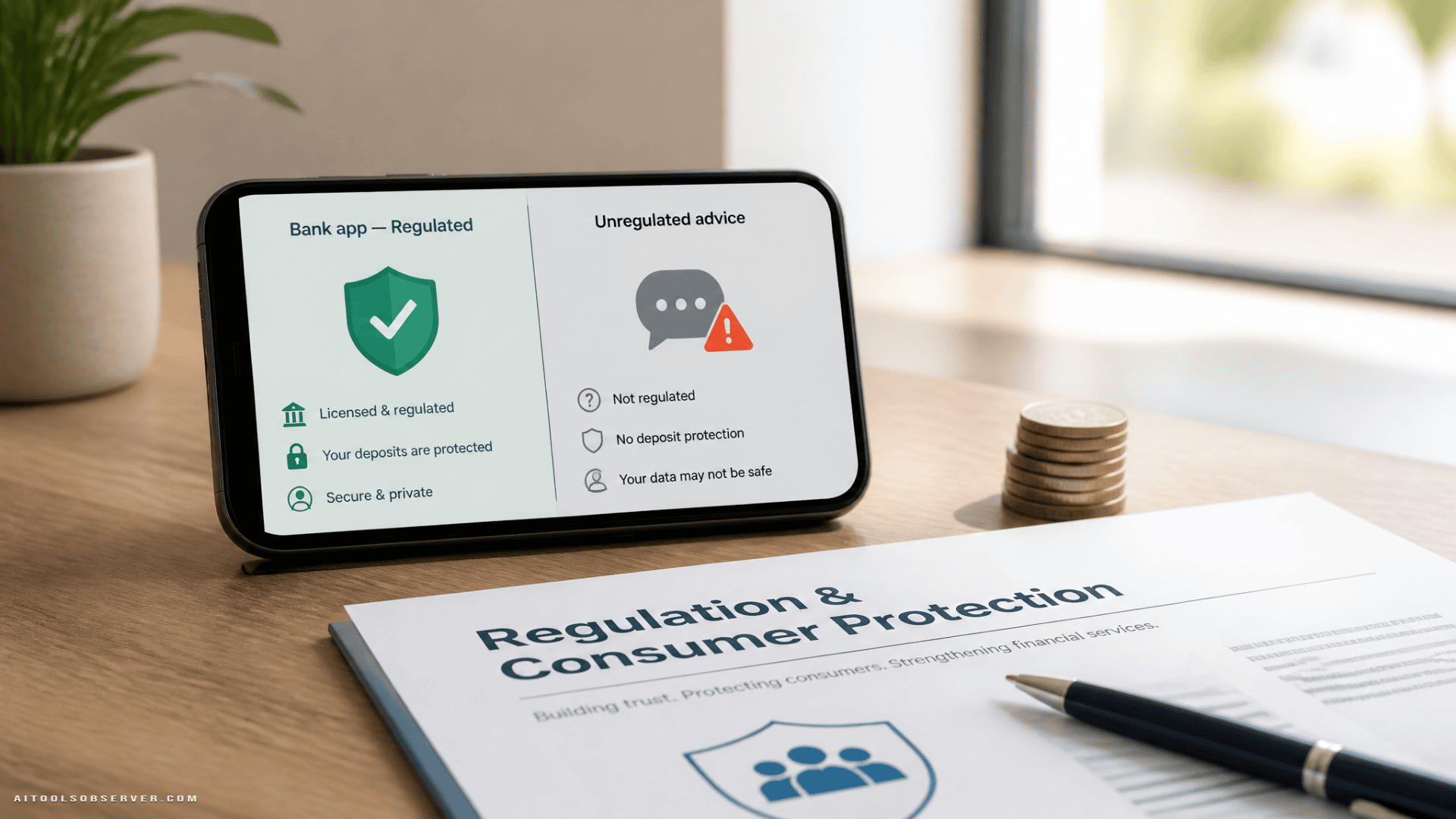
When a bank deploys an AI feature inside its own app, that tool operates within an existing regulated relationship. It has been tested, approved, and scoped to what the provider is permitted to offer. The protections you expect from your bank — complaints procedures, compensation schemes, conduct rules — still apply.
A general-purpose chatbot like ChatGPT or Google’s Gemini carries none of that. It is not regulated by the FCA. If it gives you poor investment guidance and you act on it, you have no recourse through the Financial Services Compensation Scheme or the Financial Ombudsman Service.
These are not subtle differences. They are structural ones.
What the FCA Data Actually Shows
The FCA surveyed adults aged 18 to 40 who own investments or plan to buy them within the year. The headline figures are worth reading carefully:
- 56% of respondents trust AI tools — more than trust TV and radio (47%), the press (46%), or social media influencers (29%)
- 44% incorrectly believe AI-generated financial information is regulated by the FCA
- 38% think it is acceptable to make an investment decision based solely on AI-generated information
- Nearly a third mistakenly believe they would receive compensation if AI advice went wrong
- Three-quarters expect to rely on AI more for investing over the next year
The trust level is rising faster than the understanding of limitations. That gap is precisely what the FCA is flagging.
Younger respondents showed somewhat more awareness: 73% acknowledged that AI-generated information can be inaccurate, and 86% said they understand the need to verify sources. That is encouraging, but it does not close the protection gap.
The Starling Case: What Regulated AI Looks Like in Practice
Starling’s “smart tools” launch offers a useful reference point for what AI inside a regulated banking app can look like when designed with actual users in mind.
Rather than asking customers to construct their own prompts, Starling offers preconfigured ones. One example — internally called “weekend damage” — lets users ask what they overspent over the weekend, then generates a revised budget plan for the rest of the month. Other tools include automatic VAT sweeps for business accounts, spending quizzes that test users’ self-perception against their actual transaction data, and student budgeting guidance.
What is notable is who is using it. Bernadette Smith, Starling’s chief banking officer, noted that the heaviest adopters turned out not to be tech-savvy customers but newer or less AI-familiar users who found value in being guided rather than having to navigate the app themselves.
That is a meaningful data point. Accessibility and simplicity appear to drive adoption more than technical curiosity.
Where the Protection Gap Lives
The FCA’s position is precise: AI-generated financial information from general-purpose tools is not regulated. Specific tools built to provide regulated financial advice are more likely to fall within the FCA’s scope — but that distinction is not obvious to most users, and the research confirms many are not making it.
The Financial Ombudsman Service has stated clearly that consumers using unregulated AI-generated financial advice cannot bring complaints to its service. There is no safety net.
This matters most in three scenarios:
- Acting on AI-generated investment recommendations without understanding the tool has no regulatory accountability
- Assuming compensation exists if the advice proves harmful
- Treating AI research as equivalent to regulated financial advice, when it is not
Safer Use Cases: What AI Can Legitimately Help With
The FCA’s own guidance, and commentary from investment professionals, points toward a clearer boundary.
AI is well-suited to:
- Explaining financial jargon and translating complex product terms
- Summarising company results or sector news at speed
- Exploring options before a decision, as a research starting point
- Budgeting and spending analysis within a regulated banking app
- Structuring a research tool process, as a tool that assists human judgment rather than replaces it
AI is not suited to:
- Making the actual investment decision
- Predicting how investments will perform
- Substituting for regulated financial advice when that advice is what the situation requires
James Priday of P1 Investment Services put it plainly: AI in investment management is constructive up to the point of research and building research tools. It stops before becoming the decision-maker.
The Practical Distinction for Users in 2026
If you are using an AI tool inside your bank’s app, you are operating within a regulated environment. The tool has been scoped, tested, and constrained to what the provider is permitted to offer. That is not a limitation to resent — it is a feature.
If you are using a general-purpose chatbot to research investments, you are using a research tool, not a financial adviser. The output can be useful. It can also be wrong, outdated, or confidently misleading. You carry the judgment call entirely yourself.
The FCA’s InvestSmart resource exists specifically to help consumers understand this distinction and make more informed decisions.
The Underlying Issue Is Literacy, Not Technology
The tools themselves are not the problem. The problem is a mismatch between how much users trust AI outputs and how well they understand what those outputs actually are — and what protections, if any, sit behind them.
Regulated banking AI and unregulated investment chatbots are not the same category of tool. Treating them as equivalent is the specific risk the FCA is trying to address.
For anyone using AI in personal finance right now, the most useful question is not “what does this tool say?” It is “what kind of tool is this, and what happens if it is wrong?”












Comments (0) No comments yet
Want to join this discussion? Login or Register.
No comments yet. Be the first to share your thoughts!