



From Point A to Point B—and Far Beyond
Fifteen years ago, a meaningful robotics autonomy goal was simply getting a robot to navigate between two fixed points. That framing has expanded dramatically. The International Standards Organization now defines robot autonomy as the “ability to perform intended tasks based on current state and sensing, without human intervention”—a definition that encompasses an enormous range of complexity.
The shift in ambition is not arbitrary. Advances in reinforcement learning during the 2010s, followed by large foundation models trained on massive datasets in the 2020s, have made it plausible to imagine robots that understand sequences of tasks, respond to language instructions, and adapt to novel situations. These are qualitatively different capabilities from what earlier generations of industrial robots could offer.
Industrial robots have long performed specific, repetitive motions reliably within controlled factory environments. The next level—performing tasks reliably in unstructured, open-world environments—is where current research is pushing, and where the real difficulty lies.
How Reinforcement Learning and Foundation Models Work Together
Reinforcement learning trains robots through trial-and-error interaction, either with the physical world or within simulations. It is well-suited to developing precise motor skills and task-specific competence. But it requires enormous amounts of experience to generalize, and a robot trained under very specific conditions may falter when those conditions change even slightly.
Foundation models—large pre-trained models built on visual, language, or multimodal data—address a different problem. They provide prior world knowledge that helps robots interpret context, follow instructions, and avoid unnecessary errors. The combination is complementary: foundation models supply the common sense; reinforcement learning builds the physical competence.
As one researcher framed it, reinforcement learning is like perfecting a tennis swing through repetition—but you first need basic common sense to know what you are trying to do. Neither technique alone is sufficient.
The Data Problem Is Not Solved
The most significant constraint on progress is data. Training large language models benefited from the vast, pre-existing corpus of human-generated text on the internet. No equivalent dataset exists for physical robot interaction, and it cannot simply be scraped.
Collecting useful robotics training data is expensive and slow. The most direct method involves humans teleoperating robots to demonstrate specific tasks—physically guiding the robot’s motions through a rig or interface. This produces high-quality data but at significant cost and time.
Simulation offers a cheaper alternative: robots can be trained in physics-based virtual environments without the overhead of real-world experiments. The limitation is fidelity. Simulations struggle to capture the full complexity and unpredictability of physical environments, which can cause trained behaviors to fail when transferred to the real world.
A third approach involves world models—AI systems trained to predict the physical consequences of actions. Some implementations use first-person video footage, collected by workers wearing head-mounted cameras during everyday tasks, to teach robots how physical environments behave. This is cheaper than robot-based experiments but computationally intensive and still imperfect at replicating real-world physics.
The result is a recognized gap: current methods can produce robots that are either highly reliable at one narrow task or moderately capable across many tasks—but not yet highly reliable across a broad range of tasks. Closing that gap is the central research challenge.
What Deployment Actually Looks Like Today
Boston Dynamics‘ four-legged Spot robot has been conducting autonomous facility inspections in environments hazardous to humans—electricity converter stations and highway culvert pipes among them. The robot navigates independently, captures sensor data, and reports findings without requiring a roboticist on-site. When Spot encountered slippery floors in customer facilities, the company used reinforcement learning to retrain its gait, enabling the robot to recognize low-traction surfaces and adjust its movement accordingly.
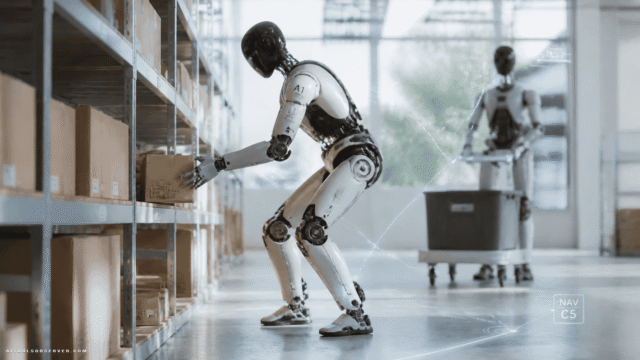
Boston Dynamics’ wheeled Stretch robot handles large packages in logistics warehouses, adapting over time to different package types, truck loading configurations, and facility layouts through ongoing real-world interaction. The company is also ramping up production of its all-electric Atlas humanoid robot, with a stated goal of deploying trained units in automotive manufacturing by 2028.
Agility Robotics took a different path to commercialization, deploying its Digit humanoid robots in a logistics warehouse environment starting in 2024—the first long-term commercial contract for humanoid robots. Digit units currently handle totes and bins, working in isolated work cells separated from human workers. The company has since expanded to automotive production lines and additional logistics facilities, accumulating substantial operational hours across deployments.
The progression Agility envisions is deliberate: from totes and bins, to picking individual items, to handling varied cardboard boxes, to eventually operating in less structured environments like retail back rooms. Humanoid robots entering homes is described as a destination many decades away—not a near-term product roadmap.
Safety Is the Actual Bottleneck
The physical danger posed by robots in human environments is not theoretical. The history of industrial robotics includes fatal incidents, and those lessons have shaped how current companies approach deployment.
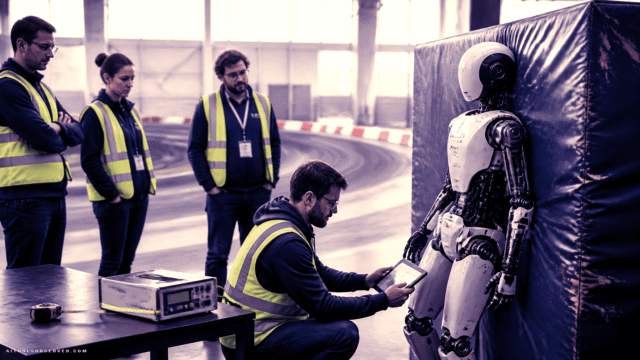
The reason commercial humanoid robot deployments remain relatively small in scale is not primarily technical capability—it is safety certification. Deploying robots that work in close proximity to humans requires demonstrating that the robot will not injure them, under any foreseeable condition.
Agility’s current Digit robots operate in isolated work cells precisely because cooperative safety with humans has not yet been fully validated. The company’s next robot generation is being positioned as the first AI-enabled humanoid robot certified for cooperative operation—capable of detecting nearby humans, stopping movement, and lowering itself to the ground before contact is possible.
Both Agility and Boston Dynamics are participating in the development of ISO 25785-1, a draft international safety standard for industrial mobile robots currently under review by an ISO technical committee. Once approved by the committee, the standard will go to a vote among ISO member nations. This standard matters because it creates a shared, verifiable benchmark for what “safe” means in practice—something the industry needs before broader deployment can proceed.
Surgical robotics illustrates a different safety calculus. Robots operating inside the human body have extremely limited autonomy by design. They function as precision instruments under continuous human surgeon control, with AI providing assistance rather than independent decision-making. The stakes of an autonomous error in that context are simply too high to accept at current reliability levels.
The Structural Limit: Reliability Across Conditions
The honest assessment from researchers and founders working in this space is consistent: current AI-driven robots can achieve high reliability on specific tasks under specific conditions, or moderate reliability across many tasks—but not both simultaneously.
That gap matters enormously for practical deployment. Industrial and warehouse environments tolerate some level of task specialization. Homes and unstructured public environments do not. A robot that handles totes reliably in a warehouse may still fail unpredictably when handed an unfamiliar object, asked to navigate a cluttered room, or confronted with an unexpected human behavior.
Progress will not arrive as a sudden capability jump. The data required for embodied AI is fundamentally different from text data—it must be collected through physical interaction, which is slow and expensive. Gradual improvement across deployment environments, from factories to warehouses to retail back rooms to outdoor delivery, is the realistic trajectory.
What This Means for the Tools Ecosystem
For founders, operators, and AI adopters watching this space, the practical implication is clear: the robotics stack is not yet commoditized, and the AI layer is still being built.
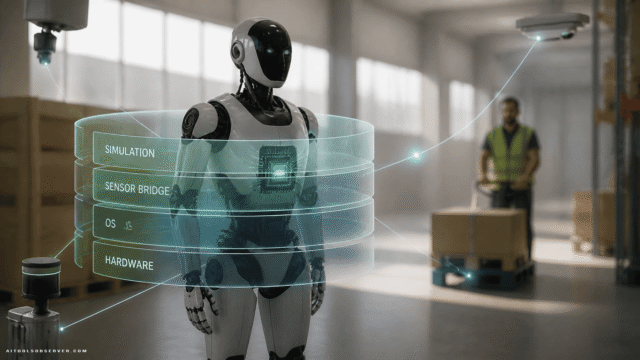
Foundation models for robotics—general AI systems that can power multiple robot types across varied tasks—are an active area of development, not a solved problem. Reinforcement learning pipelines, simulation infrastructure, teleoperation data collection, and world model training are all components of a stack that is maturing but incomplete.
The companies that will define general-purpose robotics are not necessarily those building the most impressive hardware demonstrations today. They are the ones solving the data problem, establishing safety certification pathways, and accumulating real-world operational hours that no simulation can replicate.
The road to general-purpose robotics runs through unglamorous work: warehouse totes, slippery floors, and ISO committee votes. That is precisely where the meaningful progress is happening.






Comments (0) No comments yet
Want to join this discussion? Login or Register.
No comments yet. Be the first to share your thoughts!