


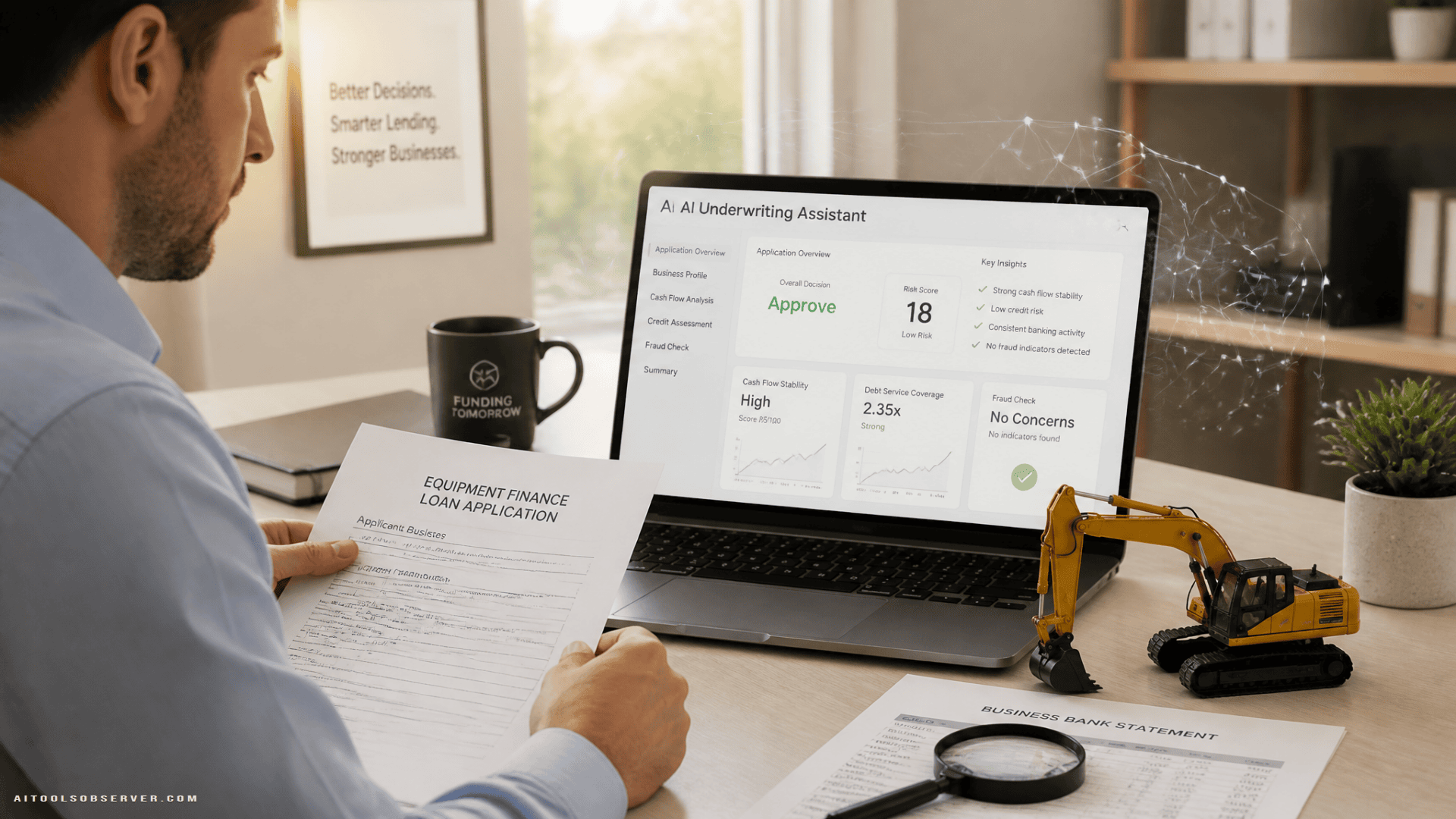
The Core Problem: Too Much Data, Too Little Speed
Independent equipment lenders deal with a specific operational challenge. They’re processing credit reports, bank statements, asset valuations, and borrower histories — often manually — while competing against larger institutions with deeper technology budgets.
Quality Equipment Finance’s Managing Director Paul Fogle put it plainly: the lender has “thousands and thousands of data points” to evaluate across its portfolio. The question wasn’t whether AI could help. It was where to start.
Front-End Data Ingestion via LLMs
One of the more practical applications Quality has deployed is using large language models to automatically populate incoming deal data into Salesforce. This removes a layer of manual data entry from the underwriting workflow and accelerates how quickly a deal moves from submission to review.
It’s a straightforward use case, but it compounds quickly when you’re processing high volumes of applications.
Credit Report and Bank Statement Analysis
Fogle described building a system that uses AI to “tear apart credit reports and really segment what’s there,” as well as automatically sifting through bank statements. These are traditionally time-intensive tasks that require an analyst to manually flag patterns, inconsistencies, or risk signals.
Automating this layer doesn’t replace underwriting judgment — it clears the path so underwriters can focus on decisions rather than data extraction.
Credit Adjudication and Faster Funding Decisions
For credit decisioning, Quality uses AI to help digest borrower information and return faster, more accurate funding decisions. Speed matters in equipment finance. Borrowers often need quick answers, and lenders that move faster without sacrificing accuracy have a real competitive edge.
Fraud Detection Without the Manual Grind
Fraud prevention is another area where AI is delivering measurable time savings. Quality uses AI tools to catch suspicious activity that would otherwise require hours of manual risk analysis. This is one of the cleaner AI ROI stories in financial services — the cost of a missed fraud event is high, and the cost of analyst time is real.
For more context on related tools, see Fraud Detection & Risk Analysis.
Sales Intelligence: Comps Data on Demand
AI is also being used to pull comparable asset data — mileage, hours, retail prices, auction values — that previously required more manual research. Fogle noted that what used to take digging now takes a prompt. That’s a small change in workflow that adds up across a sales team.
The Tools Behind the Workflow
Quality Equipment Finance works with third-party AI vendors for these capabilities. Based on available context, their stack includes Kaaj.ai, an underwriting platform, and Tamarack Technology, a data solutions provider. Both are positioned specifically for the equipment finance and leasing space, which matters — vertical-specific tools tend to outperform general-purpose alternatives when the data structures and workflows are industry-specific.
A related example of an underwriting platform in lending automation shows how specialized tooling is being applied in adjacent workflows.
What This Signals for the Broader Industry
Quality’s results aren’t happening in isolation. North Mill Equipment Finance has similarly focused on AI for credit decisioning, documentation, pricing, and fraud detection. The Equipment Leasing and Finance Association has noted that AI is “leveling the playing field” for independent lenders — giving smaller shops access to capabilities that were previously cost-prohibitive.
The global AI in lending market is projected to grow significantly through 2030, and equipment finance appears to be entering a more active adoption phase. Compliance, asset management, and information retrieval are also emerging use cases beyond the underwriting core.
For broader industry context, see AI in Financial Services 2026: ROI and Governance and AI Underwriting: Adoption Rises, Confidence Trails.
Tradeoffs and Limitations Worth Noting
A 30% efficiency gain is a meaningful headline, but context matters:
- Vendor dependency is real. Relying on third-party AI platforms means Quality’s capabilities are tied to those vendors’ roadmaps and reliability.
- Data quality drives AI quality. The value of AI-driven portfolio analysis depends entirely on how clean and structured the underlying data is.
- Human judgment still anchors decisions. AI is accelerating and informing the process — it’s not replacing credit officers. That distinction matters for how lenders communicate these tools to borrowers and regulators.
The Practical Takeaway
If you’re evaluating AI tools for a lending or financial services workflow, Quality Equipment Finance’s approach offers a useful framework: start with the highest-friction, data-heavy tasks first — document ingestion, statement analysis, fraud flagging — and build from there.
The efficiency gains compound when AI handles the extraction and pattern recognition, freeing your team to focus on judgment calls that actually require human expertise. That’s not a transformation story. It’s an operational upgrade — and in a competitive lending environment, that’s often enough to matter.











Comments (0) No comments yet
Want to join this discussion? Login or Register.
No comments yet. Be the first to share your thoughts!