



What changed
calQrisk has secured a place in the UK Financial Conduct Authority’s Supercharged Sandbox, a programme designed to help develop AI tools for financial services within a supervised regulatory setting.
Participants in the sandbox gain access to regulatory expertise, technical resources, and synthetic financial datasets. That creates a controlled environment for testing how AI systems behave before they are used in more sensitive regulated workflows.
For a company focused on governance and oversight, that setting is important. It allows product development to happen closer to real compliance expectations rather than in a generic AI testing environment.
What calQrisk is building
Based on the available description, calQrisk is developing AI oversight tools designed for regulated organisations where explainability, transparency, governance, and auditability are baseline requirements.
Its positioning is different from broad AI assistants that focus mainly on productivity. The emphasis here is on helping compliance and governance teams:
- surface relevant insights from fragmented internal information
- strengthen oversight across regulated processes
- improve the quality of regulatory evidence
- support more continuous, real-time assurance
- keep organisations in control of their own data
That last point is not minor. In regulated finance, the question is often not whether AI can analyse information, but whether it can do so in a way that preserves data governance, evidential standards, and decision accountability.
Why the FCA sandbox matters
The FCA’s Supercharged Sandbox gives firms a practical route to test AI in conditions that are closer to regulatory reality. Synthetic financial data is especially useful here. It allows model and workflow testing without exposing live sensitive customer or market information.
That makes the sandbox valuable for a class of tools that needs to prove more than output quality. It needs to prove operational discipline.
For AI oversight products, a supervised environment can help teams evaluate questions such as:
- Can the system explain why it flagged an issue?
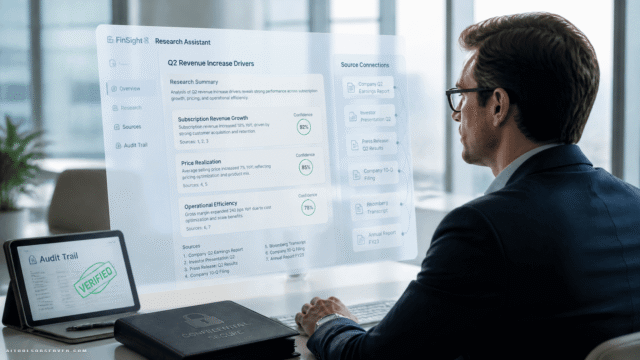
- Can users trace outputs back to source evidence?
- Can governance teams audit changes and decisions?
- Can the tool support compliance workflows without obscuring accountability?
- Can assurance be made more continuous without creating new control risks?
These are not edge concerns in financial services. They are central adoption blockers.
Why this is relevant beyond one company
calQrisk says it supports almost 300 organisations globally across enterprise risk management, operational resilience, compliance, audit, third-party risk management, and governance in financial services and other heavily regulated sectors.
That broader footprint matters because many firms face the same structural issue: governance information exists, but it is fragmented. AI becomes more useful when it helps connect that information in a controlled and reviewable way, rather than simply generating summaries on top of disconnected systems.
In other words, the opportunity in regulated AI may be less about replacing governance work and more about making existing governance evidence usable at decision speed.
The practical signal for AI buyers in finance
This update is a useful reminder that not all AI tooling for finance should be evaluated on the same criteria.
If you are assessing AI for regulated use cases, the key questions are less about novelty and more about operating discipline:
- Is the system built for explainability, not just output?
- Does it preserve an audit trail?
- Can it work with internal trusted data under clear controls?
- Does it improve regulatory evidence, not just reporting efficiency?
- Can compliance, audit, and risk teams actually defend its outputs?
For buyers, that is the more durable lens. A tool may look impressive in demos, but if it cannot support governance, evidence, and oversight requirements, it is unlikely to survive real deployment in regulated finance.
A more specific direction for regtech AI
There is a visible shift in the regtech layer of AI adoption. The market is moving from generic copilots toward systems that can support accountable decision-making in tightly controlled environments.
calQrisk’s sandbox participation fits that direction. The focus is not on open-ended automation. It is on building AI capabilities that help regulated organisations connect their own governance data and turn it into usable assurance through secure, governed, and auditable processes.
That is a narrower claim than many AI announcements, but also a more practical one.
What to watch next
The real test will be whether tools developed in this kind of sandbox can show measurable value in day-to-day oversight work without weakening control frameworks.
For teams in financial services, the useful takeaway is simple: when evaluating AI for compliance and governance, prioritise systems that can show their reasoning, preserve evidence, and work inside regulated operating constraints. In this category, trustworthy process design matters as much as model capability.







Comments (0) No comments yet
Want to join this discussion? Login or Register.
No comments yet. Be the first to share your thoughts!