


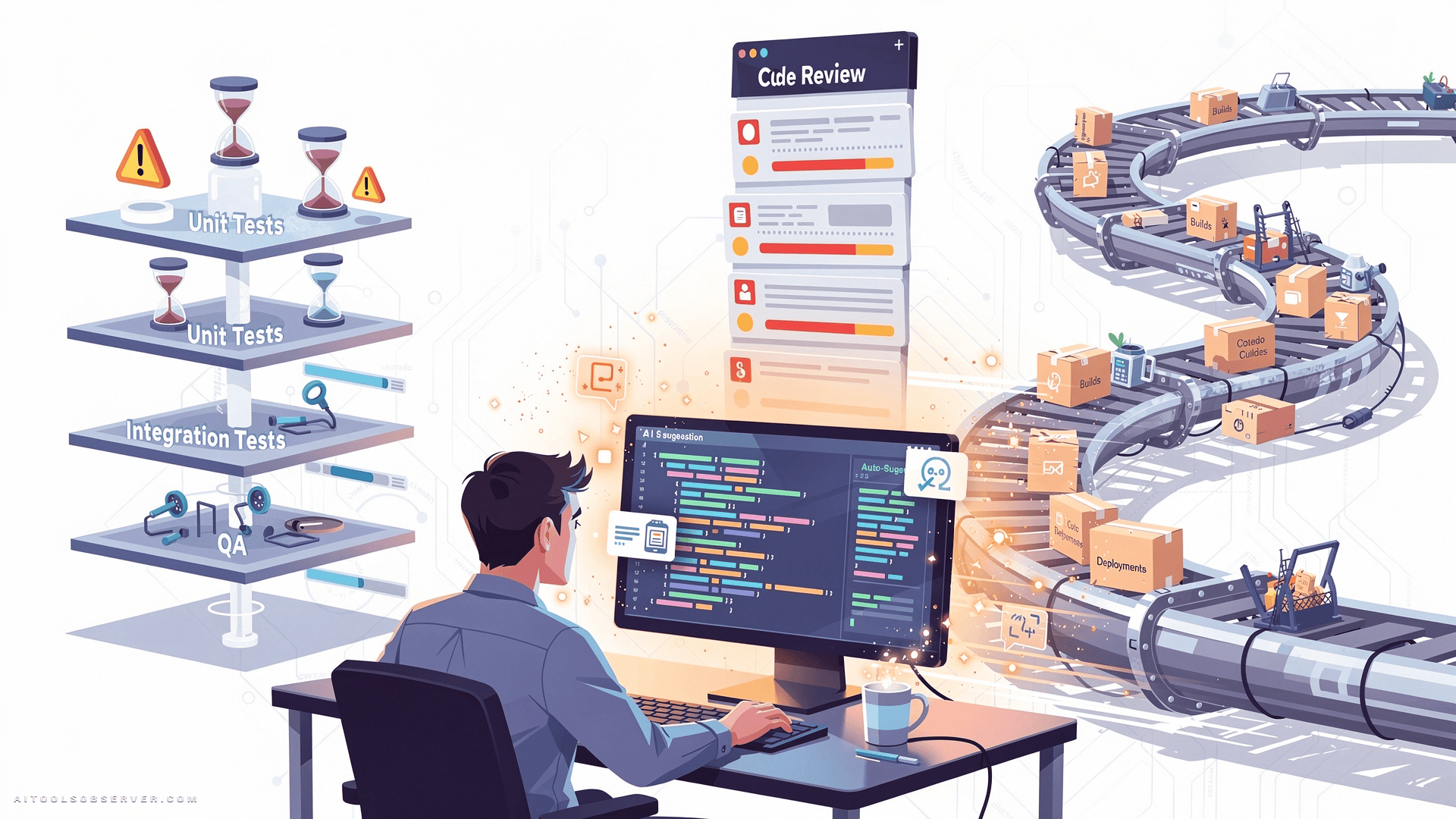
The Core Finding: A Productivity Paradox
GitLab surveyed developers across the industry and found that 78% report writing code faster thanks to AI tools. Another 73% say overall code quality has improved. On the surface, those numbers look like a win.
But here’s where it gets complicated.
79% of respondents say the overall software delivery process has not accelerated at the same pace as coding. AI sped up one stage of the pipeline while quietly exposing every inefficiency downstream.
This isn’t a minor gap. It’s a structural imbalance baked into how most engineering organizations operate.
Where the Bottleneck Actually Lives Now

The shift is measurable. According to GitLab’s data, 85% of respondents agree that AI has moved the bottleneck from writing code to reviewing and validating it.
Think about what that means in practice. Developers are generating more code, faster. But review cycles, testing pipelines, and validation workflows haven’t scaled to match. The queue just got longer.
This mirrors what developers have been saying in the wild for months. In a widely-cited Reddit thread, one engineer described AI as accelerating “speed at the text editor/terminal layer” while leaving them stuck “wading through the quicksand of agile/Jira and middle management bloat.” Another noted that despite impressive coding gains, their team wasn’t shipping more story points sprint after sprint — because the mechanics of writing code represent only a fraction of the actual job.
The data backs this up. Testing, in particular, keeps surfacing as the primary constraint. As one developer put it bluntly:
producing code faster only exacerbates the problems of most development teams.
The Governance Gap Nobody Planned For

Speed isn’t the only problem. There’s a deeper issue emerging around accountability and traceability — and it’s one that most organizations weren’t prepared for.
Manav Khurana, Chief Product and Marketing Officer at GitLab, points to supply chain attacks, reliability incidents, and growing regulatory pressure as evidence that knowing what shipped and where it came from is now a critical organizational requirement. AI-generated code complicates that picture significantly.
Three factors are making traceability harder:
- 43% cite difficulty distinguishing AI-generated code from human-written code
- 40% point to fragmented toolchains
- 39% flag systems that don’t track code origin at all
The result is a confidence gap that should concern any engineering leader. 87% of respondents believe their team could determine within 24 hours whether AI-generated code contributed to a production incident. But when GitLab looked at organizations that actually experienced an incident in the past year, only 34% could make that determination.
That’s not a small discrepancy. That’s a systemic blind spot.
Why Governance Is Now a Technical Priority
The industry is starting to treat governance not as a compliance checkbox but as a core engineering concern. GitLab’s report reflects this shift clearly.
85% of respondents say stronger governance is the solution — specifically, establishing clear policies around the provenance and accountability of AI-generated code. Without those guardrails, 83% of organizations view accumulating AI-generated code as a risk, and 44% rank it among their top technological concerns.
This isn’t abstract risk management. It’s about knowing what’s running in production, who approved it, and whether it can be audited when something goes wrong.
What This Means for DevOps Teams Right Now
GitLab’s findings reframe the conversation around AI in software development. The question was never just “can AI make developers faster?” The real question is: can your delivery pipeline, review process, and governance infrastructure absorb that speed?
For most organizations, the honest answer is no — not yet.
The teams getting the most value from AI coding tools aren’t just adopting them at the individual contributor level. They’re rethinking the entire pipeline: investing in automated testing, streamlining review workflows, and building traceability into their toolchains from the start.
Toolchain fragmentation is a particularly urgent problem. When code moves through disconnected systems with no shared audit trail, accountability becomes nearly impossible to enforce — especially when AI is generating a growing percentage of what ships through software delivery.
The Takeaway
AI has made writing code faster. That part is real and measurable. But GitLab’s 2026 report makes clear that faster code generation without corresponding investment in testing, review, and governance doesn’t accelerate delivery — it just relocates the friction.
The organizations that will actually benefit from AI in software development are the ones treating it as a systems problem, not a developer productivity hack. Speed at the keyboard is table stakes. What matters now is whether your entire delivery pipeline can keep up — and whether you can prove, when it matters most, exactly what shipped and why.









Comments (0) No comments yet
Want to join this discussion? Login or Register.
No comments yet. Be the first to share your thoughts!