


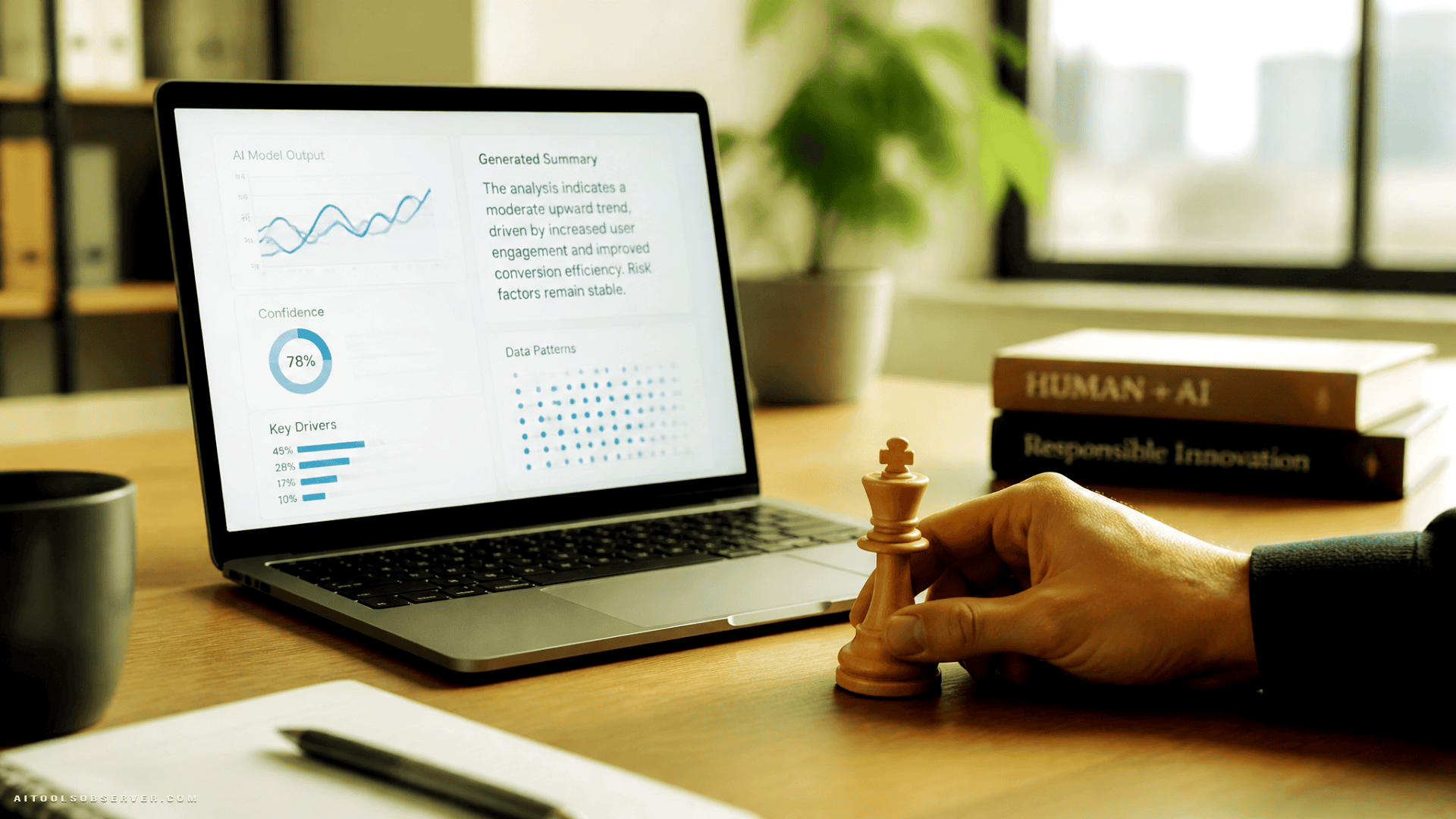
AI Is a Tool, Not a Thinker
Artificial intelligence is a branch of computer science that uses large amounts of data and processing power to perform tasks that would take humans far longer to complete.
That’s it. There’s no understanding happening. No judgment. No awareness. AI systems are, at their core, sophisticated pattern-detection and prediction machines.
The distinction matters because it shapes how you use AI responsibly. A tool that processes data quickly is useful. A tool you mistake for a decision-maker is a liability.
Two Types of AI Worth Knowing
Not all AI works the same way. For workplace purposes, the most useful distinction is between limited memory AI and generative AI.
Limited Memory AI
Limited memory AI temporarily stores information to predict what to do next — then discards it. It doesn’t learn from past interactions or build on previous experiences.
A self-driving car is a clear example. It scans current conditions, checks its destination, and decides whether to go, stop, or turn. Drive through the same intersection a hundred times and it still treats it as new. No recognition, no memory of what worked last time.
In the workplace, limited memory AI shows up in tools like resume screening software that searches for specific skills, or performance management systems that offer real-time feedback based on current employee actions. These tools process what’s in front of them and move on.
Generative AI
Generative AI — including large language models (LLMs) — retains vast amounts of data and can be designed for a wide range of tasks. Some systems also integrate new information into their functioning over time.
Practical workplace examples include:
- Tools that draft job descriptions and postings
- Chatbots that answer employee questions about HR policies
- Data analysis systems that monitor patterns and flag changes in real time
Generative AI can also follow multi-step processes, account for variables, scan its own outputs, and in some cases identify and correct errors. That’s genuinely useful — but it still doesn’t understand what it’s doing.
AI Has Been in Your Workplace Longer Than You Think
Before “AI” became a buzzword, it was already embedded in everyday tools. Autocorrect is one of the earliest examples most people encounter. It scans language patterns, predicts the next likely word, and over time can recognize phrases you use regularly.
But you probably wouldn’t let autocorrect write an important email on your behalf. That instinct is correct — and it applies to more powerful AI tools too.
What AI Is Actually Good At
When AI is applied to the right problems, it delivers real value. Here’s where it performs well.
Data Processing and Organizing
AI can process billions of data points in minutes. Categorizing documents, summarizing years of work by topic, organizing information at scale — these are tasks AI handles faster and more consistently than any human team.
Think of it this way: anything you can do with logic, math, and structured data processing, AI can do faster. That’s a significant capability.
Pattern Recognition and Prediction
AI excels at finding patterns in large datasets and using those patterns to make predictions. This is how AI-generated text works — it predicts the next word, then the next, over and over at speed.
In a workplace context, this translates to identifying trends in employee data, predicting outcomes based on historical behavior, and flagging anomalies before they become problems.
Insights and Analytics
AI can collect, synthesize, and report on anything that can be quantified or measured. It can keep data current, detect changes as they happen, and send alerts when something significant shifts.
Monitoring and Anomaly Detection
When a system knows what “normal” looks like, it can flag what isn’t. AI can be designed to recognize deviations from expected patterns and either alert a human or walk through a correction process automatically.
Adaptation Over Time
Unlike humans, AI doesn’t find continuous change stressful. Systems that integrate new data can update their outputs in near real time, identify emerging patterns, and adjust predictions accordingly.
What AI Cannot Do
This is the part that gets glossed over in most AI coverage — and it’s the part that matters most for responsible use.
If something isn’t based on math, logic, or measurable data, AI can’t do it. More specifically:
- AI cannot draw on context outside its training data
- AI cannot make creative associations the way humans do
- AI does not understand what it produces
- AI cannot apply wisdom, common sense, or emotional intelligence
- AI cannot decide what matters or why
Only humans can take information and apply judgment, fairness, and compassion. Only humans can weigh competing values and make decisions that account for context AI will never have access to.
Accountability Stays With Humans
This is non-negotiable: when AI is involved in a workplace decision, the organization still owns the outcome.
That’s especially true in HR, where decisions affect people’s careers and livelihoods. Using AI to screen candidates, evaluate performance, or inform compensation decisions doesn’t transfer responsibility — it concentrates it. If the AI produces a biased or unfair result, the organization is accountability.
Responsible AI use in the workplace means:
- Assigning clear ownership for every AI-assisted decision
- Aligning AI policies across teams before problems arise
- Keeping employees informed about what AI is doing and why
- Going beyond bias audits to build genuine accountability structures
The Practical Takeaway
AI is a capable, fast, and genuinely useful tool for processing data, recognizing patterns, and handling structured tasks at scale. It is not a replacement for human judgment, and it was never designed to be.
The organizations that use AI well are the ones that understand exactly what it can and can’t do — and build their processes accordingly. Start there, and the tool becomes an asset. Skip that step, and you’re handing a powerful instrument to someone who doesn’t know how it works.










Comments (0) No comments yet
Want to join this discussion? Login or Register.
No comments yet. Be the first to share your thoughts!