


The Problem With Traditional Mosquito Surveillance
Catching mosquitoes is the easy part. Knowing which mosquitoes you’ve caught is where things slow down.
Traditional surveillance requires specialists to examine insects under a microscope — a process that can take two to three days. During an active outbreak, that lag matters. By the time results come back, the window for early intervention may already be closing.
Speed isn’t the only issue. Scale is too. Mosquito control teams cover large geographic areas with limited resources. Without fast, reliable data on where dangerous species are appearing, it’s hard to know where to focus.
What Digitomy’s Trap Actually Does
Developed by researchers at the University of South Florida, the Digitomy AI mosquito trap is designed to close that gap.
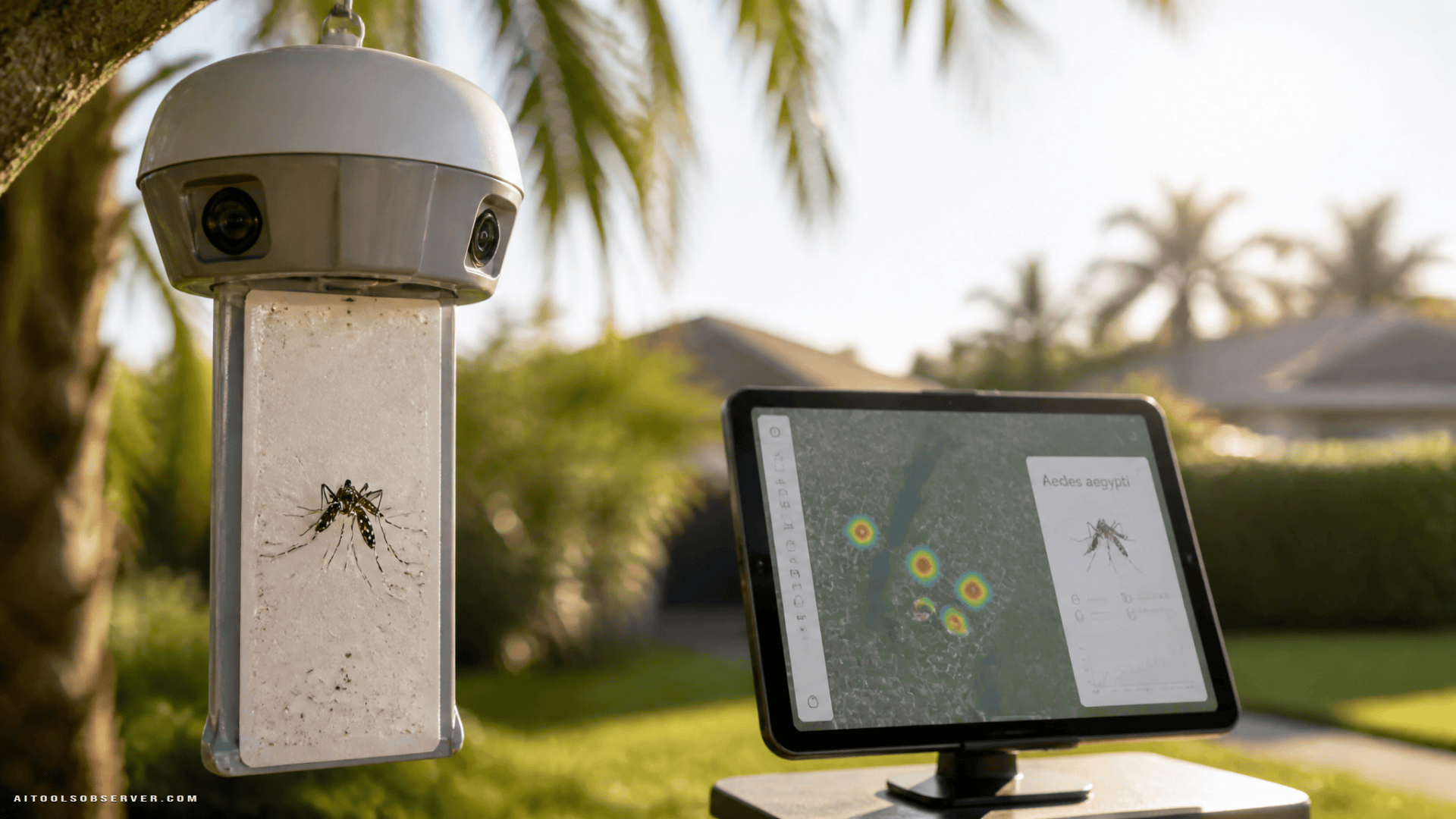
The setup is straightforward: the trap hangs from a branch or sits on the ground, attracts mosquitoes with light or bait, and pulls them in with a small fan. Once they land on a sticky pad, two built-in cameras photograph them. An AI system then compares those images against a species database and returns an identification — reportedly with over 98% accuracy in laboratory testing.
It goes beyond just species ID. The system can also determine whether a captured mosquito is male or female, and whether it has recently fed on blood. That’s operationally useful, since only female mosquitoes bite and transmit disease.
One important caveat: identifying a mosquito species capable of carrying dengue is not the same as confirming infection. Lab testing would still be needed to verify the presence of the virus.
From Trap to Dashboard
The more interesting layer is what happens after identification.
Digitomy feeds trap data into a mapping dashboard, giving mosquito control teams a near-real-time view of where specific species are appearing. The researchers have already integrated this into a Global Mosquito Observations Dashboard that also incorporates citizen science reports.
The goal is to combine automated trap data with community observations — creating something closer to an early warning system than a simple counting tool.
If multiple traps in one neighborhood start detecting elevated Aedes aegypti activity (the species primarily responsible for spreading dengue), teams could investigate and respond before case counts climb. That’s the theory, anyway. Real-world performance across varied conditions is still being validated.
Where It Stands Right Now
Digitomy has already run tests at USF and worked with a mosquito control district in St. Johns County. Field validation with Hillsborough County — the epicenter of Florida’s current outbreak — is in progress.
The startup is pursuing a licensing model, working with established mosquito trap manufacturers to integrate the AI identification system into existing equipment. No consumer product or retail price has been announced.
The team is also building an online education platform for mosquito control professionals, using AI-generated feedback to help practitioners sharpen their species identification skills.
Why This Use Case Is Worth Watching
AI applied to public health surveillance is a genuinely useful category — not because it replaces expertise, but because it can extend it. Faster identification, better geographic data, and smarter resource allocation are exactly the kinds of incremental improvements that compound into real outcomes.
The 98% lab accuracy figure is promising. But lab conditions and field conditions are different animals. The real test is whether the system holds up across messy real-world deployments — different lighting, humidity, trap placement, and mosquito behavior.
If it does, mosquito control teams gain a tool that helps them act on information while it’s still actionable. That’s a meaningful shift from reacting to outbreaks to getting ahead of them.
For now, the most useful takeaway is this: AI doesn’t have to be dramatic to be valuable. Sometimes it just needs to tell you which mosquito you caught — and do it before the end of the day.








Comments (0) No comments yet
Want to join this discussion? Login or Register.
No comments yet. Be the first to share your thoughts!