


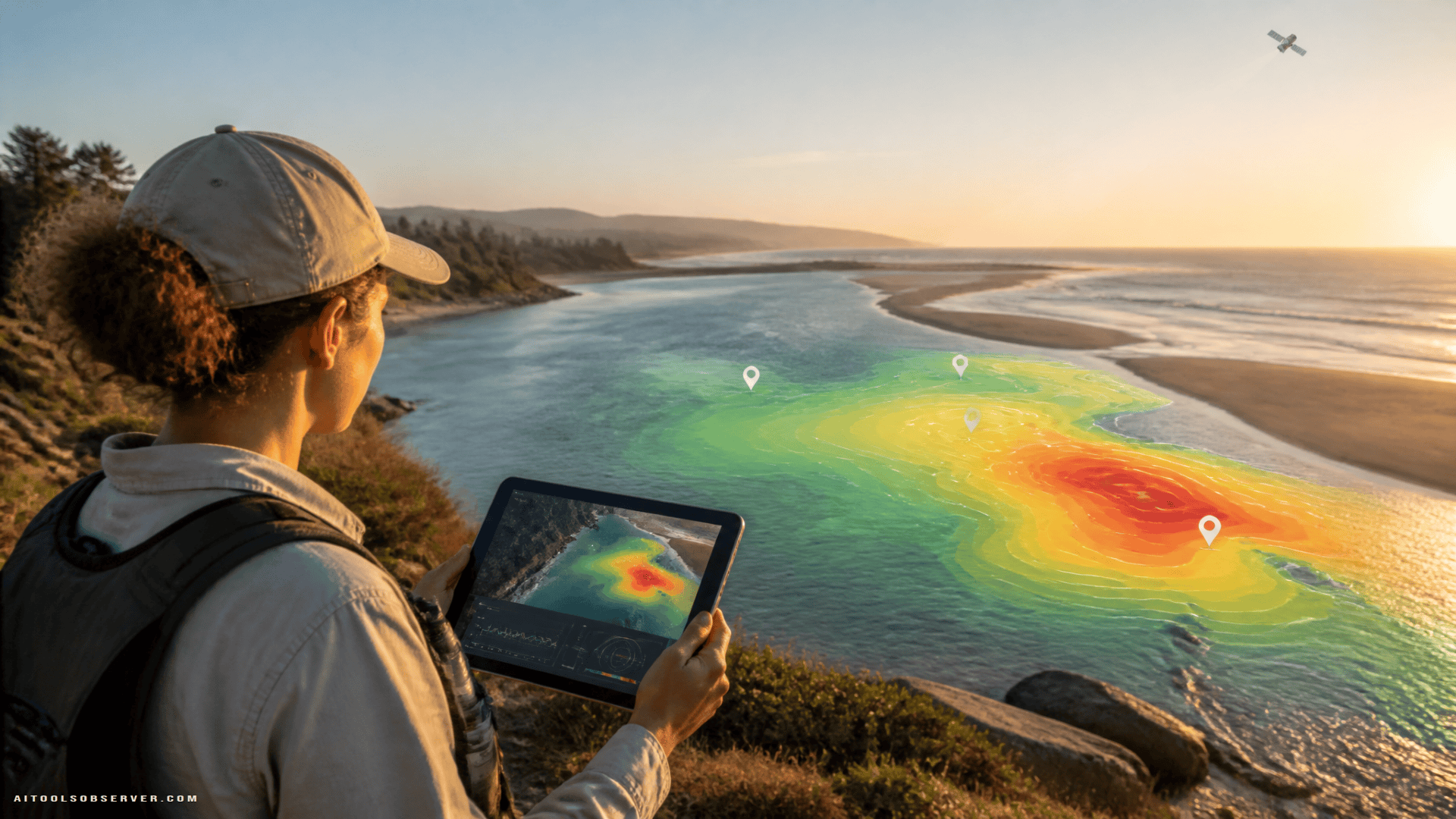
The use case: turning messy environmental signals into risk alerts
Vibrio vulnificus is a bacteria associated with warm, brackish water, especially where freshwater and saltwater meet. People can be exposed by ingesting contaminated water or food, such as raw oysters, or through an open wound.
That makes this a forecasting problem, not just a testing problem. By the time a person is already sick, the useful moment for prevention has passed.
The UF project appears designed to answer a simple question:
- Where are conditions becoming favorable for this bacteria?
- How risky might a specific coastal area be?
- Can that be predicted early enough for people and agencies to act?
If yes, the output is not “AI for AI’s sake.” It is a beach-risk decision tool.
Why AI fits this problem
No human is going to manually combine satellite observations, water temperature shifts, hydrology, climate patterns, and microbiological signals every day across a coastline. That is where predictive analytics earns its keep.
Researchers say they are using current NASA satellite sensors and environmental data to track conditions linked to bacterial hotspots. The goal is to identify high-risk areas three to four weeks in advance.
That lead time matters. A same-day warning is helpful. A multi-week forecast is operational.
It gives room for:
- clearer beach advisories
- better public health messaging
- more targeted monitoring
- smarter personal decisions for higher-risk groups
In short: not just “is the water bad now?” but “where might it become risky soon?”
What the workflow could look like
This is a useful AI workflow because it follows a pattern many industries can learn from: detect conditions, estimate risk, and turn that into action.
Inputs
The system is being built around environmental signals, including:
- satellite data
- weather and climate conditions
- water temperature
- hydrology
- microbiological indicators
Individually, these inputs are noisy. Together, they may reveal patterns that correlate with bacterial growth.
Model layer
The AI system would look for combinations of conditions that tend to precede Vibrio hotspots. Think less “magic diagnosis” and more “probability map with better timing.”
This is similar in spirit to weather forecasting. You are not predicting one exact event with perfect certainty. You are estimating where risk is rising.
Outputs
The most useful output is probably not a research dashboard. It is a plain-language coastal warning system people can actually use.
For example:
- risk maps for specific coastal zones
- beach alerts with time windows
- public health guidance for wound exposure or seafood-related risk
- decision support for local agencies
If the interface is clunky, the model loses value fast. A good forecast still needs a good handoff.
The real-world problem it solves
Public health warnings often struggle with timing and specificity. “Use caution” is technically fine and practically vague.
This kind of tool aims to make alerts more local and more actionable. Instead of broad seasonal concern, agencies could flag areas where conditions appear favorable for bacterial hotspots.
That changes the decision from abstract to immediate:
- Should I avoid entering the water with a fresh cut?
- Should a higher-risk person skip this location?
- Should officials post a stronger warning here, not everywhere?
That is a much better use of attention.
Why this matters beyond Florida
The headline is local. The pattern is not.
Environmental AI is increasingly useful when a health risk depends on changing natural conditions. That includes heat, air quality, algae blooms, mosquito patterns, and water contamination.
The UF project shows a broader category of AI use case: combining remote sensing with health-risk forecasting. For founders and operators, the interesting part is the workflow design:
- gather large-scale environmental data
- model changing conditions
- estimate location-specific risk
- deliver simple decisions to the public
Different domain, same playbook.
Tradeoffs and limits
This kind of system sounds neat until you remember nature enjoys being complicated.
A few practical constraints stand out:
- Forecasts are probabilistic, not guarantees.
- Satellite data can indicate favorable conditions, not directly explain every local exposure.
- Public alerts need to be accurate enough to build trust without causing alert fatigue.
- Testing and validation matter a lot before any system becomes broadly relied upon.
Researchers reportedly expect development first, then testing. That is the right order. In public health, “pretty good” still has to be pretty reliable.
What AI adopters can learn from this
You do not need to be building a disease forecast to borrow the lesson.
This is a strong example of applied AI because it starts with a clear operational decision: warn earlier, warn better. The model serves the decision, not the other way around.
If you are evaluating AI use cases in your own organization, this is the checklist worth stealing:
- Is there a recurring risk pattern hidden in large, messy data?
- Would earlier prediction change what people do?
- Can the output be turned into a simple action?
- Does the model improve timing, specificity, or resource allocation?
If the answer is yes, you may have a real use case instead of an expensive science fair project.
The smarter takeaway
The most useful AI tools often do something unglamorous: help people avoid preventable harm a little earlier. UF’s Vibrio forecasting effort fits that mold.
For anyone choosing AI projects, that is the bar to watch: not whether a model looks impressive, but whether it helps somebody make a better decision before the water gets dangerous.



Comments (0) No comments yet
Want to join this discussion? Login or Register.
No comments yet. Be the first to share your thoughts!