


The Problem He Was Solving
Deepfake detection sounds like a solved problem until you actually try to use it in the real world.
Most detection models are trained and tested under clean, controlled conditions. Real-world media doesn’t cooperate. It gets compressed, re-uploaded, cropped, and shared across platforms that quietly degrade quality at every step. It also increasingly comes from AI systems that weren’t around when the detection model was trained.
Anand’s work focused specifically on these gaps — compression artifacts, domain shift, and synthetic content from novel generation systems. That framing is more practically useful than chasing benchmark scores on clean datasets.
How DeepTrust Works
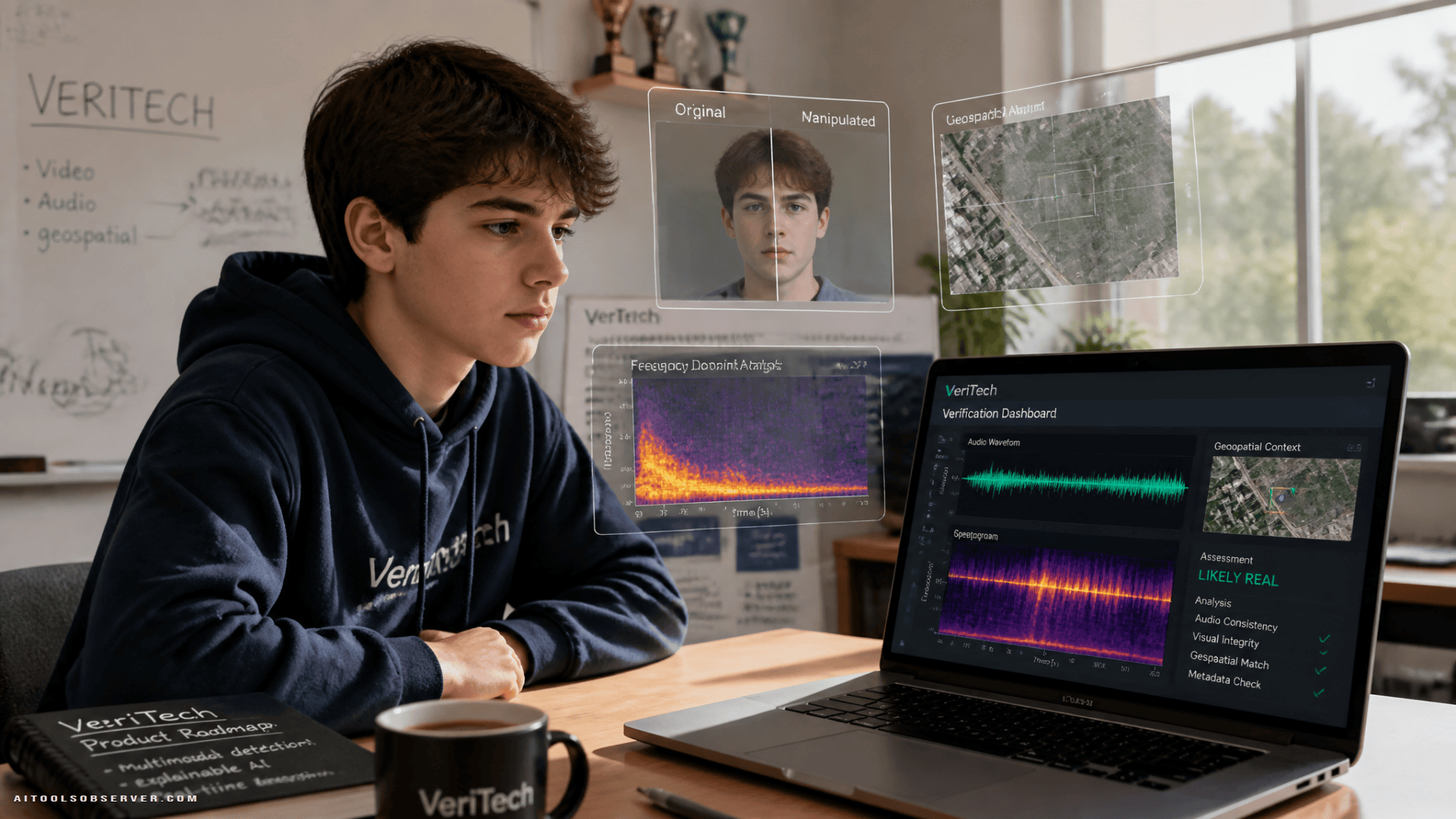
DeepTrust is described as a multimodal deepfake detection platform, meaning it doesn’t just look at video. The system is designed to analyse synthetic video, audio, images, and satellite media within a single framework.
The core detection architecture appears to use a quad-stream approach that examines visual content through both spatial and frequency-domain analysis. The description suggests this is patent-pending, which indicates the approach is considered meaningfully distinct from existing methods.
Why Satellite Imagery?
This is the part that catches most people off guard.
Anand extended his research into detecting synthetically generated satellite imagery — a less obvious but genuinely high-stakes application. When satellite images are used as evidence in journalism, legal proceedings, or geopolitical analysis, a convincing fake doesn’t just mislead one person. It can mislead institutions. His work in this area has been presented through IEEE-related venues.
Making It Usable Outside Cybersecurity Labs
Research papers don’t protect ordinary people. That gap appears to be a deliberate focus for DeepTrust.
Alongside the core platform, Anand developed AITruthCheck.app — an installation-free tool aimed at making media verification accessible to students, older users, and anyone who isn’t a security professional. The platform is also described as multilingual, which matters when deepfake disinformation crosses language boundaries.
School pilots are reportedly underway, which positions DeepTrust less as an enterprise security product and more as a public-facing verification layer.
From High School Project to Recognised Research
The timeline is worth noting:
- August 2024 — Anand founds DeepTrust at 16, still in high school
- 2025–2026 — Research expands into peer-reviewed work and international presentations
- 2026 — DeepTrust named a Top 100 global finalist in the Blue Ocean Entrepreneurship Competition and a Top 5 global finalist in the Conrad Challenge
That progression — from personal incident to research to patent-pending platform to educational deployment — is a more complete arc than most adult-founded AI startups manage in the same timeframe.
Why This Actually Matters
Deepfake detection is often framed as a technical arms race between generators and detectors. That framing isn’t wrong, but it misses the more immediate problem: most people have no accessible way to verify whether media is real before they share or act on it.
DeepTrust’s approach — multimodal, installation-free, multilingual, tested in schools — is aimed at closing that gap for everyday users rather than just adding another enterprise tool to a crowded security stack.
The origin story is striking, but the more useful observation is this: the people most motivated to solve a problem are often the ones who’ve already paid the cost of it existing.













Comments (0) No comments yet
Want to join this discussion? Login or Register.
No comments yet. Be the first to share your thoughts!