


Why AI Dubbing Is Having Its Moment

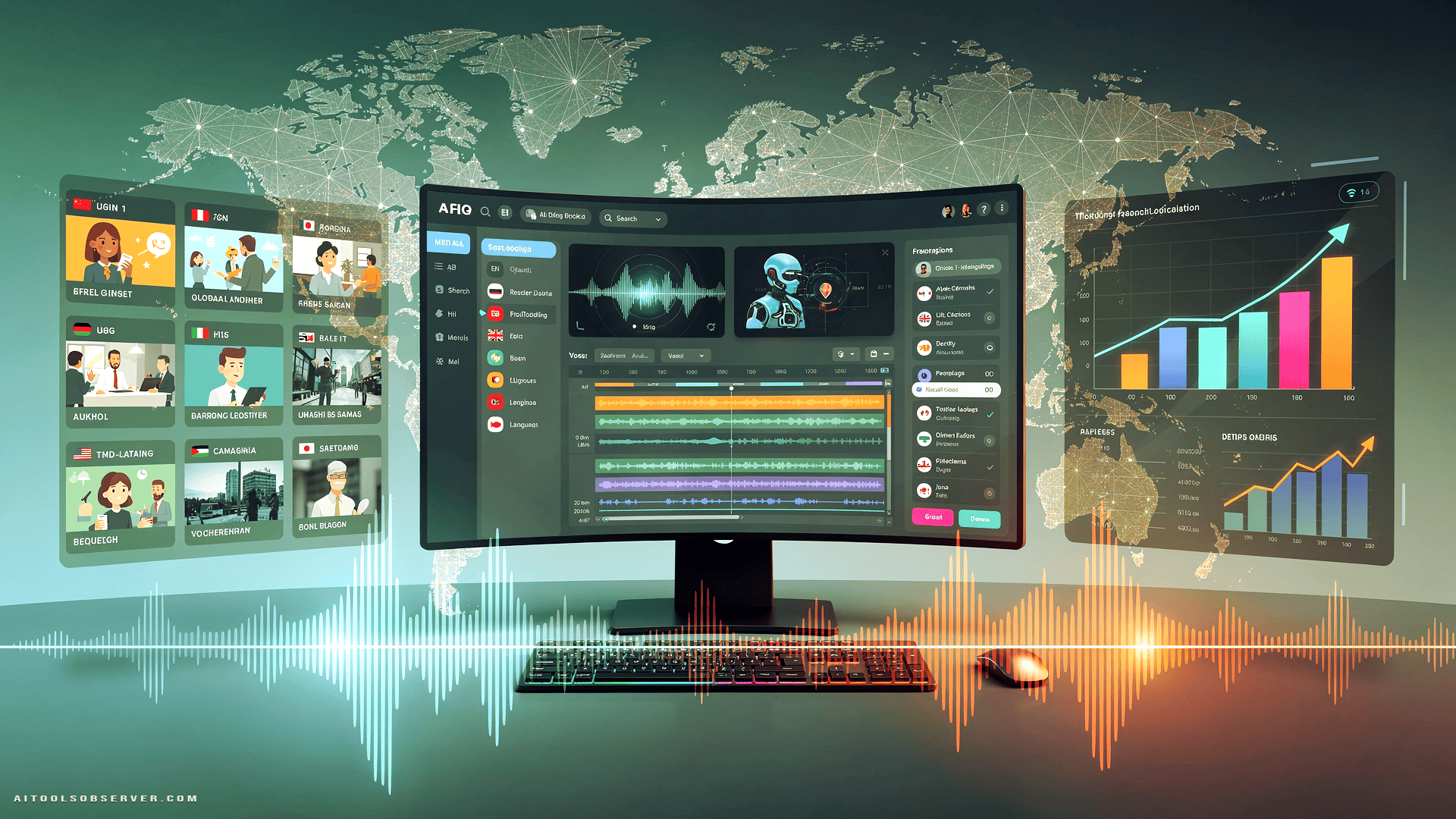
The core value proposition is straightforward. AI dubbing tools use machine learning to translate speech, clone voices, match lip movements, and produce localized audio — in a fraction of the time and cost of traditional studio dubbing.
We’re talking about cost reductions of up to 70% compared to conventional methods. Content that once took weeks to localize can now be processed in hours. And with over 190 countries now accessing dubbed material through improved AI algorithms, the addressable market is genuinely global.
Three forces are converging to accelerate adoption:
- Rising demand for localized content across streaming, e-learning, and advertising
- Advances in generative AI that make synthetic voices sound increasingly human
- Expanding internet access in Asia, Latin America, and Africa — regions with massive multilingual audiences
The Role of Generative AI: More Than Just Translation

Generative AI isn’t a feature in these tools. It’s the foundation.
Modern dubbing platforms use generative AI to handle instant translation, voice cloning, emotional tone matching, and lip-sync alignment simultaneously. Approximately 93% of leading tools now achieve accurate lip-sync, a benchmark that was nearly impossible to hit just a few years ago.
The entertainment sector leads adoption, with 45% of entertainment users already integrating these tools into production workflows. That’s not surprising — film and animation studios face constant pressure to release content across multiple language markets simultaneously.
What’s more significant is the speed of improvement. Neural networks are getting better at capturing accent nuance, emotional delivery, and dialect variation. The gap between AI-generated and human-performed dubbing is narrowing fast.
Market Size and Growth Forecast

| Metric | Value |
|---|---|
| Market Size (2025) | USD 2.75 billion |
| Market Size (2035) | USD 18.96 billion |
| CAGR (2025–2035) | 21.3% |
| North America Share (2025) | 33.7% / USD 0.92 billion |
| U.S. Market Size (2025) | USD 0.80 billion |
| U.S. Projected Size (2035) | USD 4.33 billion |
| U.S. CAGR | 18.4% |
North America holds the largest regional share, driven by a mature media and entertainment industry, advanced cloud infrastructure, and aggressive AI investment. But the growth story over the next decade will increasingly be written in Asia Pacific, Latin America, and the Middle East — regions where internet penetration is rising and multilingual content demand is surging.
Content Creators Dominate Application Share

In 2025, the Content Creators segment captured 57.2% of the market. YouTubers, TikTok creators, influencers, and small production teams are using AI dubbing to reach global audiences without hiring voice actors or translation studios.
The economics make sense at every scale. A solo creator can dub a video into 10 languages in an afternoon. A mid-size production team can localize an entire content library in days. Platforms like TikTok and Instagram have made multilingual reach a competitive advantage, and AI dubbing is the tool that makes it accessible.
In November 2025, Descript added support for 39 additional languages in caption translation and dubbing — a direct response to creator demand for broader language coverage.
Cloud-Based Solutions Lead Deployment

Cloud-based tools hold 65.8% of the market by deployment type, and the reasons are practical. No installation, automatic updates, pay-as-you-go pricing, and the ability to handle large file volumes on remote servers make cloud solutions the default choice for most teams.
The July 2025 integration of CAMB.AI’s dubbing into AWS MediaLive and MediaPackage workflows is a strong signal of where enterprise adoption is heading. Broadcasters can now add dubbed audio tracks to live streams with reduced latency and cost — a capability that was technically complex and expensive just two years ago.
Commercial End-Users Drive Revenue

The Commercial segment accounts for 73.4% of end-user revenue. Businesses across advertising, corporate training, e-learning, and media production are the heaviest users — and they have the clearest ROI case.
For a global brand running multilingual ad campaigns, AI dubbing eliminates the need for separate recording sessions in each market. For an e-learning platform serving learners across Southeast Asia, it enables rapid course localization without rebuilding content from scratch.
In September 2025, Deepdub released Lightning 2.5, a real-time voice model running on NVIDIA GPUs that delivers 2.8X throughput for enterprise dubbing workflows — purpose-built for commercial-scale production.
North America
North America leads with a 33.7% market share and USD 0.92 billion in 2025 revenue. The U.S. alone is projected to reach USD 4.33 billion by 2035. The region benefits from a dense concentration of streaming platforms, media companies, and AI infrastructure investment.
Microsoft’s May 2025 showcase of Azure AI Video Translation — featuring GenAI contextual translation, multi-speaker detection, lip-sync, and support for 70+ languages — illustrates how major cloud providers are embedding dubbing capabilities directly into enterprise AI stacks.
Asia Pacific

Asia Pacific represents the highest-growth opportunity. Diverse language markets, rising internet penetration, and growing content consumption across India, Southeast Asia, and China create strong structural demand for affordable, scalable localization.
The e-learning and advertising sectors in this region are particularly active, with dialect support becoming a key differentiator for platforms competing for local audiences.
Europe, Latin America, and MEA
Europe brings regulatory complexity but strong demand from multilingual markets across Germany, France, Spain, and the UK. Latin America and the Middle East and Africa regions are earlier-stage but growing fast as infrastructure improves and local content production scales up.
Key Players Shaping the Market

The competitive landscape includes both tech giants embedding dubbing into broader AI platforms and specialized startups building purpose-built solutions.
Major players include:
- Google LLC — deep NLP and translation infrastructure
- Microsoft Corporation — Azure AI Video Translation with enterprise-grade features
- Amazon Web Services Inc. — CAMB.AI partnership bringing emotion-aware dubbing to AWS Bedrock
- Synthesia Limited — AI video generation with multilingual avatar dubbing
- Descript Inc. — creator-focused dubbing with Overdub voice cloning across all plans
- ElevenLabs Inc. — advanced voice synthesis and cloning technology
- Deepdub Inc. — enterprise real-time dubbing with GPU-accelerated models
- ZOO Digital Group plc — media localization with AI-assisted workflows
- Speechify Inc. — text-to-speech and audio content tools
- Invideo Innovation Pte Ltd. — AI video creation with dubbing capabilities
A notable M&A signal: In June 2025, RWS acquired Papercup’s AI dubbing IP, combining voice synthesis with thousands of unique AI voices for multilingual video localization. Consolidation is beginning, and it will accelerate as the market matures.
Investment Signals and Business Opportunity

Investors are paying attention to specific capability clusters within this market:
- Platforms combining AI with human editing for high-stakes content where accuracy is non-negotiable
- Real-time dubbing for live events, sports broadcasts, and news
- Custom voice creation for brand identity — a recurring revenue model with strong retention
- Mobile-first workflows targeting the billions of users who create and consume content on smartphones
- Security-focused tools that address growing concerns around voice data privacy and synthetic voice rights
The business case for adopters is equally clear. Reaching new language markets without building local production teams, reducing localization costs by up to 70%, and maintaining consistent brand voice across regions — these are outcomes that justify fast adoption decisions.
Challenges Worth Watching

The market isn’t without friction. Two restraints stand out.
Voice quality gaps remain a real issue in emotionally complex scenes. AI-generated voices have improved dramatically, but they can still miss the subtle emotional richness that human performers bring to dramatic content. This limits adoption in premium film and animation contexts where immersion is critical.
Cultural adaptation is the harder problem. Automated translation can handle words but often misses idioms, humor, and cultural context. Dubverse’s March 2025 experience with local dialect challenges and inconsistent voice data privacy regulations across markets illustrates how technically capable tools can still stumble on cultural and legal complexity.
Voice rights and data privacy regulations vary significantly by jurisdiction, complicating cross-border projects for global enterprises. This is an area where the regulatory environment is still catching up to the technology.
Emerging Trends to Track Through 2035

The next decade won’t just be about better dubbing. It will be about deeper integration.
Real-time dubbing for live broadcasts is moving from experimental to operational. The AWS and CAMB.AI integration for live streaming is an early proof point.
AR/VR and immersive media will create new demand for seamless language adaptation in spatial environments — a use case that current tools are beginning to address.
200+ language support is becoming a baseline expectation for cloud platforms, not a premium feature.
Mobile-first workflows will democratize access further, enabling creators in emerging markets to localize content without desktop infrastructure.
Auto-edit features for cultural fit — where AI not only translates but adapts content for local sensibilities — represent the next frontier beyond pure voice dubbing.
The Bottom Line

The AI-powered dubbing tools market is one of the clearest examples of AI creating genuine economic value at scale. The math is simple: global audiences want content in their languages, traditional dubbing can’t meet that demand affordably, and AI can.
A market growing at 21.3% CAGR over a decade reflects real adoption, not hype. The segment leaders — content creators, cloud-based deployment, and commercial end-users — tell you exactly where the value is being captured today.
For founders building in this space, the opportunity is in the gaps: cultural adaptation, real-time applications, mobile-first tools, and enterprise security. For marketers and media teams evaluating tools, the ROI case is already proven. The question is which platform fits your language coverage, workflow, and scale requirements.
The tools that win through 2035 will be the ones that move beyond accurate dubbing into genuinely intelligent localization — understanding not just what to say, but how it should sound in every market they serve.












Comments (0) No comments yet
Want to join this discussion? Login or Register.
No comments yet. Be the first to share your thoughts!