



Why Hurricanes Are a Network Nightmare
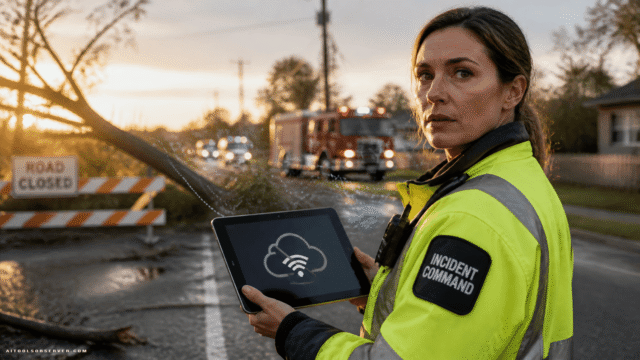
Cell towers need power to operate. When a hurricane knocks out the electrical grid, stationary towers go dark. The problem compounds fast: millions of people are simultaneously trying to call, text, and stream updates at the exact moment the network is most vulnerable.
Restoration used to take days. Engineers had to physically survey damage before they could even begin repairs. In a post-storm environment flooded with debris, that process was painfully slow.
That’s the core problem AI and modern disaster tech are solving.
How Verizon Uses AI and Drones to Cut Restoration Time

Verizon starts its hurricane response roughly a week before a storm makes landfall. According to Srini Kalapala, Verizon’s Senior Vice President of Wireless Engineering and Operations, the preparation window is critical.
Before the storm hits, Verizon deploys drones to photograph coverage areas and establish a baseline. After the storm passes, those same drones fly again — and AI compares the before-and-after imagery to pinpoint damage locations with precision. Engineers and technicians receive exact coordinates, not vague reports. That specificity alone dramatically accelerates repair timelines.
“Hurricanes, especially, you don’t understand the damage until it’s fully done,” Kalapala said.
The Animal Fleet: COWs, HAWKs, and Mobile Infrastructure

Verizon’s backup toolkit reads like a wildlife guide. When stationary towers fail, the company deploys a fleet of mobile assets with animal codenames:
- COW — Cell on Wheels. A portable cell tower mounted on a trailer that can be driven into a disaster zone and activated quickly.
- HAWK — High Altitude Wireless Network. A drone that carries small cell equipment into the air to broadcast signal from above.
These tools have helped Verizon compress restoration times from days down to hours — and in some cases, minutes. That’s not a small improvement. In a disaster scenario, every hour of connectivity restored is lives and safety decisions enabled.
How AT&T Merges Disaster Teams for Faster Response
AT&T also begins preparations about a week out. But what sets its approach apart is the breadth of its disaster response fleet and how it’s organized.
Shannon Browning, Associate Director of AT&T’s Network Disaster Recovery team, explained that the company moves boats, barges, helicopters, and specialized equipment across the country throughout the year — not just during hurricane season. That flexibility matters because disaster seasons now overlap.
“It used to be [that hurricanes] were very season-specific. And then you started to see that wildfire season crept into hurricane season,” Browning said.
One Unified Disaster Team
AT&T’s response to overlapping disaster seasons was structural: it merged several separate disaster response teams into a single unified group. The result is a more streamlined operation that can pivot resources between hurricanes, wildfires, and snowstorms without bureaucratic friction.
This kind of organizational efficiency is underrated. Having one team with shared protocols and equipment pools means faster deployment and fewer coordination gaps when conditions change rapidly.
How T-Mobile Uses AI to Stretch Battery Life and Satellite Backup
T-Mobile takes the longest runway of the three. Chief Operating Officer Jon Freier said the company begins disaster preparation three to five months in advance — well before hurricane season officially opens in June.
When power goes out during a storm, T-Mobile customers automatically receive free satellite connectivity as a bridge service. That alone is a significant safety net for users in areas where towers go dark.
But the more technically interesting piece is what T-Mobile does with AI during an outage.
AI-Driven Antenna Adjustment and Battery Conservation
T-Mobile deploys AI tools that automatically adjust antenna configurations and manage backup battery consumption in real time. The goal is to extend how long towers can operate without grid power — buying critical hours for customers and first responders alike.
“From my experience in these disasters, people will go without power a little bit longer, and they’re more patient,” Freier said. “But they want that smartphone to work, and to be connected.”
That insight drives the entire strategy. Power outages are tolerated. Connectivity loss is not.
First Responders Come First — Here’s Why That Matters
Before civilian service is restored, first responders get priority access. Law enforcement, firefighters, and paramedics depend on carrier networks for far more than voice calls.
Peter Antevy, Medical Director for several fire departments in Broward County, Florida, described how his teams use cell and Wi-Fi connectivity to conduct telemedicine appointments, transmit test results, and receive live updates from 911 dispatch centers to ambulances in the field.
“There is a lot of data that goes back and forth,” he said.
Carriers in the Room During Disaster Planning
Amy Weber, Chief of Emergency Medical Services at the Galveston County Health District in Texas, said Verizon and AT&T representatives attend her department’s disaster planning meetings directly. They coordinate which equipment will be deployed, where, and when.
“Communication is always a huge breakdown for first responders, because we get inundated with calls just from the service area, so putting us at top priority helps us be able to do our job,” Weber said.
This kind of pre-event coordination is what separates a functional disaster response from a chaotic one. The technology only works if the logistics are planned in advance.
What Real Users Actually Experience
The gap between carrier marketing and ground-level reality is real. Anthony Leone, a resident of North Carolina’s Outer Banks, has cycled through multiple carriers over the years. With his previous provider, getting a signal was a daily struggle — not just during storms. He’s been with AT&T for over a decade now and describes his hurricane-season service as reliably functional.
When a storm approaches, he gets a heads-up text. If service drops during a power outage, it typically comes back within a couple of days.
That’s a reasonable experience. But not everyone has it.
The Coverage Gap Problem
Jackie Santillan, a doctoral student and content creator in the Houston suburbs, tells a different story. With her previous carrier, there was a single square foot in her home where calls would connect. She switched to T-Mobile — and says the situation hasn’t improved much. On a storm-free day, she has to walk half a mile toward the highway to get a reliable signal.
“I just have a lot of hurricane anxiety. I know that if something were to happen, we wouldn’t be able to reach out to anybody,” she said.
Santillan launched a petition in May demanding a new cell tower in her neighborhood, gathering nearly 200 signatures. T-Mobile responded with a statement acknowledging the gap and pointing to ongoing investments in tower buildouts, 5G upgrades, and network resilience across Texas, North Carolina, and beyond.
The technology exists. The deployment is still catching up.
The AI Tools Powering Telecom Disaster Response
To make this concrete for anyone evaluating how AI fits into infrastructure resilience, here’s a breakdown of the core AI applications at work:
Damage Assessment AI
Verizon’s post-storm drone imagery is analyzed by AI to identify and geolocate infrastructure damage. This replaces manual surveys and cuts the time between storm landfall and repair mobilization.
Predictive Network Management
T-Mobile’s AI monitors tower battery levels and antenna performance in real time, making automatic adjustments to extend operational windows during outages.
Automated Customer Communication
Carriers use AI-driven systems to send proactive alerts to customers in storm paths — managing expectations and reducing inbound support volume during peak demand.
Resource Allocation Modeling
Behind the scenes, AI helps carriers model where to pre-position mobile assets like COWs and HAWKs based on storm track predictions, population density, and historical outage data.
What This Means for Businesses and Remote Workers
If you’re running a business in a hurricane-prone region — or managing a team that works remotely — telecom resilience directly affects your operations. Here’s what to factor in:
Know your carrier’s disaster protocols. Not all carriers invest equally in disaster recovery infrastructure. Verizon, AT&T, and T-Mobile all have documented programs. Ask your carrier representative what specific assets they deploy in your region.
Understand first responder priority. During active disasters, network resources are triaged. First responders come first. Plan for reduced civilian bandwidth in the immediate aftermath of a major storm.
Satellite backup is becoming standard. T-Mobile’s free satellite fallback during outages is a meaningful differentiator. As satellite connectivity matures, expect this to become a baseline expectation across carriers.
Coverage gaps are a real risk. If your home or office sits in a low-coverage area today, a hurricane will make it worse. Identify your weak points before storm season peaks.
The Bigger Picture: AI Is Becoming Infrastructure
What’s happening in telecom disaster response is a preview of how AI integrates into critical infrastructure more broadly. It’s not replacing engineers or first responders. It’s compressing the time between damage and diagnosis, between outage and restoration.
The carriers that invest in AI-driven network resilience aren’t just protecting their customers during storms. They’re building a competitive advantage that compounds over time — because reliability during the worst moments is what earns long-term trust.
Hurricane season runs June through November. The technology is ready. The question is whether the coverage reaches everyone who needs it.







Comments (0) No comments yet
Want to join this discussion? Login or Register.
No comments yet. Be the first to share your thoughts!