


Why this moved from niche policy to national fight
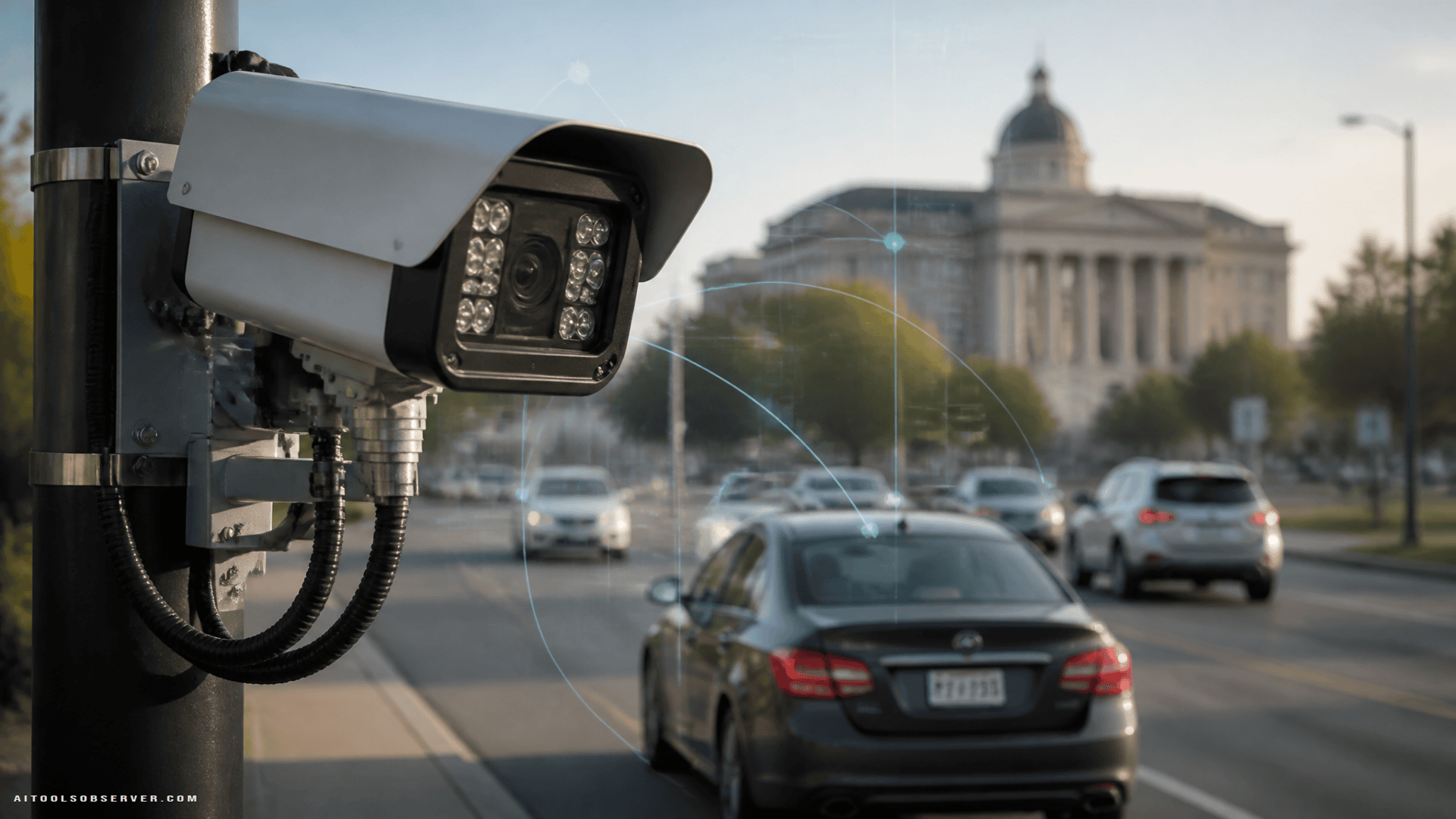
Automatic license plate readers, or ALPRs, sit quietly on roads, poles, and intersections collecting vehicle and location data. Most drivers never notice them. That invisibility is part of the problem.
What changed is less the existence of cameras and more the growing power around them. Lawmakers and privacy advocates are increasingly focused on how AI expands what these systems can infer, connect, and retain. A plate scan is one thing. A searchable map of someone’s movements starts to feel very different.
That tension has pushed ALPRs into the broader AI regulation debate, alongside familiar concerns about mass surveillance, civil liberties, and the limits of public-private data systems.
Flock Safety is now the lightning rod
Flock Safety appears to be the company drawing the most attention in this round of backlash, even though it’s not the only ALPR provider. That often happens when one company becomes the shorthand for a whole category.
The scrutiny is being fueled by two competing realities:
- the systems have reportedly helped in some urgent public safety cases
- misuse cases make the technology feel less like a scalpel and more like a dragnet
A recent example cited by lawmakers involved a former police officer accused of repeatedly using Flock technology to monitor a specific plate. That kind of story tends to collapse the abstract policy debate into a very concrete fear: not just “Could this be abused?” but “Apparently, yes.”
What both sides are actually worried about
The bipartisan overlap here is striking. Different political camps are using different language, but they’re circling many of the same concerns.
Privacy and constitutional limits
For critics, the issue isn’t merely that cameras exist in public. It’s whether the state, or systems working with the state, can reconstruct a person’s movements at scale without meaningful limits.
That’s where Fourth Amendment concerns keep showing up. The argument is less about one snapshot of a car on a road and more about continuous, searchable monitoring over time.
AI creep
Some lawmakers are also warning that “license plate reader” is now too narrow a label. The fear is that AI-enhanced systems could move beyond plate identification into richer analysis of vehicles, passengers, or activity inside the car.
Even when providers dispute specific capabilities, the policy issue remains the same: regulation usually describes what a tool used to do, not what it may soon do.
Mission creep and weak oversight
A lot of public tech controversy can be translated into one sentence: the tool was introduced for one purpose, then quietly expanded.
That’s the concern here too. If ALPR systems are adopted for serious crime prevention, what stops them from being used for routine monitoring, personal misuse, or low-threshold searches? Without clear access rules, audit logs, retention limits, and penalties, “authorized use” can become a very elastic phrase.
The argument for ALPRs hasn’t disappeared
Supporters are not pretending these systems are harmless. Their case is simpler: useful tools can still need rules.
ALPR backers point to cases involving stolen vehicles, investigations, and missing persons. In that framing, the cameras are not inherently the problem; bad policy is. Even some defenders of the technology appear to agree that stronger guardrails would make sense.
That’s an important detail. This doesn’t look like a clean fight between “keep the cameras” and “ban the cameras.” It looks more like a fight over conditions:
- Who can access the data?
- For what kinds of cases?
- For how long is data stored?
- What auditing exists?
- What happens when someone abuses the system?
Those are boring questions, which is exactly why they matter.
Why this matters beyond one company
This story is bigger than Flock Safety and bigger than roadside cameras.
It points to a recurring AI governance problem: a product category can become widely deployed before the public has a clear model for what it does, what data it creates, and what safeguards are in place. By the time lawmakers catch up, the system is already embedded in day-to-day operations.
For AI adopters and observers, that pattern should sound familiar. The lesson is not “all AI tools are surveillance tools.” It’s that once a system touches identity, movement, or behavioral data, the compliance question arrives faster than the product team expects. Concerns around mass surveillance and rights impacts are part of that broader pattern.
What to watch next
The likely next phase is not a dramatic nationwide switch-off. More likely: a patchwork of local restrictions, federal proposals, procurement standards, and public pressure campaigns.
Watch for debate around:
- mandatory audit trails for searches
- tighter limits on data retention
- restrictions on non-criminal use
- reporting requirements for misuse
- clearer rules on whether AI-enhanced features change the legal standard
Also watch the framing. If policymakers continue treating ALPRs as a broader AI surveillance issue rather than a narrow policing tool, regulation could expand well beyond roadside cameras.
The practical takeaway
If a tool can quietly log where people go, the burden is no longer on the public to prove why that feels invasive. The burden is on the system’s operators to prove why it won’t be abused.
That’s the shift here. For anyone building, buying, or evaluating AI tools, especially in public safety, “helpful” is no longer enough. The new baseline is helpful, accountable, and hard to misuse.















Comments (0) No comments yet
Want to join this discussion? Login or Register.
No comments yet. Be the first to share your thoughts!