


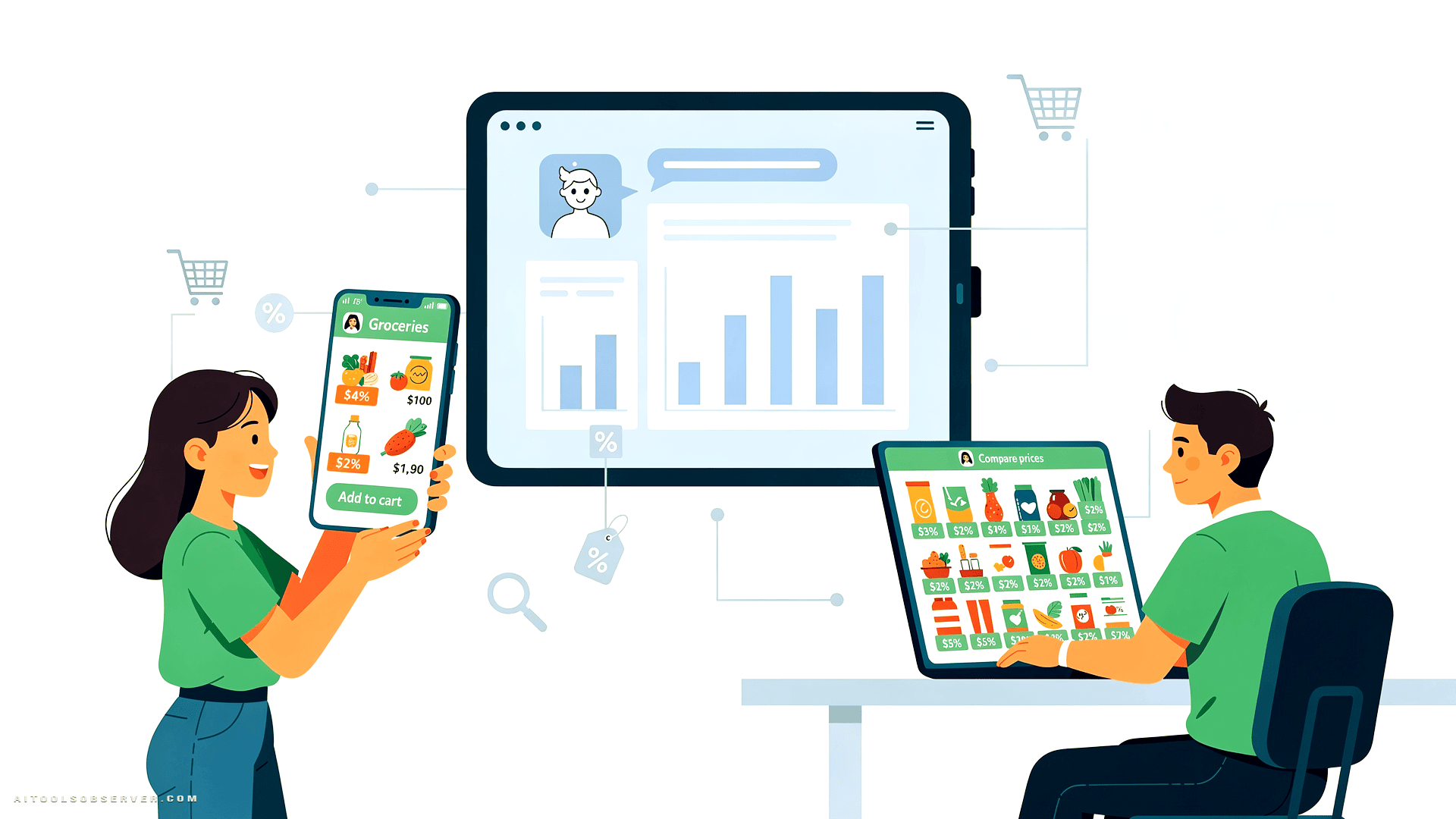
The Numbers Tell a Clear Story

Among shoppers who used AI for grocery buying, the breakdown is striking:
- 66% used AI to compare prices or assess options before purchasing
- 47% used it to research product information
- 28% had already used AI tools to actually complete a grocery purchase
Price comparison leads the pack by a wide margin. That makes sense. Grocery shoppers are value-driven, time-pressed, and highly familiar with the idea that the same product costs different amounts at different stores. AI just makes that comparison faster and more conversational.
What’s notable is the 28% who went beyond research and actually bought through AI. That’s not window shopping. That’s a completed transaction — and it signals that trust in AI-assisted purchasing is building faster than most retailers expected.
This Isn’t a Tech-Savvy Niche Anymore

One of the most important details in the Rithum data is the age distribution of respondents. The survey was evenly split: 25% aged 18–27, 26% aged 28–43, 25% aged 44–59, and 24% aged 60 or older.
AI grocery adoption isn’t concentrated in younger demographics. It’s spread across generations.
That matters enormously for how retailers should interpret this trend. If AI-assisted shopping were limited to Gen Z or millennials, it could be treated as an emerging behavior to watch. When it spans all age groups at roughly equal rates, it’s already mainstream infrastructure.
How AI Is Changing the Discovery Funnel

For years, the online grocery journey followed a predictable path: search engine or retailer app → product listing → cart → checkout. That funnel is fracturing.
Shoppers are now starting with a question to an AI assistant — “Where can I get the cheapest oat milk delivered today?” or “Which protein bar has the best value per gram?” — and receiving curated answers pulled from multiple sources before they ever land on a retailer’s website.
Sam Griffin, Vice President of Strategy and Engagement at Rithum, put it directly:
“Consumers are increasingly using AI as a personal grocery comparison tool, forcing retailers to compete in entirely new discovery environments.”
He went further:
“When shoppers ask AI where they can find the best deal, the most suitable product, or the fastest delivery option, retailers need to ensure their pricing, promotions and product information are accurate enough to surface in those recommendations.”
That’s the crux of the problem for grocers. If your product data is stale, your pricing isn’t updated in real time, or your promotions aren’t structured in a way AI tools can parse — you simply won’t appear in the recommendation. You lose the sale before the shopper ever visits your site.
The Digital Shelf Just Got More Complicated

Retailers have spent years optimizing their own digital shelves — product images, SEO titles, review counts, sponsored placements. That work still matters. But it’s no longer sufficient on its own.
AI tools generate responses based on available product details, delivery terms, and price points from across the web. That means the “digital shelf” now extends into environments retailers don’t directly control. A supermarket’s pricing strategy, promotional calendar, and product catalog need to be legible not just to human shoppers browsing an app, but to AI systems synthesizing options on a shopper’s behalf.
This is a new kind of competitive pressure. And it’s arriving in grocery — a category defined by thin margins and high purchase frequency — faster than most industry players anticipated.
Why Grocery Is the Canary in the Coal Mine
It would be easy to dismiss AI shopping adoption if it were concentrated in high-consideration categories like electronics or travel. Those are purchases where research-heavy behavior already exists.
Grocery is different. Purchases are frequent, often habitual, and typically low-effort. The fact that AI is breaking into this category suggests the tools have crossed a usability threshold. They’re no longer reserved for complex decisions. They’re becoming part of the weekly routine.
That’s the signal worth paying attention to. When consumers start using AI to decide between two brands of pasta sauce, the technology has genuinely embedded itself in everyday life — not just in boardroom strategy decks.
What This Means for Retailers Right Now

The Rithum findings carry practical implications that go beyond marketing strategy.
Product data quality becomes a competitive moat. Accurate titles, descriptions, pricing, and availability aren’t just good SEO hygiene anymore — they’re the raw material AI tools use to make recommendations. Retailers who invest in clean, structured, real-time product data will surface more often in AI-generated responses.
Promotions need to be machine-readable. A flash sale buried in a banner image won’t get picked up by an AI assistant. Structured, accessible promotional data will.
Discovery channels are multiplying. Retailers can no longer assume shoppers arrive through their own app or a Google search. AI assistants are becoming an upstream filter — and that filter operates on data quality, not brand loyalty.
The competitive set is expanding. When AI compares options across multiple retailers simultaneously, smaller players with better data or sharper pricing can surface alongside established supermarket chains. The playing field is shifting.
The Broader Trend: AI as Everyday Infrastructure

The Rithum survey is one data point in a much larger pattern. Across categories — travel, finance, healthcare, retail — AI tools are moving from novelty to utility. The grocery finding accelerates that timeline.
What’s changing isn’t just consumer behavior. It’s the architecture of how products get discovered, evaluated, and purchased. Retailers, brands, and anyone building tools for the commerce ecosystem need to treat AI-assisted discovery as a primary channel — not a secondary experiment.
Thirty-six percent of grocery shoppers using AI isn’t the ceiling. It’s the baseline. The retailers who recognize that now and adapt their data, pricing, and discovery strategies accordingly will be the ones competing effectively in the next phase of online retail. The ones who wait will find themselves invisible in the conversations that matter most.














Comments (0) No comments yet
Want to join this discussion? Login or Register.
No comments yet. Be the first to share your thoughts!