


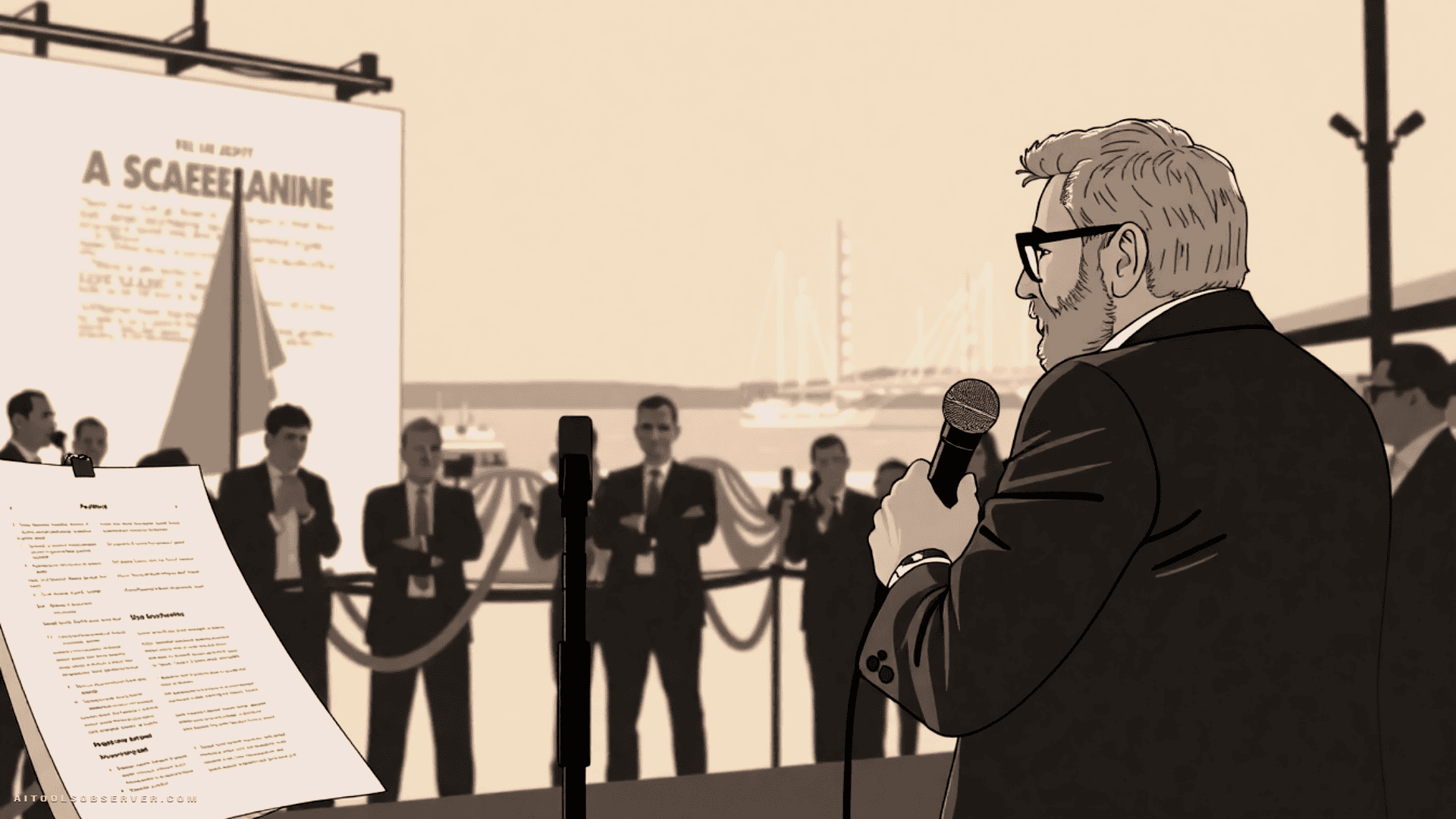
What Rogen Is Actually Arguing
The surface reading is that Rogen dislikes AI writing tools. The more precise reading is different.
His critique targets instinct — the impulse to offload the generative act of writing to a machine before the writer has even struggled with the blank page. That is a meaningful distinction. He isn’t arguing against spell-checkers, research assistants, or scheduling tools. He is arguing that the creative impulse itself cannot be outsourced without hollowing out the craft.
His reference to Instagram videos promising “Hollywood is cooked” — followed by what he calls “the most stupid dog shit I’ve ever seen” — points to a specific failure mode: AI-generated content that mimics the surface structure of storytelling without the underlying judgment, taste, or lived experience that makes a script worth reading.
This is not technophobia. It is a quality argument.
The Legitimate Tension AI Writing Tools Face

Rogen’s position lands in a market that is genuinely divided. AI writing tools — ranging from general-purpose large language models to purpose-built screenwriting assistants — have proliferated rapidly. Their value propositions vary considerably.
Some tools target professional writers as productivity accelerators: handling formatting, generating structural outlines, or stress-testing dialogue against genre conventions. Others are marketed more broadly, implying that the barrier to writing a screenplay is now primarily technical rather than creative.
That second category is where Rogen’s critique bites hardest.
When a tool’s marketing suggests that anyone can produce professional-grade scripts with minimal creative investment, it conflates output generation with authorship. The distinction matters — commercially, legally, and artistically. Hollywood’s ongoing negotiations around AI use in writers’ rooms are not abstract; they reflect real uncertainty about where machine assistance ends and human authorship begins.
What the Film Industry’s Resistance Signals to the Market

Rogen is not alone at Cannes or in the broader industry. Resistance to AI in creative production has been a consistent theme among established writers, directors, and guilds since generative AI entered mainstream awareness. The WGA’s 2023 strike drew a hard line around AI-generated material, and those contractual boundaries remain active.
For AI tool developers targeting the entertainment sector, this resistance is a market signal worth reading carefully.
It suggests that the adoption curve in creative industries is not primarily a technical problem — it is a trust and positioning problem. Tools that position themselves as replacements for human creative judgment will face structural resistance from the professionals who control production pipelines. Tools that position themselves as precision instruments for specific, bounded tasks have a more viable path.
The distinction is not semantic. It determines product design, go-to-market strategy, and long-term retention.
Where AI Writing Tools Actually Add Value

To be precise: AI tools do demonstrably useful work in the writing process when deployed with appropriate scope.
Research and fact synthesis — pulling background material, summarizing source documents, identifying structural precedents in existing scripts — is a legitimate accelerator. Formatting and continuity checking removes mechanical friction. Generating variation drafts from a human-written scene can help a writer stress-test dialogue or pacing without committing to a direction prematurely.
These are instrument-level applications. They augment a writer’s existing judgment rather than substituting for it.
The failure mode Rogen identifies — and that the market should take seriously — occurs when the tool is positioned at the origin point of the creative act. When the first question a writer asks is “what should this script be about?”, and the answer comes from a language model, the human has not written a script. They have curated one. That is a different occupation, and arguably a less skilled one.
The Cannes Context Is Not Incidental

It matters that this statement was made at Cannes, not in a podcast studio or a trade interview.
Cannes 2026 is a festival that simultaneously celebrates auteur filmmaking and grapples with an industry under significant economic pressure. Streaming consolidation, production slowdowns, and AI-driven cost-cutting conversations are all present in the background. Rogen attended in support of Tangles, an animated feature with a substantial human creative team — writers, voice actors, producers — whose work represents exactly the kind of labor-intensive creative production that AI advocates sometimes suggest could be streamlined.
His statement, in that context, is also a positioning act. It signals to collaborators, studios, and audiences where he stands — and implicitly, what kind of projects he will and will not attach himself to.
For the AI tools industry, that kind of public positioning by influential creators shapes the cultural environment in which adoption decisions are made.
The Takeaway for AI Tool Observers
Rogen’s Cannes remarks are not a policy statement, and they will not halt the development or adoption of AI writing tools. But they are a precise articulation of where creative professionals draw the line — and that line is worth mapping accurately.
The tools that will earn durable adoption in creative industries are those built with enough restraint to respect where human judgment is irreplaceable. The tools that overreach — that promise to replace the writer’s instinct rather than sharpen it — will continue to generate resistance, contractual friction, and the kind of public dismissal Rogen delivered in Cannes.
Observe the resistance carefully. It is not irrational sentiment. It is the market telling you where the product boundary should be.

















Comments (0) No comments yet
Want to join this discussion? Login or Register.
No comments yet. Be the first to share your thoughts!