



What changed
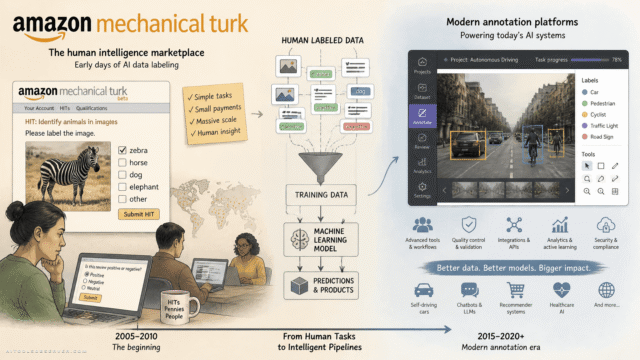
Amazon announced that Mechanical Turk will shut down on Sept. 30, 2026. The platform launched in 2005 and became widely known for distributing small digital jobs, or Human Intelligence Tasks, to a large pool of remote workers.
Those tasks often included:
- data labeling
- audio or video transcription
- survey completion
- content review
- human checks for machine-generated outputs
Jeff Bezos once described the model as “artificial artificial intelligence,” a phrase that captured the basic logic well: when software could not do something reliably, a person stepped in.
Why Mechanical Turk mattered
Mechanical Turk occupied a specific place in the AI stack. It gave researchers, startups, and enterprises a relatively simple way to access distributed human labor for repetitive but necessary tasks.
For years, that mattered because many machine learning systems needed large amounts of labeled data. If you wanted to classify images, clean text, validate predictions, or collect human judgments at scale, MTurk was often one of the default options.
It also shaped a generation of research workflows. Academic studies, early-stage AI products, and lightweight data collection pipelines frequently relied on the platform because it was familiar, accessible, and operationally straightforward.
Why the shutdown matters now
The closure reflects a broader market reality: data work has matured, specialized, and fragmented.
Mechanical Turk was built for general-purpose microtasks. Today, many AI teams need more than raw task distribution. They want tighter quality controls, workforce management, domain specialization, compliance features, and better integration into model development pipelines.
That is where newer annotation providers and data-work platforms have gained ground. Instead of offering only a marketplace, they often position themselves as managed systems for data operations.
In practical terms, the market has moved from “find humans to do tasks” toward “design a repeatable data pipeline.”
The pressure points MTurk struggled with
Several forces appear to have made the old model less durable.
1. Higher expectations for data quality
As models became more capable, the quality bar for training data rose. It is no longer enough to collect labels cheaply if consistency, domain expertise, or auditability are weak.
Teams now care more about:
- reviewer calibration
- consensus workflows
- expert annotation
- traceability
- edge-case handling
A broad open marketplace can be useful for speed and scale, but it may be less suited to tasks that require stricter controls.
2. More competition from specialized platforms
The market for AI data labeling is more crowded and more focused than it was when MTurk launched. Platforms such as Scale AI, Prolific, and Mercor represent different approaches to sourcing and organizing human work.
That does not mean they are direct substitutes in every case. But it does mean buyers now have more choices depending on whether they need research participants, managed annotation, domain-specific reviewers, or broader recruiting infrastructure.
3. Growing concern about worker-side use of AI
One of the central tensions in modern data work is that annotators themselves now have access to powerful AI tools. That can help productivity in some contexts, but it can also undermine the reliability of tasks meant to capture genuine human judgment.
If a platform is used to generate “human” labels, but workers rely heavily on AI to complete them, the value of that dataset becomes less clear. For buyers, this creates a quality assurance problem. For platforms, it creates a governance problem.
4. Synthetic data is changing the economics
Not every training pipeline still depends on large volumes of manually labeled human data. Synthetic data, model-generated augmentation, and automated evaluation methods are reducing demand for some categories of crowd work.
This does not eliminate the need for humans. It changes where humans are most valuable.
More teams now reserve human effort for:
- gold-standard evaluation
- safety checks
- exception handling
- domain-specific review
- reinforcement and preference signals
The low-end, high-volume labeling layer is under more pressure than before.
For more on how AI systems rely on training data, this shift is part of a broader rethinking of where human input adds the most value.
What this means for AI training workflows
For AI builders, the main lesson is simple: human data work is not disappearing, but it is becoming more selective and more operationally demanding.
If your process still assumes that a generic crowd marketplace can handle most labeling needs, this shutdown is a reminder to reassess. The replacement is rarely a one-to-one platform swap.
Instead, many teams now combine several methods:
- managed annotation vendors for core datasets
- internal review teams for sensitive tasks
- synthetic data for scale
- expert validators for high-risk outputs
- smaller human studies for evaluation and feedback
That hybrid model is more complex, but often better aligned with today’s model development needs.
What it means for companies still using MTurk
Some businesses still depend on Mechanical Turk for recurring workflows. For them, the shutdown creates immediate operational risk.
The first issue is continuity. If human review sits inside an existing process for surveys, classification, moderation, or document handling, those flows need replacement before the closure date.
The second issue is migration quality. Moving from MTurk to another provider is not only about preserving throughput. It also requires checking whether the new platform changes cost, worker demographics, turnaround times, or label consistency.
A practical transition review should cover:
- task types currently running on MTurk
- quality controls now in place
- turnaround expectations
- sensitivity of the data
- whether workers need domain knowledge
- how much of the workflow can be automated or synthesized
In many cases, the right answer may not be “pick the nearest substitute.” It may be “redesign the workflow.”
What it means for workers
Mechanical Turk also mattered because it provided flexible remote work to a large population of online workers. For some, it was casual supplemental income. For others, it was a regular and meaningful source of earnings.
That makes the shutdown a labor market event, not only a product update.
Workers who built routines around MTurk now face a familiar platform-economy problem: the marketplace can disappear faster than the livelihood attached to it. Some will likely move to competing data platforms. Others may struggle if they relied on MTurk’s specific task mix, accessibility, or work patterns.
This is also a reminder that AI infrastructure still depends on people whose work often remains invisible until a platform closes.
The bigger signal for the AI tools market
From an AI tools perspective, Mechanical Turk’s end is a marker of market consolidation and workflow specialization.
The older idea was that human labor could be attached to software as an on-demand utility. The newer idea is that data work is a product layer of its own, with requirements around quality systems, orchestration, compliance, and model-specific evaluation.
That shift affects how buyers should compare vendors. The right question is no longer just “who can get labels fastest?” It is increasingly:
- what kind of human input do we actually need?
- where is synthetic data good enough?
- which tasks require experts rather than crowds?
- how do we verify that “human” outputs are truly useful?
- how tightly does the annotation layer connect to the model lifecycle?
Those are procurement questions, but also strategy questions.
What to watch next
The most important trend after MTurk is not simply which platform absorbs displaced demand. It is how AI teams rebalance human labor, automation, and synthetic generation.
Expect more focus on:
- human-in-the-loop review for high-risk use cases
- benchmark-quality evaluation data
- narrower expert taskforces instead of broad crowds
- verification methods for annotator authenticity and quality
- integrated data engines rather than standalone task marketplaces
For founders and AI adopters, this is a good moment to inspect the hidden dependencies in your stack. If your product, research, or operations still rely on anonymous microtask labor somewhere in the pipeline, treat that as a strategic component, not a background utility.
Mechanical Turk helped define an era of AI data work. Its shutdown makes one point clear: the human layer is still essential, but the market now expects it to be more controlled, more specialized, and far more deliberate.






Comments (0) No comments yet
Want to join this discussion? Login or Register.
No comments yet. Be the first to share your thoughts!