


What Is Forward Deployed Engineering — and Why Now?

The term “forward deployed engineer” originates with defense contractor Palantir, which pioneered the model of embedding technical talent inside client organizations more than a decade ago. The concept is straightforward: instead of selling software and leaving customers to figure out implementation, you send your engineers in.
The model has seen a sharp resurgence in 2025 and 2026 as enterprise AI adoption has stalled not from lack of interest, but from lack of execution capacity. Companies have the budget and the intent — they lack the internal engineering depth to move fast.
OpenAI and Anthropic both moved into this space earlier this year. OpenAI launched the OpenAI Deployment Co. alongside private equity firms including TPG+, Advent International, and Bain Capital. Anthropic formed a parallel “AI services company” with Blackstone, Hellman & Friedman, and Goldman Sachs, targeting midsized businesses deploying Claude. AWS is now the first major hyperscaler to formalize a comparable initiative.
The Structure: Pods, Agents, and Speed

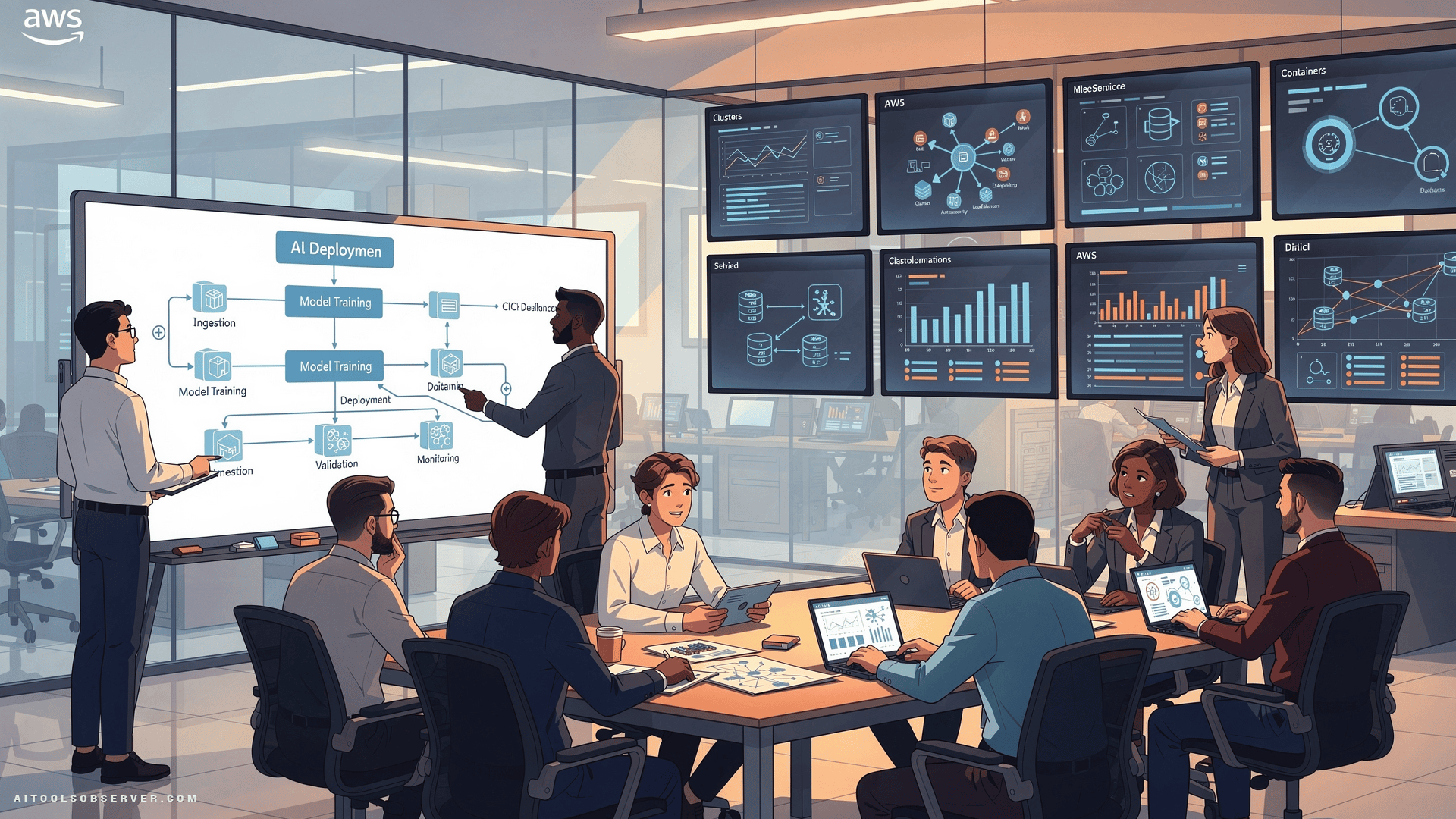
AWS’ new unit will be seeded with thousands of FDEs, according to Francessca Vasquez, AWS’ Vice President of Frontier AI Engineering and Services. Deployments will operate in pods of roughly five to six engineers embedded within a single customer at a time.
Critically, those engineers will work alongside AI agents — autonomous tools capable of completing tasks independently. This human-plus-agent model reflects the current direction of enterprise AI implementation: not pure automation, not pure consulting, but a hybrid that compresses timelines.
The stated goal is to leave behind self-sufficient teams with new solutions and capabilities within weeks, not quarters. Early customers already working with AWS FDEs include the Allen Institute, the NBA, the NFL, and Ricoh — a mix of data-intensive organizations spanning research, media, and enterprise services.
Competitive Positioning: Collaboration or Collision?
AWS has invested billions in both Anthropic and OpenAI, which creates an unusual dynamic. The company is simultaneously a financial backer of the two firms it is now competing with in the deployment services market.
AWS has not shied away from this tension. A company spokesperson confirmed that AWS expects to work with the FDE organizations from both OpenAI and Anthropic, with partner program details to follow. Whether that cooperation holds as all three organizations compete for the same enterprise contracts remains an open question.
What is clear is that AWS holds a structural advantage: it controls the cloud infrastructure that most of these AI workloads run on. Embedding engineers who understand that infrastructure natively — and who can optimize deployments across AWS services, security layers, and data pipelines — is a differentiated position that neither OpenAI nor Anthropic can easily replicate.
Who This Is Actually For
Vasquez was direct about the target customer profile: organizations in highly regulated industries with complex, diverse datasets. Financial services, healthcare, legal, and government-adjacent sectors are the logical next wave of adopters.
These are precisely the environments where off-the-shelf AI deployment fails. Compliance requirements, data residency constraints, legacy system integration, and internal security review cycles all create friction that a remote vendor relationship cannot resolve. An embedded engineer changes that calculus.
“This is for customers that are really looking at ways to evolve their workflows,” Vasquez said.
The underlying signal is that AWS is betting the next phase of enterprise AI adoption will be won not in the model layer, but in the implementation layer.
What This Means for AI Tool Decision-Makers
For founders, CTOs, and enterprise technology leaders evaluating AI adoption strategies, this announcement carries a practical implication: the market is moving toward deployment-as-a-service at scale.
The emergence of FDE units from AWS, OpenAI, and Anthropic simultaneously signals that the industry has accepted a hard truth — most organizations cannot self-implement complex AI systems fast enough to generate meaningful ROI. The competitive advantage is shifting from model quality to deployment velocity.
If your organization is evaluating AI infrastructure decisions in the next six to twelve months, the question is no longer only which model or which cloud. It is also which partner can put engineers inside your walls and ship working systems in weeks.
AWS has just made a $1 billion argument that the answer should be them.















Comments (0) No comments yet
Want to join this discussion? Login or Register.
No comments yet. Be the first to share your thoughts!