



The Foundation Problem Nobody Talks About
Most AI implementation conversations start with the tool. Which platform, which model, which vendor. That’s understandable — the tooling landscape is genuinely interesting right now. But it skips a more important question: what exactly is the AI being asked to optimize?
If the answer is “a process we’ve never fully mapped,” the results will be predictably underwhelming. AI accelerates what’s already there. Clarity gets clearer. Chaos gets faster.
Organizations with mature process disciplines — documented workflows, defined metrics, established feedback loops — give AI systems something real to work with. The model doesn’t have to guess at what good looks like. The organization already knows.
Why Operational Rigor Is the Actual Differentiator

According to research compiled by MIT Technology Review Insights, the market for AI-powered process optimization is projected to exceed $113 billion within the next decade. And in a related study, 88% of business leaders anticipated increasing their investments in AI-infused process intelligence within the next 12 to 18 months.
That’s a lot of capital moving toward a capability that only fully delivers under specific conditions.
Those conditions aren’t mysterious. They’re cultural and operational: a comfort with data-driven decision-making, a habit of measuring outcomes, and a willingness to treat process as a first-class asset rather than background infrastructure.
Companies already operating this way don’t need to build that culture alongside their AI rollout. They just need to point the tools at the right problems.
What “Process Excellence” Actually Enables
It’s worth being specific about what mature operations unlock when they bring AI into the picture.
Faster signal, less noise
When data pipelines are clean and KPIs are well-defined, AI-generated insights land in context. Teams can act on them. In organizations without that foundation, the same insights often create more debate than direction.
Compounding returns on existing methodology
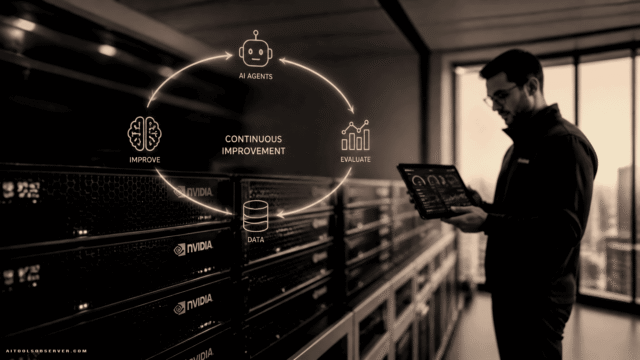
Process excellence frameworks — whether Lean, Six Sigma, or something more bespoke — were built around continuous improvement. AI doesn’t replace that logic. It accelerates the feedback cycle, shortens the iteration loop, and surfaces anomalies that human review would catch too slowly or too late.
Scalable discipline
One of the harder problems in operations is maintaining rigor as headcount and complexity grow. AI-powered process intelligence can extend consistent standards across larger teams and more complex workflows — but only if those standards exist and are legible to the system.
The Trap for Everyone Else
Organizations without strong process foundations aren’t locked out of AI. But they face a harder path. They’re often trying to solve two problems simultaneously: fix the process and automate it. That’s not impossible, but it’s expensive, slow, and prone to locking in the wrong patterns at scale.
The smarter sequence is usually to establish operational clarity first, then layer in AI tooling. It’s less exciting than jumping straight to automation, but the compounding effect is significantly better.
Pulling the Levers Together
The framing that holds up here is simple: AI can accelerate process excellence, but existing process excellence is what makes AI genuinely impactful. Technology and process stopped being separate levers a while ago. The organizations that treat them as one integrated system are the ones building durable advantages — not just impressive demos.
If you’re evaluating AI tools for operational use, the most useful question isn’t “what can this tool do?” It’s “what does our process need to be true for this tool to work?” Answer that first, and the tool selection gets a lot easier.













Comments (0) No comments yet
Want to join this discussion? Login or Register.
No comments yet. Be the first to share your thoughts!