


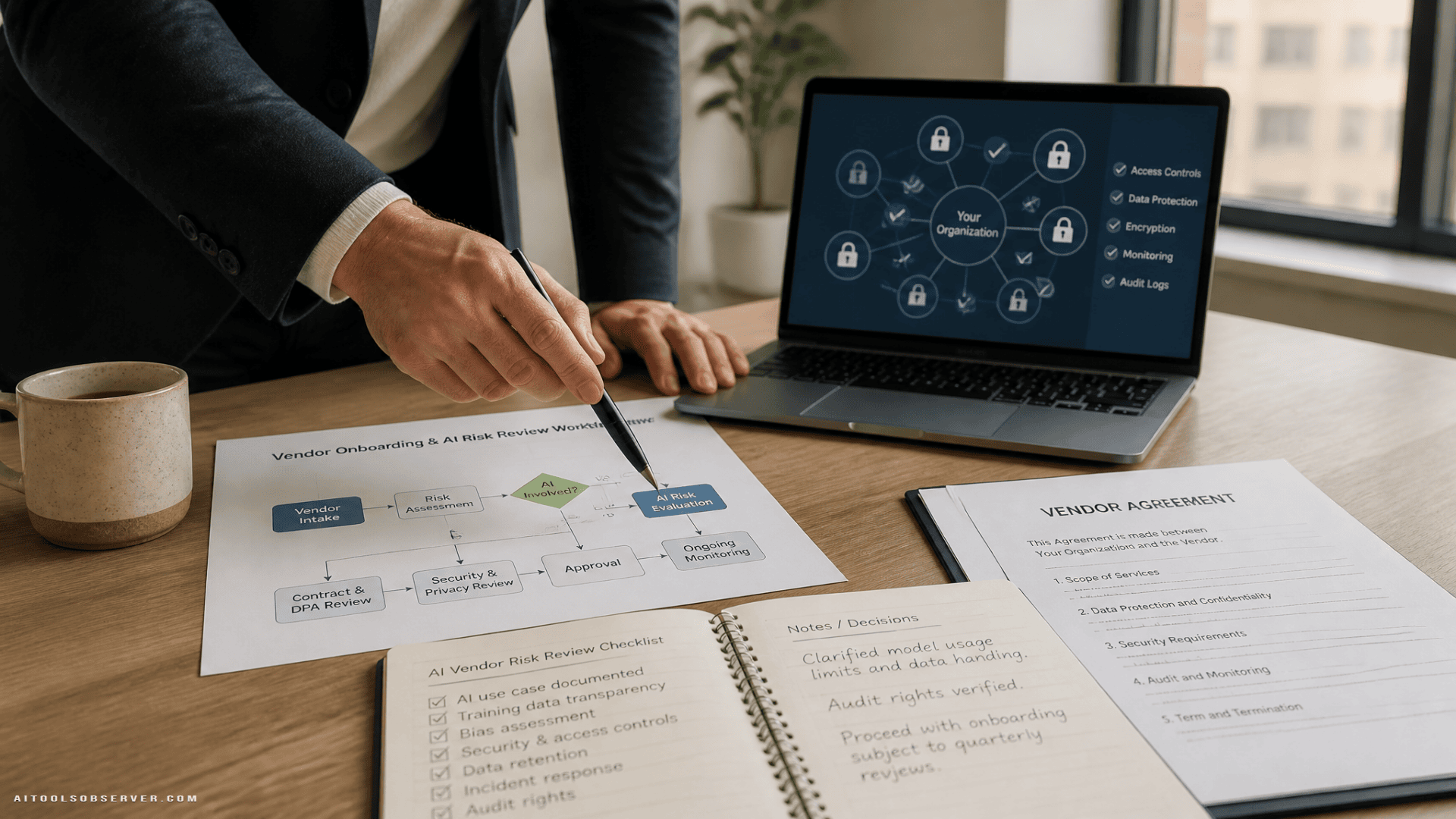
Why AI governance matters in everyday operations
The risk is not only a bad output. It is the absence of a clear process for approving, monitoring, and reviewing how AI got into a workflow in the first place.
In practical terms, teams need to know:
- where AI is being used
- what it is actually doing
- what data it can access
- who owns the workflow
- where human review happens
- what evidence exists for audit or compliance review
This is especially important when AI is embedded inside ordinary business systems. A document assistant is not the same as a model influencing payment exceptions, fraud alerts, or customer eligibility. Treating both the same leads to either over-control or under-control.
AI governance is usually an extension of existing controls
A common mistake is assuming AI requires a completely separate governance framework. In most organizations, the building blocks already exist.
You likely already have some version of:
- approved tool processes
- data handling rules
- access controls
- logging and retention
- vendor management
- change management
- risk and compliance reviews
The practical move is not to create a parallel control universe. It is to adjust those existing disciplines for how AI changes the risk profile.
That matters because two governance failures show up again and again:
- A heavy approval model for every AI use case, even low-risk ones.
- A light-touch model for everything, including sensitive workflows.
Neither works well. The first slows adoption. The second leaves obvious gaps. This is also why governance has to connect to existing process controls rather than sit beside them.
Start with one question: what is the AI actually doing?
Before choosing controls, define the use case in plain language.
That sounds basic, but it is where many organizations lose the plot. Teams often discuss “using AI” as if it were one thing. It is not. Summarizing internal notes, drafting emails, identifying anomalies, and influencing regulated decisions are very different activities.
A useful governance review starts with questions like these:
- Is the AI generating content, classifying information, or making recommendations?
- Is it being used for productivity support or for decision support?
- Does it affect customers, vendors, employees, or financial reporting?
- Is it operating inside a regulated workflow?
- Is sensitive or restricted data involved?
- Can a human override or validate the output?
If you cannot explain the function clearly, you will struggle to defend the controls later.
What auditors and reviewers will want to see
Many teams focus on whether an AI tool is accurate enough. That matters, but audit readiness usually starts earlier.
Reviewers typically want evidence that the AI capability passed through governance at all. In other words, was there a decision process before production use?
Useful documentation often includes:
- the intended use of the AI
- the workflow where it is used
- the data it can access
- identified risks
- approval and ownership
- required human review points
- monitoring or exception handling
- retention and logging approach
This does not need to become a bureaucratic mountain. But if a tool is live and producing output, there should be a record of why it was allowed, how it was scoped, and who is accountable.
Workflow controls that matter most
Good AI governance is less about slogans and more about control points. If you are trying to manage AI in real operations, these are often the practical areas to tighten first.
1. Access and environment controls
Not every AI tool should be available to every team, and not every workflow should allow unrestricted use.
Control questions:
- Is the AI used only in approved environments?
- Are users authenticated and role-based?
- Is data movement restricted?
- Are public and internal-use tools clearly separated?
This is the difference between managed adoption and shadow usage, especially when AI is embedded in a workflow tool.
2. Data use controls
AI risk often starts with data, not the model itself. If teams paste regulated, confidential, or customer-sensitive information into tools without clear rules, the governance problem is already live.
Focus on:
- what data can be entered
- where that data can go
- whether retention rules apply
- whether outputs contain sensitive information
- whether prompts and results are logged appropriately
Simple data rules prevent a large share of avoidable AI risk.
3. Human-in-the-loop review
AI can increase speed and coverage, but that benefit only holds if someone who understands the work checks the result.
This is especially important in workflows involving:
- financial reconciliations
- policy compliance reviews
- legal or contract interpretation
- fraud or exception handling
- regulated customer outcomes
Human oversight should not be symbolic. It should be designed into the workflow with clear responsibility for review, escalation, and override.
4. Output validation and exception handling
Even when AI performs well, it can still link the wrong record, misread context, or produce a confident but flawed result.
Teams need to decide:
- what gets auto-accepted
- what must be reviewed
- what conditions trigger escalation
- how false positives and false negatives are handled
Without this, “AI-assisted” quickly becomes “AI-trusted by default,” which is where control failures start.
5. Logging and evidence retention
If an AI-supported workflow affects important outcomes, there should be enough logging to reconstruct what happened.
That may include:
- who used the tool
- what task was performed
- what inputs were used
- what output was produced
- who reviewed or approved it
- what final action was taken
This supports internal accountability and future audit review.
The shift from samples to full-population review
One of the most practical operational benefits of AI is broader review coverage.
Traditionally, many control functions relied on sampling because reviewing every contract, transaction, asset record, or exception manually took too much time. AI changes that. In the right environment, teams can review much larger populations, and sometimes entire ones.
Examples might include:
- checking every vendor contract against a standard policy
- reviewing full transaction sets for anomalies
- reconciling complete fixed-asset roll-forwards
- scanning all exceptions in a process instead of a small sample
That is a meaningful shift. Better coverage can surface issues that samples miss.
But speed is not the real value. Coverage is. And coverage without review discipline can create a false sense of assurance. If the AI flags the wrong issue, misses context, or connects to the wrong source, a person still needs to catch that.
The winning model is not “replace sampling with AI.” It is “use AI to widen coverage, then apply human review where it matters.”
Vendor AI risk is often the biggest blind spot
Many organizations worry most about the AI tools they intentionally adopt. In practice, the bigger risk often comes from vendors.
AI capabilities are increasingly added to systems that were approved years ago. A platform that started as a workflow tool, document system, CRM, or security product may now include AI features that affect how data is processed or how decisions are shaped.
That creates a governance problem: your organization may still be accountable for the outcome even when the AI comes from a third party.
What to ask about third-party AI
Vendor management needs to catch up to how AI is actually arriving in the business.
Useful questions include:
- Is the vendor using AI in the product or service?
- What part of the workflow does that AI affect?
- What data does it access or process?
- Is the feature optional, default-on, or embedded?
- Are fourth-party or fifth-party providers involved?
- What human oversight remains on your side?
- What contractual terms address data use, confidentiality, and responsibility?
This is where many due diligence efforts stay too shallow. A standard assurance report alone does not explain what the AI capability is doing in your environment.
The better approach is to connect vendor review to intended use. A low-risk drafting assistant deserves one level of review. A vendor feature that influences regulated workflow outcomes deserves another.
Do not confuse vendor approval with vendor understanding
A tool can be “approved” and still poorly understood.
That gap matters because AI features are often scalable by design. Once enabled, they can spread quickly across teams and use cases. What starts as a limited productivity feature can become embedded in decision support before anyone updates the control model.
That is why vendor AI governance should include:
- current-state inventory
- intended use restrictions
- contract review
- data handling review
- ongoing change monitoring
- periodic reassessment as features evolve
Vendor risk is not a one-time onboarding task anymore. It is an ongoing control activity.
Why human judgment matters more, not less
As more output becomes machine-generated, human judgment becomes more important.
Teams still need people who can:
- question surprising results
- recognize when context is missing
- spot when a workflow is not a good fit for AI
- challenge overreliance on automation
- explain decisions to auditors, regulators, customers, or leadership
That last point gets overlooked. In regulated or high-stakes workflows, it is not enough for a process to work most of the time. Someone must be able to explain how decisions are made and how errors are caught.
AI does not remove that responsibility. It sharpens it.
A simple way to right-size controls by risk
Not every use case needs the same oversight. A practical model is to group AI usage by impact.
Lower-risk use cases
These often include internal productivity support, drafting, summarization, or research assistance with limited sensitive data.
Typical controls:
- approved tool list
- user guidance
- data restrictions
- basic logging
- manager oversight
Medium-risk use cases
These may influence internal decisions, compliance reviews, operational monitoring, or customer communications.
Typical controls:
- documented intended use
- workflow owner approval
- stronger logging
- defined human review
- exception handling
- periodic testing
Higher-risk use cases
These affect regulated workflows, significant financial reporting, sensitive customer outcomes, or material compliance decisions.
Typical controls:
- formal governance review
- stricter access and data controls
- detailed documentation
- mandatory human oversight
- vendor diligence if third-party
- evidence retention for audit readiness
- ongoing monitoring and reassessment
This kind of tiering helps avoid two bad outcomes: treating every use case like a crisis, or treating every use case like a harmless assistant.
Do not ignore the risk of using AI just to use AI
There is a quieter governance problem that deserves attention: unnecessary AI adoption.
Some workflows benefit from AI because they gain coverage, speed, consistency, or insight. Others get more complex, less explainable, or harder to control.
A strong governance culture makes room for a simple question: should this process use AI at all?
That question is not anti-innovation. It is a control. If the use case adds little value or creates disproportionate risk, saying no is a valid governance outcome.
Inaction is also a decision
Some organizations still frame AI governance as something to build after broader adoption. That is risky because AI is already entering workflows through vendors, employees, and embedded product features.
Choosing not to govern it does not keep the business still. It usually means AI use grows informally, without visibility or consistent controls.
A better path is controlled adoption:
- start with real business needs
- identify where AI is already present
- classify use cases by risk
- apply controls that match the use
- keep humans involved in important decisions
- maintain enough evidence to support audit and compliance review
That approach protects the business without forcing every team through unnecessary friction.
A practical operating model for AI governance
If you need a working starting point, keep it operational.
Build your approach around five actions:
- Inventory where AI is used or embedded.
- Define what each use case actually does.
- Assign ownership for workflow, data, and approval.
- Apply controls based on risk, not hype.
- Review vendor AI just as closely as internal use.
This is the difference between having an AI policy on paper and having AI governance that actually works in production.
The takeaway
The organizations that handle AI well are not the ones with the most tools. They are the ones that know where AI is in the workflow, what it is doing, and which controls are non-negotiable.
If you are managing regulated processes, vendor platforms, or sensitive operational decisions, start there. Map the workflow, identify the AI touchpoints, define the human review, and make sure the evidence exists before someone asks for it. That is how you stay audit-ready without slowing the business to a crawl.












Comments (0) No comments yet
Want to join this discussion? Login or Register.
No comments yet. Be the first to share your thoughts!