



What the Essays Actually Said
The results weren’t subtle. Students who fed the prompt directly into an AI tool ended up submitting essays about the Industrial Revolution that contained lines like:
- “Madagascar floats sideways through the afternoon.”
- “Madagascar purple bicycle whispers to the ceiling.”
- “Madagascar wore a toaster to a basketball game.”
One student attempted a more logical insertion: “…much like a long journey to Madagascar might have once influenced a family visit.” Awkward, but at least grammatically coherent.
None of them had proofread their work before submitting it as part of a final exam evaluation. That detail is arguably more alarming than the cheating itself.
The Real Problem Isn’t Just Cheating
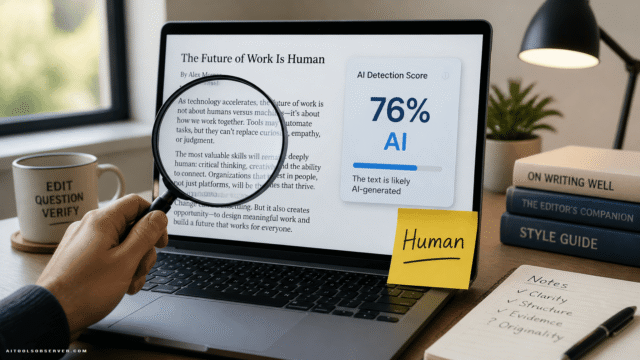
Gibson had tried AI-detection software before. It wasn’t working. Students have access to tools — humanizers, autotypers, paraphrasers — that rewrite AI output to sound more human, insert typos, and break detectable patterns. These tools are actively advertised to students online.
The Madagascar trap worked precisely because it bypassed detection software entirely. It didn’t analyze writing style or flag suspicious phrasing. It simply required the student to have read what they were submitting.
As the top comment on Gibson’s TikTok post about the incident put it: “Actually, all 35 students used AI. The ones who passed just proofread their responses.”
That comment cuts to the core of the issue. The three students who passed didn’t necessarily write their own essays. They just paid enough attention to remove the evidence.
What This Reveals About AI Use in Classrooms
This case study surfaces a few uncomfortable truths worth sitting with.
AI detection tools are losing the arms race. By the time a detection method becomes widely used, students have already found workarounds. Gibson’s manual trap outperformed any software he had access to.
The problem isn’t AI — it’s passive consumption. Gibson describes learning like compound interest: every time you engage with material, you build on what you already know. Students who outsource all of that to a chatbot aren’t just cheating on an assignment. They’re opting out of the entire process that makes education valuable.
Proofreading is now a differentiator. In a world where AI can generate a passable essay in seconds, the students who actually read their output before submitting it are already ahead. That’s a low bar, but it’s apparently not low enough for most.
What Professors Can Actually Do
Gibson’s approach offers a practical model, but it’s not infinitely scalable. You can only hide so many Madagascar traps before students start checking for white text.
A few approaches that appear to hold more long-term promise:
- In-person, handwritten exams for high-stakes assessments — harder to outsource, easier to verify
- Process-based assignments that require drafts, outlines, and revision history
- Oral defenses or follow-up questions tied to submitted work
- Prompts that require personal experience or class-specific context that an AI can’t fabricate without inside knowledge
- Rotating, unique prompts per student so shared AI outputs become obvious
None of these are foolproof. But they shift the burden back onto the student to engage with the material at some point in the process.
The Bigger Stakes
The concern Gibson raises goes beyond academic integrity policies. If students can move through a degree program by feeding prompts into a chatbot and submitting the output unread, they graduate with credentials that don’t reflect actual knowledge or capability.
That’s a problem for employers who hire them. It’s a problem for industries that depend on those graduates. And it’s a problem for the students themselves — who will eventually be asked to perform skills they never actually developed.
There’s a certain irony here. One of the loudest anxieties around AI is that it will replace human workers. Students who use AI to simulate competence they don’t have are essentially accelerating that outcome for themselves.
The Takeaway
Gibson’s Madagascar trap is a clever, low-tech solution to a high-tech problem. It worked not because it was sophisticated, but because it exposed something most AI-generated submissions have in common: nobody read them.
If you’re an educator, the lesson isn’t to copy this exact method. It’s to design assessments that require students to be present somewhere in the process — not just at the moment they hit submit.
And if you’re a student using AI to write your essays: at minimum, read what you’re turning in. Madagascar wore a toaster to a basketball game is not a sentence that should appear in a final exam about the Industrial Revolution.







Comments (0) No comments yet
Want to join this discussion? Login or Register.
No comments yet. Be the first to share your thoughts!