


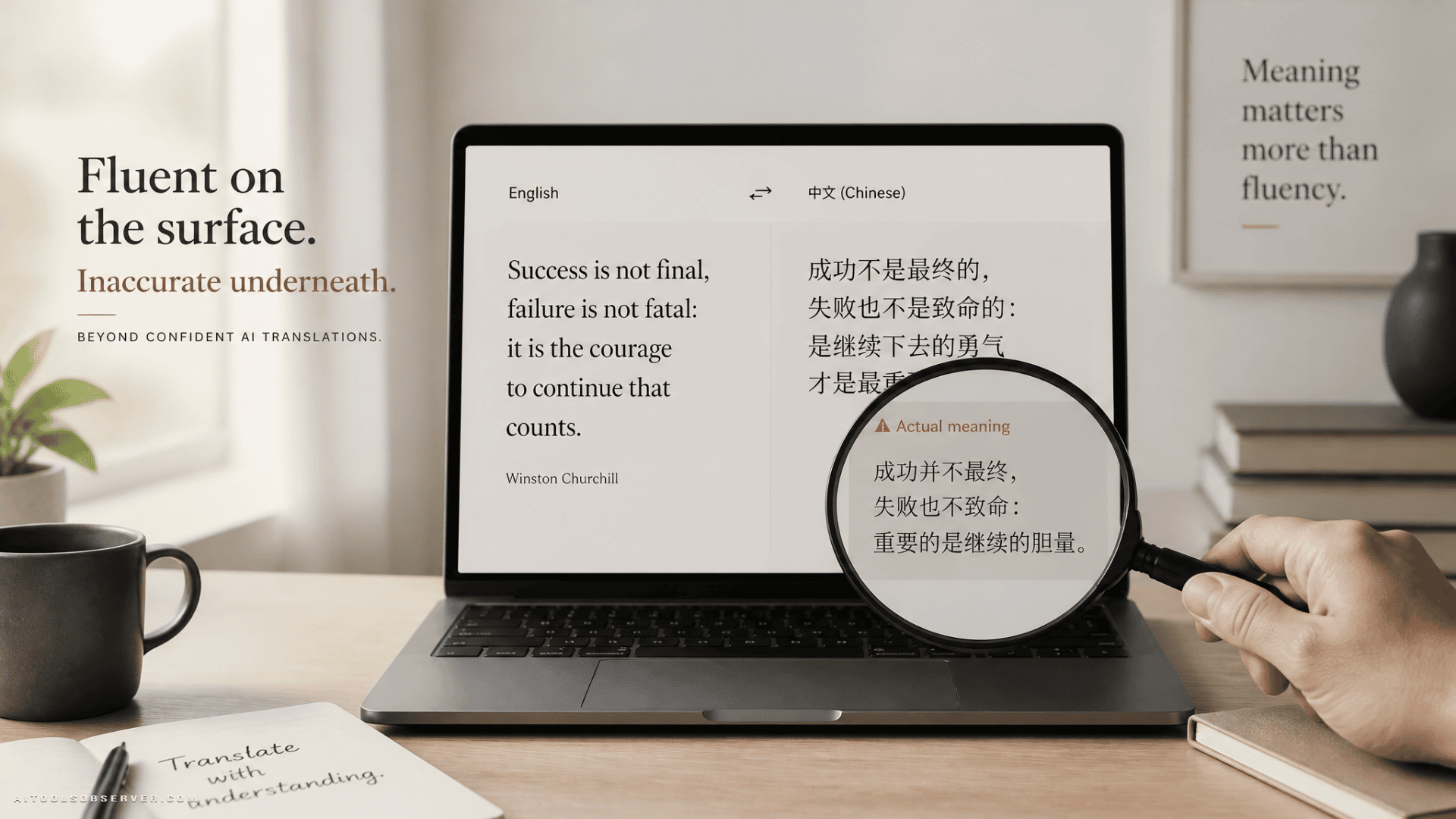
Fluency is not accuracy
A fluent sentence is easy to trust. It has the right rhythm, the right grammar, and none of the old-school robotic clunkiness people associate with machine translation.
But fluency is surface quality. Accuracy is whether the meaning survived the trip.
That gap matters because many translation errors are not dramatic. They don’t scream “wrong.” They slip in wearing good grammar.
Why AI translation goes wrong
Some errors come from familiar AI issues:
- weak or missing context
- vague prompts
- uneven training data
- hallucinations, where the system confidently invents or distorts meaning
Other errors are less fixable because they come from language itself. Human language is messy, flexible, context-heavy, and full of hidden assumptions. Translation is not just word replacement. It’s interpretation.
English and Chinese make this especially visible because they differ in structure, reference, and social tone, even when both languages are well represented in training data.
Word-level mistakes: one word, two meanings, one wrong turn
Words are sneaky. Many have multiple meanings, and AI does not always pick the right one.
A classic example: “thongs” in Australian English can mean flip-flops. In another context, it can mean underwear. An AI system may choose the wrong sense if it doesn’t understand the setting.
The output can still sound perfectly natural. It just becomes a different story.
Tense is another trap
English marks tense directly in verbs: “go,” “went,” “is going.” Chinese does not work the same way. Time is often carried by context, particles, or surrounding clues rather than verb changes.
So when translating Chinese into English, AI may guess the wrong tense. That can change whether something already happened, is happening now, or is still to come.
Small grammar choice. Big meaning shift.
Sentence-level mistakes: grammar can be correct and still be wrong
Some sentences are ambiguous on purpose. Others are ambiguous by accident. Either way, a translator has to decide what the sentence means.
Take a sentence like: “You can see him in the store.”
That could mean:
- he is in the store
- you are in the store when you see him
A human translator can often resolve this by using broader context. AI, especially in chatbot form, is more likely to make a probability-based guess. Sometimes it guesses well. Sometimes it just guesses smoothly.
That’s the dangerous version of wrong.
Text-level mistakes: coherence breaks quietly
Translation is not only about getting each sentence right. A full text needs internal logic. References must stay consistent. Readers need to know who is doing what, and what “it,” “they,” or “the issue” refers to.
English and Chinese handle cohesion differently.
English often uses articles and reference words to point back to earlier ideas. Chinese may rely more on repeating key terms directly. If AI links these references incorrectly, the whole passage can wobble without fully collapsing.
You may not notice until a paragraph suddenly feels vague, confusing, or oddly detached from itself.
Culture is not a footnote
Translation is also social design. It shapes distance, tone, authority, and relationship.
A government message in English might use “we” and “you” to sound direct and approachable. In Chinese, a more formal and institutionally distanced style may feel more appropriate depending on the context.
So even when the literal information is correct, the relational message can shift.
That matters for:
- public communication
- education
- healthcare
- customer support
- anything where tone carries trust
AI can deliver the words but miss the social setting those words live in.
Sensitive terminology is where things get awkward fast
Language changes. Communities update terms. Institutions slowly catch up. Models do not always keep pace.
This is especially risky with identity, disability, gender, mental health, and other socially sensitive areas. A translation may be understandable but outdated, blunt, or unintentionally offensive.
That can happen when newer, more inclusive terms are underrepresented in training data, while older terms are still more common in historical text.
In other words: the machine may be fluent in yesterday.
Hallucinations make translation riskier than it looks
A translation system should transfer meaning, not improvise. But generative AI sometimes does improvise.
It may add certainty where the original was vague. It may smooth over gaps by inventing detail. It may choose a plausible interpretation and present it as fact.
That is especially risky when translating:
- legal material
- medical content
- policy documents
- contracts
- academic work
- politically sensitive text
If the original is ambiguous, the model may “solve” that ambiguity for you. Convenient, until it’s wrong.
English-Chinese translation has strong support, but that doesn’t solve everything
English and Chinese are widely used languages with plenty of available text data. That usually helps AI systems perform better than they do on lower-resource language pairs.
Still, more data does not eliminate core translation problems.
You can still get:
- incorrect word sense
- wrong tense
- broken reference chains
- flattened cultural nuance
- socially clumsy terminology
- hallucinated certainty
High-resource does not mean low-risk. It just means the mistakes are often better dressed.
When AI translation is more trustworthy
AI translation tends to be more reliable when the source text is boring in the best possible way.
That usually means:
- the topic is familiar and concrete
- the writing is clear and grammatical
- the sentences are not ambiguous
- the content does not depend heavily on culture or subtext
- the terminology is stable and non-sensitive
- the language pair is widely used
- the prompt includes purpose, audience, and context
If you’re translating a simple product description or trying to grasp the general meaning of a non-critical text, AI may be good enough.
If you’re translating something where wording affects interpretation, reputation, or harm, “good enough” stops being a reassuring phrase.
Chatbots are not the same as translation systems
A general-purpose chatbot can translate, but translation is not necessarily its main job. Dedicated machine translation systems are typically designed specifically for that task.
That difference matters. A system built for conversation may optimize for fluency and helpfulness. A system built for translation is more likely to focus on faithful transfer of meaning.
Still, even specialized systems are not magic. They reduce certain problems. They do not erase them.
How to use AI translation without being fooled by it
If you want speed without walking into avoidable mistakes, use AI translation with a few guardrails.
Before translating
Write source text that gives the model fewer chances to be clever.
- keep sentences short
- remove avoidable ambiguity
- define unusual terms
- include context about audience and purpose
During translation
Ask for more than one output when the wording matters. If versions differ, that is a clue the source may be ambiguous.
You can also ask the model to:
- explain uncertain terms
- flag culturally sensitive wording
- preserve ambiguity instead of resolving it
- note where multiple interpretations are possible
After translation
Review against the source, not just for readability.
Check:
- tense and time references
- who is speaking
- who is being referred to
- tone and formality
- sensitive terms
- places where the output feels smoother than the original
That last one is often where meaning went missing.
So, can you trust it?
Yes, with limits. No, not blindly.
AI translation is useful for gist, drafts, and speed. It is much less trustworthy when precision, nuance, culture, or sensitivity matter. The polished output can hide the very errors you most need to catch.
A practical rule: trust AI translation more for understanding what a text is roughly saying, and less for deciding exactly what it means.
If the stakes are low, AI can save time. If the stakes are high, treat it like a fast intern with excellent grammar and occasional wild confidence.












Comments (0) No comments yet
Want to join this discussion? Login or Register.
No comments yet. Be the first to share your thoughts!