


The Problem AI Is Actually Solving
Conservationists aren’t drowning in a little data. They’re drowning in decades of weather records, billions of insect movement data points, and camera trap footage from ecosystems spanning continents. The traditional approach — manual sorting, then statistical tools that flatten complexity — was never going to scale.
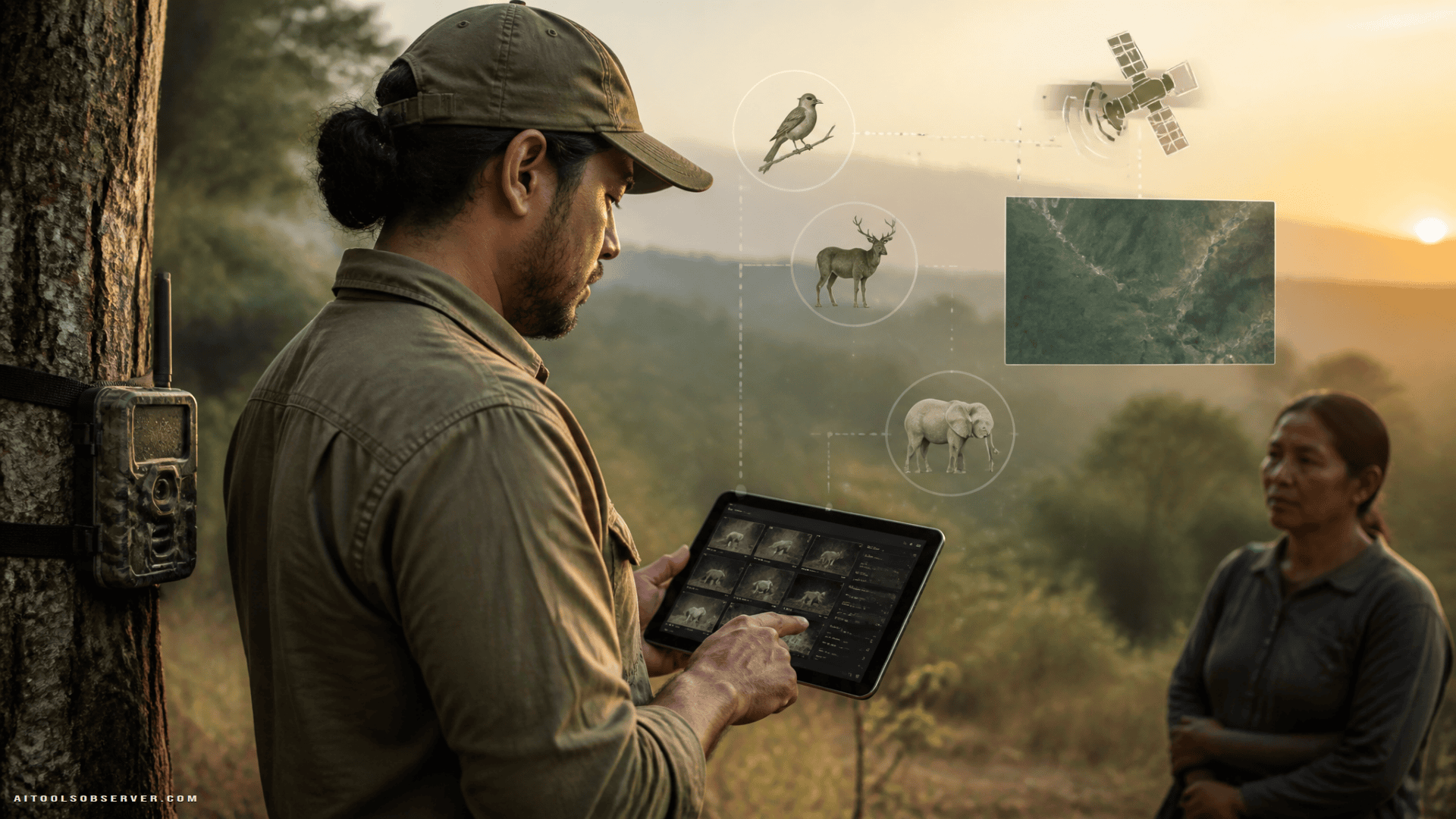
AI offers a genuine upgrade here. Image recognition models can process camera trap footage at scale, feeding databases like Wildlife Insights with behavioral data that helps predict how climate change or industrial development will hit biodiversity. That’s not hype. That’s a real workflow improvement.
Land use modeling is another strong fit. Custom AI models trained on economic and landscape data can flag likely deforestation before it happens, giving conservationists a window to act rather than react.
Where It Gets Genuinely Useful
A few specific applications stand out:
- Wildlife tracking at scale — birds, whales, insects — across migration routes and seasonal cycles
- Poaching detection — mass surveillance of shared human-animal landscapes to catch illegal harvesting in near real-time
- Illegal wildlife trade monitoring — chatbots scanning product listings the moment suspicious activity appears
- Extinction risk assessment — synthesizing hundreds of scientific publications faster than any research team could
- Environmental impact assessments — pulling from multiple sources to draft the foundational documents behind land development decisions
That last one is tempting as a shortcut. Which is exactly why it deserves the most scrutiny.
Bias baked in from the start
An AI model is only as good as what it was trained on. Train an audio recognition system on city recordings and it will confidently hear pigeons in a rainforest. Train a conservation chatbot primarily on research from high-income, historically male-dominated institutions in the global north, and it will reflect those perspectives — often at the expense of local ecological knowledge and indigenous communities.
This isn’t a theoretical edge case. It’s a structural problem with how most AI trained on data is assembled.
The map that loses the territory
A skilled ecologist walking an ecosystem notices things that weren’t on the checklist — a conversation with a local farmer revealing planned land expansion, signs of wildlife harvesting that never got digitized. An AI system can only read what’s already been converted into data. It can’t ask questions. It can’t be surprised.
Replacing field judgment with AI-generated maps risks producing confident, detailed, and quietly wrong outputs.
Surveillance cuts both ways
Mass monitoring of wildlife landscapes also monitors the people in them. Local communities living off that land may experience this as intrusion — and respond by opposing conservation governance or disabling equipment. An AI deployment that alienates the humans closest to an ecosystem isn’t a conservation win. It’s a new problem.
The expertise erosion loop
When AI handles animal identification, the human skill of taxonomy atrophies. That skill is already declining faster in biodiversity-rich, lower-income countries in Africa — the places where it matters most. And here’s the loop: that human expertise is exactly what’s needed to catch and correct AI errors. Lose the experts, lose the error-checking.
What Responsible Use Actually Looks Like
The researchers behind the horizon scan that surfaced these issues are clear: strong regulation isn’t optional, it’s a moral and legal imperative. The sector needs:
- Validation protocols to catch fabricated or hallucinated information before it influences decisions
- Limits on chatbot authority — AI should inform human judgment, not replace it
- Mandatory disclosure of AI prompt histories so outputs can be audited
- Training dataset standards so practitioners can select models appropriate to their specific ecosystem and context
None of this is anti-AI. It’s pro-accuracy.
The Useful Takeaway
AI in conservation is a force multiplier — which means it amplifies whatever you bring to it. Bring strong ecological expertise, local knowledge, and critical oversight, and it genuinely helps. Bring shortcuts and unchecked automation, and it will produce confident, scalable, hard-to-reverse mistakes.
The tools are ready. The governance frameworks, in most places, are not. That gap is the actual problem worth solving right now.









Comments (0) No comments yet
Want to join this discussion? Login or Register.
No comments yet. Be the first to share your thoughts!