


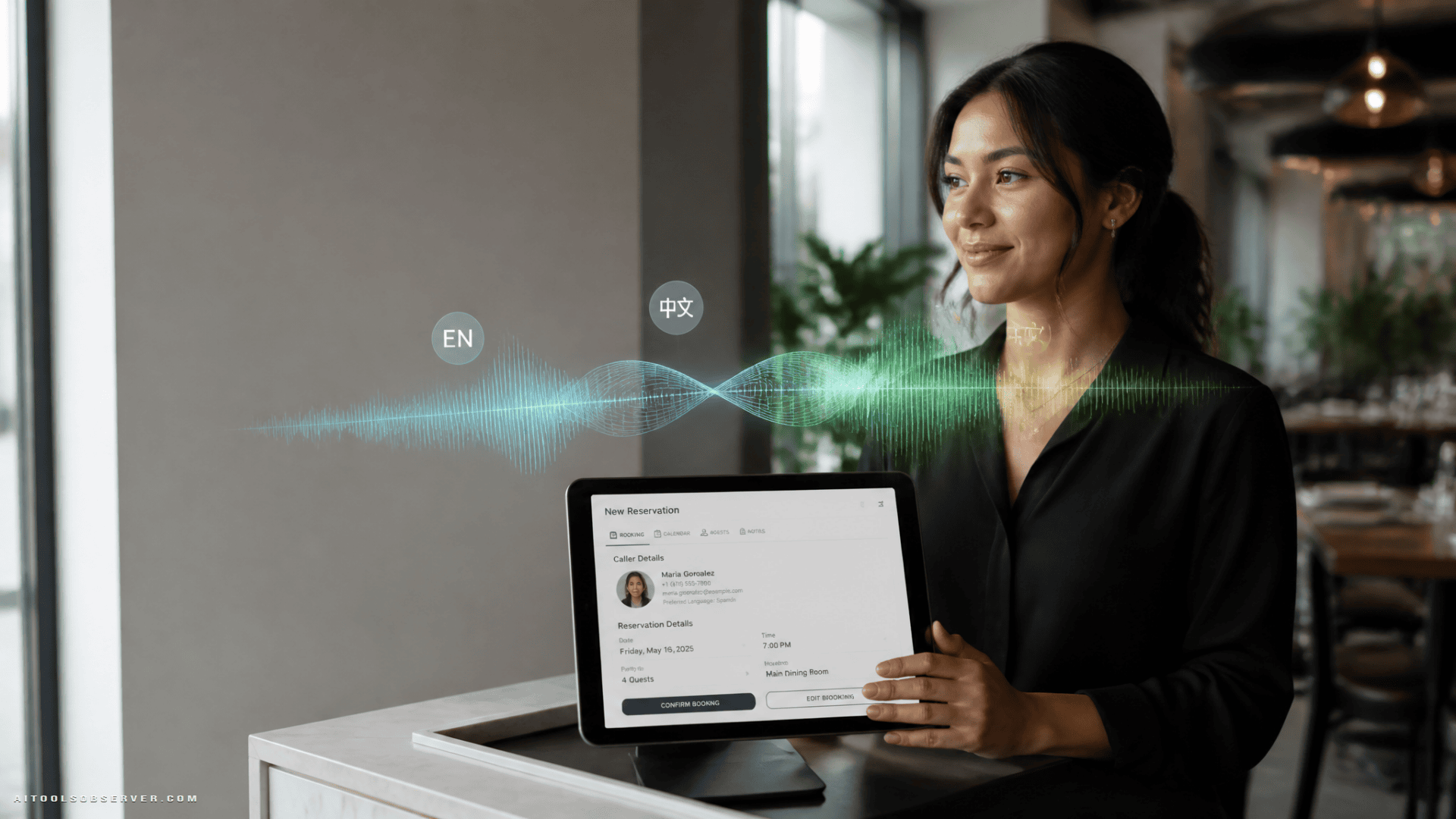
What GPT-Live-1 Actually Changes
The core shift is architectural. Previous voice AI systems typically operated in a turn-based pattern: the caller speaks, the system processes, the system responds. Full-duplex removes that constraint, allowing both sides of the conversation to speak simultaneously without the AI losing its thread.
For Yelp Host and Hatch, this translates into three practical improvements:
- Natural turn-taking — callers can interrupt, correct themselves, or ask follow-up questions mid-sentence without the system stalling
- Automatic language detection — the voice agents identify and respond in the caller’s language without requiring manual configuration
- Sharper transcription accuracy — post-call records are cleaner, which matters for restaurant operators reviewing call logs or service businesses auditing lead quality
Early testing with Yelp Host reportedly shows callers speaking in full, natural sentences rather than clipped voice commands—a signal that the interaction feels less like talking to a machine.
Yelp Host: One Million Calls and Counting
Yelp Host launched in October 2025 and has since handled more than one million calls for restaurants. The product is built on Yelp’s proprietary business data—reservation availability, menu information, seating configurations, food ordering—giving it operational context that a generic voice model would lack.
The GPT-Live-1 integration layers improved conversational fluency on top of that existing data foundation. The combination is the relevant point here: a frontier voice model alone does not know a restaurant’s seating policy or current specials. Yelp Host’s value proposition rests on pairing model capability with structured, business-specific data.
Initial production results suggest improved call-handling rates and a reduction in calls transferred to human staff—though specific figures have not been disclosed.
For readers tracking adjacent restaurant automation, restaurant recommendations and booking workflows remain another visible part of how AI is being applied in hospitality.
Hatch: Operational Intelligence for Service Businesses
Hatch, a Yelp company focused on service businesses such as HVAC, plumbing, and home repair, operates at a different scale. The platform manages tens of millions of leads across voice, text, email, and web channels.
Its voice AI is designed around the operational logic of service businesses: verifying service areas, checking technician availability, applying scheduling rules, and routing emergency calls appropriately. GPT-Live-1 improves how those conversations feel; Hatch’s existing operational layer determines what actually happens as a result.
The practical outcome is a voice agent that can qualify a lead, confirm job details, and book an appointment in a single call—without a human dispatcher involved. For businesses handling high inbound volume from third-party lead sources, that workflow compression has direct revenue implications.
What This Means for the Broader Voice AI Market
This integration is a useful data point for anyone evaluating voice AI tools for local or service businesses. A few observations worth noting:
Model quality is necessary but not sufficient. Both Yelp and Hatch are explicit that GPT-Live-1 improves the conversational experience, but the operational value comes from the business-specific intelligence built on top of it. Buyers evaluating voice AI tools should ask what proprietary data or workflow logic sits beneath the model layer.
Full-duplex is becoming a baseline expectation. As more platforms adopt this architecture, turn-based voice AI will increasingly feel dated. Tools that have not yet made this transition are worth watching closely.
Multilingual support without configuration is a meaningful differentiator. For restaurants and service businesses in diverse urban markets, automatic language detection removes a real operational gap. Previously, a language mismatch often meant a lost customer.
Improved transcription accuracy also matters beyond the live conversation, especially when teams rely on call records for auditing and follow-up.
The Practical Takeaway
If you are evaluating voice AI for a restaurant or service business, the Yelp Host and Hatch integrations represent a concrete benchmark for what current-generation voice AI can deliver: natural conversation flow, operational context awareness, multilingual handling, and booking automation in a single workflow.
The more useful question to ask of any voice AI vendor right now is not whether they use a capable model—most do—but whether their system understands the specific operational rules of your business well enough to act on a call without human intervention.













Comments (0) No comments yet
Want to join this discussion? Login or Register.
No comments yet. Be the first to share your thoughts!