


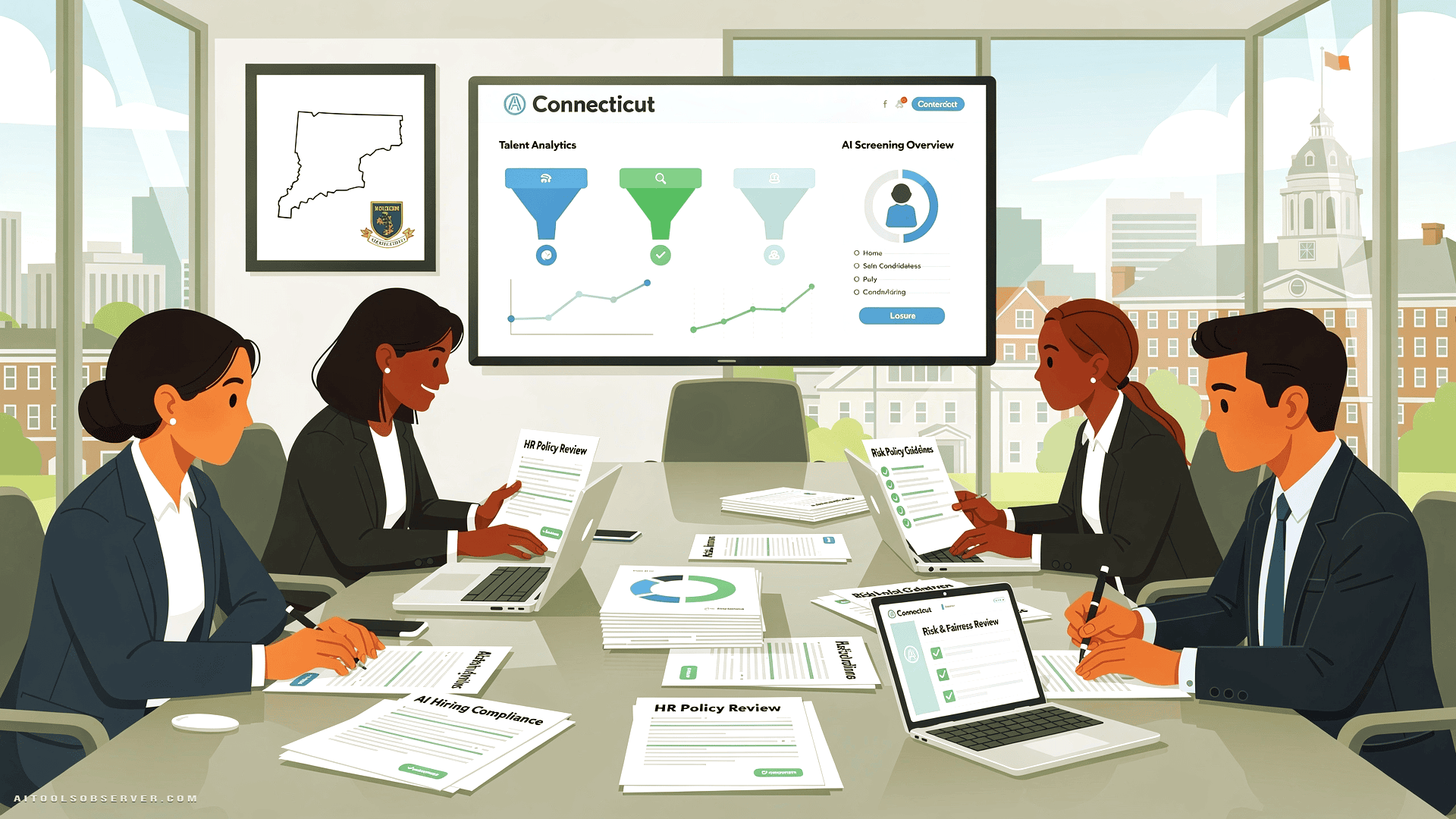
Why SB 5 Is a Landmark Moment for AI in the Workplace

State AI laws have been building for years, but Connecticut’s SB 5 is different in scope. It doesn’t just regulate one slice of AI use — it creates a layered compliance framework across consumer, employment, and government contexts simultaneously.
For the AI tools ecosystem specifically, the employment provisions are the most immediately disruptive. They directly constrain how employers can deploy automated decision tools and what disclosures they must make when those tools influence someone’s job.
Colorado recently pulled back its own AI law and delayed its effective date. Connecticut moved forward. That contrast signals something important: state-level AI regulation is not slowing down, it’s diverging — and employers operating across multiple states now face a patchwork that demands active governance, not passive monitoring.
What Counts as “Automated Employment-Related Decision Technology”

Before you assess your exposure, you need to understand exactly what the law covers.
SB 5 defines “automated employment-related decision technology” as any technology that processes personal data and uses computation to generate outputs — predictions, recommendations, classifications, rankings, scores — that are a substantial factor in making an employment-related decision.
Employment-related decisions include:
- Hiring and firing
- Promotions and demotions
- Discipline
- Tenure, terms, and conditions of employment
The law carves out common software tools — word processors, spreadsheets, spam filters, antivirus software, map navigation — so routine productivity software is not in scope. Scheduling tools, productivity monitoring, and decisions resulting in nonmaterial changes to job tasks are also excluded.
But if your ATS scores candidates, your performance platform generates termination recommendations, or your compensation tool ranks employees for raises — those are almost certainly in scope.
The Notice Requirements: What Employers Must Disclose

This is where the operational weight lands. Starting October 1, 2027, any employer deploying covered automated employment-related decision technology must provide written notice to affected employees or applicants before making a decision using that technology.
What the Notice Must Include
The disclosure isn’t a checkbox — it requires specific, substantive information:
- That the employer has deployed the technology
- The purpose of the technology and the nature of the decision being made
- The trade name of the technology
- The categories of personal data being analyzed and how it will be assessed
- The sources of that personal data
- Contact information for the deployer
Plain language is required. If it would be obvious to a reasonable person they’re interacting with automated technology, the interaction-level disclosure can be skipped — but the pre-decision written notice still applies.
What Happens If You Don’t Comply
Failure to provide notice constitutes an unfair or deceptive trade practice, enforceable exclusively by the state attorney general. There is no private right of action for notice violations.
For violations before December 31, 2027, employers get a 60-day cure window after receiving a notice of violation. After that grace period closes, enforcement becomes more direct.
The absence of a private right of action sounds like relief — but attorney general enforcement at scale can be just as consequential for brand reputation and operational disruption.
AI Is Not a Shield Against Discrimination Claims

This provision deserves its own spotlight because it directly reshapes how legal teams and HR leaders think about AI tool adoption.
SB 5 amends Connecticut’s employment discrimination law to explicitly state that using covered automated decision technology is not a defense against a discrimination complaint. You cannot argue “the algorithm decided” as a way to deflect liability.
Courts and the Connecticut Commission on Human Rights and Opportunities can, however, consider evidence of anti-bias testing as a mitigating factor. The quality, recency, scope, and results of that testing all matter.
The practical implication is clear: deploying an AI hiring or performance tool without documented bias audits is now a legal liability, not just an ethical concern. Vendors who cannot provide bias testing documentation become a compliance risk for their enterprise customers.
RIF Disclosures: The WARN Act Gets an AI Layer

This provision takes effect earlier — October 1, 2026 — and it directly affects how employers communicate mass layoffs.
Any employer required to file a WARN Act notice (100 or more employees, 60 days advance notice for plant closings or mass RIFs) must now disclose whether those reductions are related to the employer’s use of AI or another technological change.
This is significant for several reasons.
First, it creates a public record linking AI adoption to workforce displacement. Second, it signals to regulators, employees, and the public when automation is driving headcount decisions. Third, it puts pressure on employers to be deliberate — and honest — about how they frame technology-driven restructuring.
If you’re planning a RIF in the next 12 months and AI tools are part of the operational rationale, your legal and communications teams need to coordinate on this disclosure now.
Whistleblower Protections for Frontier AI Developers

SB 5 also targets the companies building the most powerful AI systems — what the law calls “frontier developers” of “foundational models.”
These are AI systems with some level of autonomy, capable of making inferences and influencing physical or virtual environments. Think large language models and autonomous AI agents.
What Frontier Developers Must Do
By January 1, 2027, large frontier developers must:
- Establish an anonymous internal reporting process for employees who believe the company’s AI poses a specific and substantial danger to public health or safety
- Follow up on reports and provide reasonable investigation updates
- Disclose investigation status and actions taken to officers and directors at least quarterly
- Provide clear written notice to all employees — including new hires and remote workers — of their whistleblower rights
Retaliation against employees who report safety concerns is prohibited. Violations carry civil penalties of up to $1,000 per violation, enforced by the attorney general.
For AI tool companies operating in Connecticut or employing Connecticut residents, this creates a new internal governance obligation that sits alongside product safety and model evaluation processes.
The Workforce Impact Study: A Signal of What’s Coming

SB 5 directs the Institute for Municipal and Regional Policy at the University of Connecticut to study AI’s impact on Connecticut’s workforce — tracking RIFs, job displacement, effects on entry-level roles, and disproportionate impacts on women and underrepresented populations.
This study isn’t just academic. It’s the data infrastructure for the next wave of regulation.
When that research surfaces concrete numbers on AI-driven displacement — especially for vulnerable populations — expect it to fuel additional legislative action, both in Connecticut and in states watching closely. Employers and AI tool vendors who aren’t already tracking their own workforce impact data will be playing catch-up.
What AI Tool Vendors Need to Understand

SB 5 doesn’t just regulate employers — it reshapes what enterprise buyers will demand from AI tool vendors.
If your platform influences hiring, performance management, compensation, or workforce planning, your customers in Connecticut now need:
- Your tool’s trade name disclosed in employee notices
- Documentation of what personal data your tool processes and how
- Evidence of anti-bias testing they can present as a mitigating factor in discrimination proceedings
- Clarity on whether your tool’s outputs constitute a “substantial factor” in covered employment decisions
Vendors who can provide clean, auditable answers to these questions will have a competitive advantage. Those who can’t will face procurement friction as enterprise HR and legal teams tighten their AI governance requirements.
Compliance Steps to Take Before the Deadlines Hit

The timeline is tight. October 1, 2026 is the first compliance date — less than six months from signing.
Here’s where to focus:
Immediate (now through Q3 2026)
- Audit every AI tool currently used in employment-related decisions
- Identify which tools meet the definition of “automated employment-related decision technology”
- Review WARN Act procedures and update RIF notice templates to include AI disclosure language
- Assess whether any planned RIFs are connected to AI or technology adoption
Before October 1, 2027
- Build or update employee and applicant notice workflows for each covered AI tool
- Collect trade names, data categories, data sources, and contact information for every covered deployment
- Commission or review bias audits for tools used in hiring, promotion, and termination decisions
- Implement or update an AI governance and use policy
Ongoing
- Monitor attorney general enforcement guidance as it develops
- Track parallel developments in Colorado, the federal AI executive order framework, and other state legislatures
- Establish a review cadence for AI tools as your vendor landscape evolves
The Bigger Picture: State AI Law Is Accelerating

Connecticut’s SB 5 doesn’t exist in isolation. Colorado is recalibrating. The Trump administration is pushing for a federal preemption framework. Other states are watching Connecticut’s approach closely.
The direction of travel is clear: AI tools that touch employment decisions are entering a regulated environment, and that environment is getting more structured every quarter.
For HR leaders, this means AI tool selection is now a compliance decision, not just a productivity one. For AI tool vendors, it means enterprise sales increasingly run through legal and compliance review. For founders building in this space, it means transparency, auditability, and bias documentation are product requirements — not optional features.
Connecticut drew a line. The question isn’t whether other states will follow. It’s how fast.










Comments (0) No comments yet
Want to join this discussion? Login or Register.
No comments yet. Be the first to share your thoughts!