



What Is Unity AI Gateway?
Unity AI Gateway is Databricks’ answer to the question: how do you govern AI at scale without slowing it down?
Built on top of Unity Catalog — the same framework enterprises already use to govern data and AI assets — Unity AI Gateway extends that governance into the live interactions between models, agents, tools, and enterprise systems. It covers access control, cost management, runtime policy enforcement, and observability in a single platform.
The key distinction is runtime scope. Traditional governance tells you who can access a model. Unity AI Gateway also governs what that model or agent is allowed to do during a specific interaction, and at what cost.
The Four Pillars Announced at Data + AI Summit 2026
Databricks unveiled a significant expansion of Unity AI Gateway at Data + AI Summit 2026. The new capabilities fall into four coherent areas, each addressing a distinct governance challenge that emerges as AI scales across an enterprise.
1. Cost Controls and Smart Routing

AI spend is increasingly fragmented. Token costs accumulate across coding agents, frontier model APIs, internal applications, and custom pipelines — often with no unified view of where money is going or why.
Unity AI Gateway now provides unified AI spend visibility, aggregating costs across Databricks-hosted models, external model providers, and third-party coding agents into a single dashboard. Administrators can attribute spend by user, team, tool, or use case, making it possible to understand not just total cost but where AI is actually delivering value.
Two new enforcement mechanisms add teeth to this visibility. Hard spend caps automatically halt requests once a budget threshold is crossed, preventing runaway costs from unchecked agent loops or high-volume pipelines. Smart routing goes further by recommending and automatically directing requests to the most appropriate model based on task complexity, quality requirements, and cost — a practical tool for organizations running both large and small models in parallel.
Udemy offers a concrete illustration of this in practice: routing all foundation model traffic through Databricks AI Gateway gives them a single governance layer, with PII detection pipelines intelligently balancing smaller and larger GPT models for cost efficiency.
2. Unified Governance of AI Assets and Interactions

As AI deployments grow, the number of models, agents, MCP servers, and skills multiplies quickly. Most enterprises still govern these assets separately — if at all — which produces fragmented access policies and limited visibility into what AI systems are actually doing.
Unity Catalog now extends beyond data to govern the full AI asset inventory: foundation models from any provider, external MCP services, registered agents, and reusable skills. The same fine-grained access policies used for data can now be applied to model access, with dynamic enforcement based on attributes such as model provider, country of origin, or approval status.
Managed MCP services for Google Drive, Jira, Confluence, Slack, GitHub, and SharePoint are now available out of the box, removing the infrastructure burden from teams that need governed integrations quickly. Custom MCP services can also be registered, creating a centralized inventory of approved tools that developers can discover and use from Databricks, coding agents, Genie, or external frameworks.
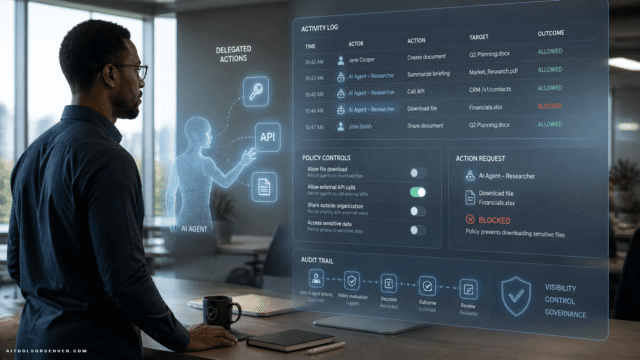
The most significant new addition here is Contextual Service Policies, currently in Beta. These policies move governance beyond access control into behavioral control. Administrators can allow, deny, or require approval for specific agent actions — such as pushing code to GitHub, modifying files, or accessing sensitive data — based on the user, agent, model, tool, or the actual contents of a request or response. Runtime guardrails can also enforce protections against PII exposure, prompt injection, jailbreaks, and unsafe content.
This is a meaningful shift. It means governance is no longer just a gate at the entry point; it travels with the agent throughout the interaction.
3. Agent Monitoring and Incident Investigation
When an AI workflow spans multiple models, agents, and MCP services, reconstructing what happened during a specific interaction is genuinely difficult. Logs are scattered, traces are incomplete, and troubleshooting requires piecing together information from systems that were never designed to talk to each other.
Unity AI Gateway now provides end-to-end agent tracing — a unified telemetry layer that captures model interactions and MCP tool activity together, giving teams a coherent view of how AI workflows execute across services.
Two additional capabilities extend this monitoring into analysis and investigation. Genie integration allows teams to explore coding agent logs in natural language, identifying costly workflows and understanding how agents spend their time. Lakewatch integration enables security teams to analyze Gateway traces, detect suspicious activity, investigate policy violations, and accelerate AI security investigations.
For organizations in regulated industries — where auditability is not optional — this kind of unified observability is a prerequisite for responsible AI deployment at scale.
4. An Open Ecosystem of Security and Identity Integrations
Unity AI Gateway is designed as an open governance platform, not a closed one. Databricks is expanding its ecosystem with integrations across AI security, identity governance, data protection, and threat detection.
Upcoming integrations include AI security providers such as CrowdStrike, Palo Alto Networks, Netskope, HiddenLayer, Zscaler, and others, alongside identity providers including Okta, Ping Identity, and Saviynt. The intent is to allow organizations to bring their existing security and identity infrastructure into the AI runtime path rather than building parallel controls from scratch.
CrowdStrike’s framing is instructive: the goal is to make the Falcon platform the security layer for AI, delivering visibility and protection at the same level enterprises expect for their broader infrastructure. Okta’s integration extends consistent identity governance to agents and the data pipelines they touch — a recognition that agents, like users, need verifiable identities and explicit permissions.
Omnigent on Databricks: Managed Agent Workflows
Alongside the Gateway announcements, Databricks introduced Omnigent on Databricks in Beta — a managed version of the open-source Omnigent meta-harness for building and running agents across models, frameworks, and coding tools.
The value proposition is straightforward: bring your existing Omnigent setup — harnesses, workflows, skills — and deploy it to Databricks for managed execution with shared history, remote access, collaboration, and isolated cloud execution on Lakebox. Unity AI Gateway governs every Omnigent interaction automatically, applying cost controls, smart routing, and unified telemetry without requiring additional configuration.
Who Is This For?
Unity AI Gateway is built for organizations that have moved beyond AI experimentation and are now managing AI at scale — multiple models, multiple agents, multiple vendors, and real cost exposure.
The primary audience is enterprise AI and platform teams responsible for governance, security, and cost management. It is equally relevant to AI engineers who need observability and policy enforcement without building custom tooling, and to security and compliance teams in regulated industries where auditability is a hard requirement.
It is less relevant for teams running a single model in a contained environment with no cross-system integrations. The platform’s value scales with complexity.
What Makes This Approach Distinct
Most AI governance solutions address either access control or observability, but rarely both — and almost none extend into behavioral runtime controls. Unity AI Gateway’s architecture is notable for combining all three layers: who can access what, what they can do during an interaction, and a full audit trail of what actually happened.
The integration with Unity Catalog is also a meaningful architectural choice. Organizations that already govern their data through Unity Catalog do not need to build a separate governance framework for AI interactions. The same policies, the same lineage model, and the same access controls extend naturally into the AI runtime.
A Closing Observation
The trajectory of enterprise AI is toward greater distribution — more models, more agents, more external services, more autonomous action. Governance frameworks that were designed for static data access are not equipped for that environment.
Unity AI Gateway represents a considered attempt to build governance that travels with AI as it acts, not just as it is accessed. Whether the execution matches the architecture will depend on how organizations implement it in practice. But the design direction — runtime controls, unified cost visibility, behavioral policies, and an open ecosystem — reflects a clear-eyed understanding of where enterprise AI governance actually needs to go.











Comments (0) No comments yet
Want to join this discussion? Login or Register.
No comments yet. Be the first to share your thoughts!