


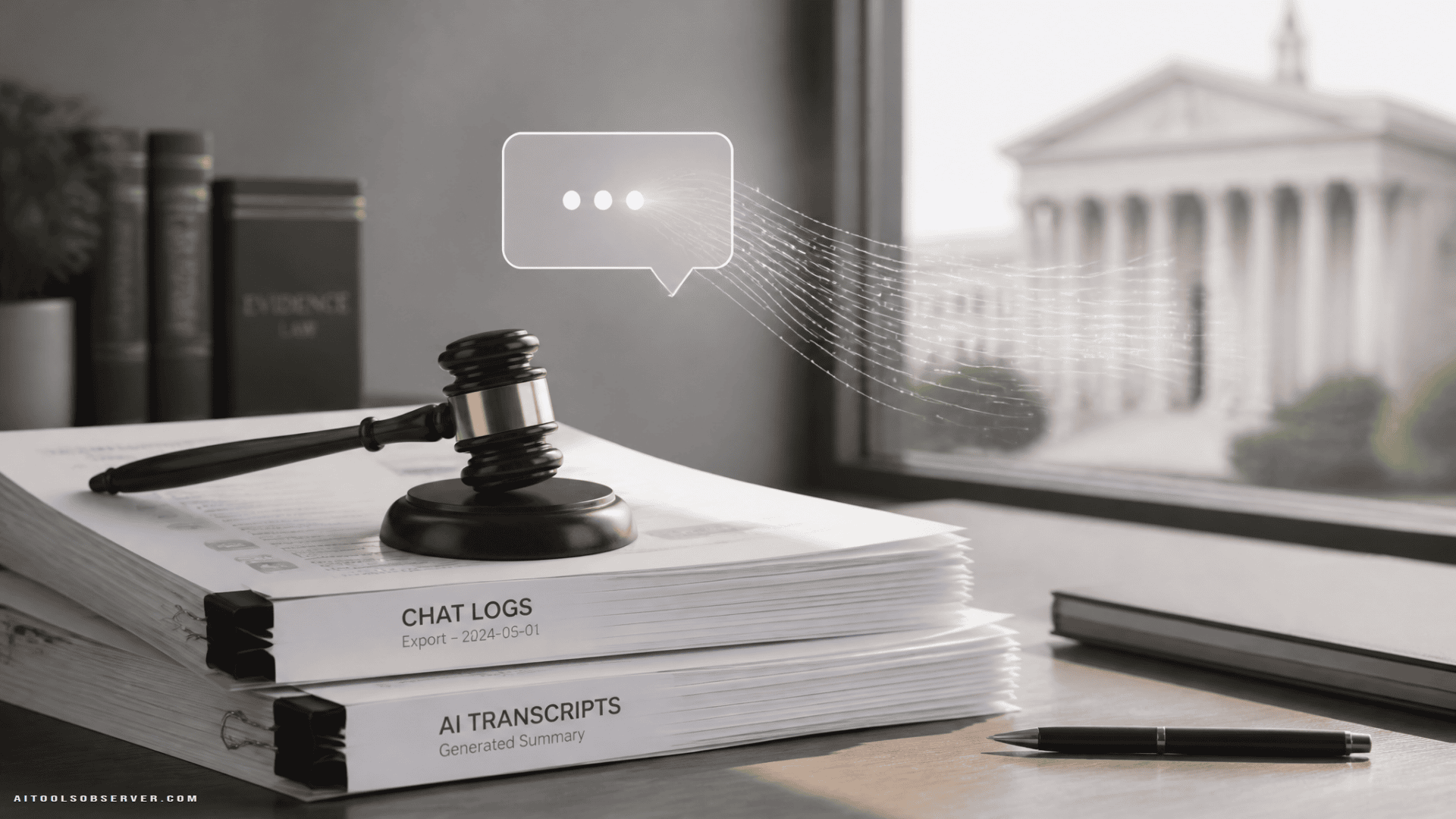
Your Chatbot Is a Prolific Record-Keeper
Generative AI has become one of the most active document-creation systems inside modern organizations. Employees use it to draft memos, summarize meetings, analyze data, and think through strategy. Every one of those exchanges leaves a trail.
Courts have not invented a special exemption for AI-generated material. They’ve applied the ordinary discovery framework — and that framework is not gentle.
The copyright litigation against OpenAI offers a useful preview. A magistrate judge ordered the preservation and production of vast quantities of output-log data, including millions of anonymized ChatGPT logs. Privacy concerns shaped how the material was produced, not whether it was. That distinction matters enormously.
The practical read: if your AI records are relevant to a dispute, they can be ordered produced. Treating them as invisible is a planning failure waiting to become a sanctions problem.
The Spoliation Trap Is Already Set
The duty to preserve relevant evidence attaches once litigation is reasonably anticipated — before any complaint is filed. That duty now extends to AI-generated ESI.
Here’s the problem: most AI tools aren’t designed to retain data by default. Many delete conversation history automatically. Some offer ephemeral sessions that vanish by design. A company that anticipates litigation and does nothing to override those defaults may find that relevant prompts and outputs are simply gone.
That’s the classic setup for a spoliation claim.
When a legal hold is triggered, counsel now needs to ask:
- Which AI tools are employees using?
- Are those tools auto-deleting conversation history?
- What steps are needed to suspend deletion and capture relevant logs?
Most legal-hold checklists don’t include those questions yet. They should.
Privilege Is Not a Safe Assumption
Companies sometimes assume that an AI exchange involving counsel is automatically protected. Courts have started pushing back on that assumption — and the emerging split is genuinely unsettling.
The fault line runs through public versus enterprise tools. Some courts have suggested that feeding protected material into a public AI model can jeopardize privilege, on the theory that disclosure to an outside system undercuts confidentiality. Other courts have declined to find waiver, treating the tool more like ordinary software than a third-party disclosure.
The result: the same prompt can be shielded as work product in one court and exposed in another.
What Actually Affects the Analysis
- Which tool was used — consumer-grade or enterprise, and under what terms
- Whether counsel was genuinely involved — not just cc’d
- Whether the platform contractually protects confidentiality — many consumer tools reserve broad rights to retain and use inputs
- Whether the purpose was documented — after-the-fact assertions are harder to defend
The safer course is to keep sensitive or privileged material away from tools whose confidentiality posture is uncertain. A public chatbot is not a secure channel for litigation strategy.
When AI Output Becomes a Business Record
Here’s a category question many organizations haven’t confronted: when does an AI output carry its own retention obligations?
If employees rely on AI outputs to make decisions — or if those outputs support compliance, audit, or client-facing functions — the outputs can take on the character of business records. In regulated industries, that’s not a theoretical concern. A financial services firm whose advisers use AI to draft client communications, or a healthcare organization whose staff use AI to summarize records, may have retention and supervision duties that reach the AI layer.
Ignoring those duties creates exposure not just in civil discovery but in regulatory examinations.
There’s also a less obvious risk on the other side: over-retention. Indefinitely keeping every prompt and output builds a growing reservoir of material that can be subpoenaed and used against the organization in future disputes. A candid, hastily typed prompt can read very differently to a jury than it did to the person who wrote it.
The goal isn’t maximal retention. It’s deliberate retention — keeping what the business genuinely needs and what the law requires, for defined periods, under a policy applied consistently.
What to Actually Do About It
The path forward is governance, not avoidance. A few concrete starting points:
Inventory your AI usage. Include shadow AI — tools employees adopted on their own without IT approval. A preservation duty can’t be met for data no one knows exists.
Set deliberate retention policies. Don’t default to whatever the vendor’s settings happen to be. Make explicit choices about what AI data is kept, for how long, and where.
Update legal-hold procedures. Add a checklist item that prompts counsel to identify AI usage, suspend auto-deletion, and capture relevant prompts, outputs, and logs when a hold attaches.
Address AI ESI in litigation protocols early. Sources, formats, search methodology, privacy safeguards, and protective orders — courts increasingly expect these to be negotiated upfront.
Train employees plainly. Their AI interactions are not private, may be preserved, and may become evidence. Sensitive or privileged material belongs on vetted, contractually protected enterprise tools — not public chatbots.
None of this requires abandoning generative AI. It requires treating AI-generated content as what courts have already decided it is: ordinary ESI, governed by ordinary rules, carrying ordinary risk.
The organizations that internalize that now — before a preservation demand forces the issue — are the ones whose chatbots won’t end up as the most damaging witnesses in their own cases.
















Comments (0) No comments yet
Want to join this discussion? Login or Register.
No comments yet. Be the first to share your thoughts!