


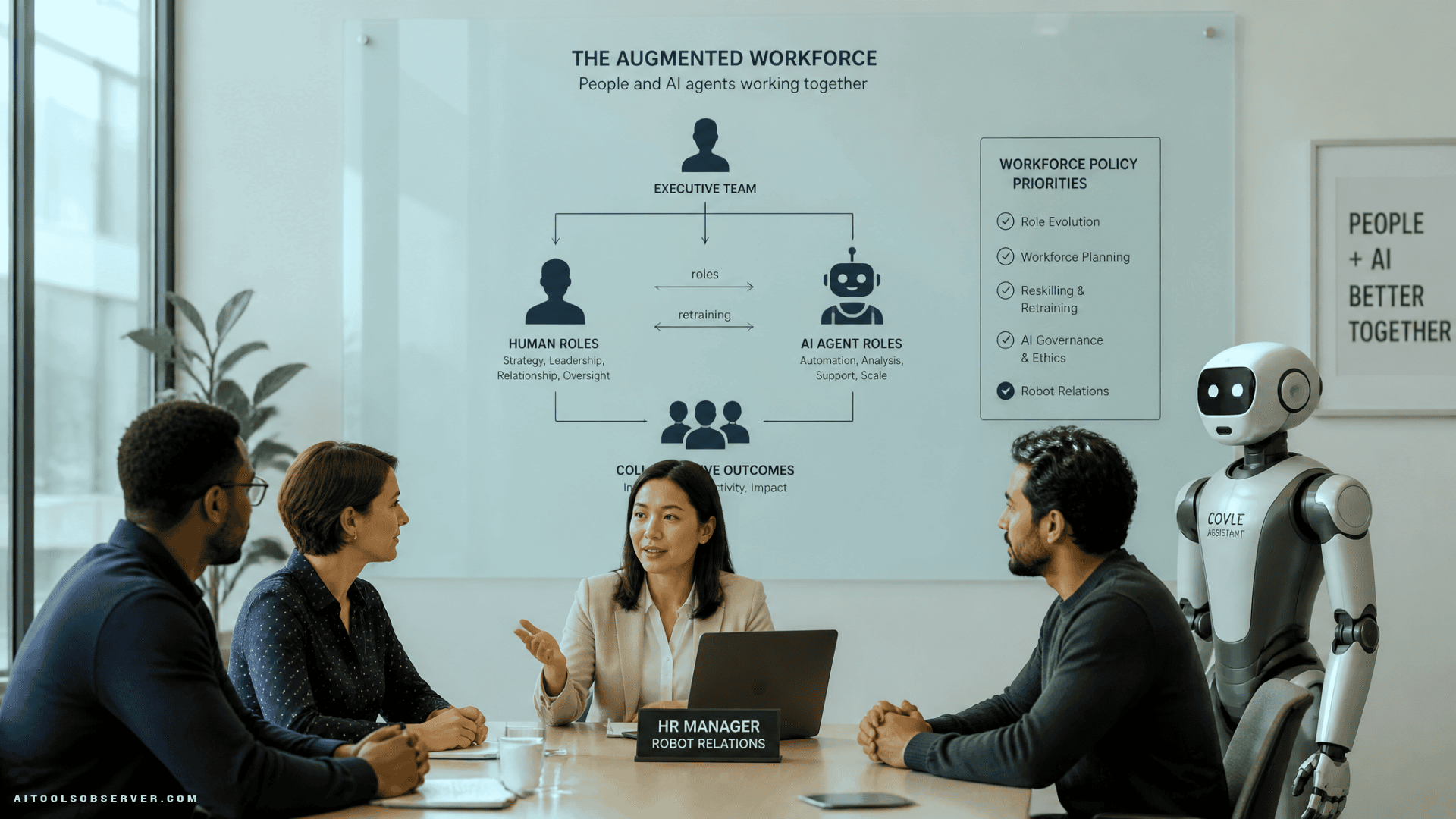
A New Organizational Function Is Emerging
The concept of a dedicated “Robot Relations” (RR) function is gaining traction as a practical response to a concrete problem. When an employee believes an algorithm is treating them unfairly, or when a team cannot figure out how to integrate an AI agent into their workflow, the existing HR department typically lacks the technical literacy to respond usefully. And the IT department lacks the human-relations framing to address it properly.
The emerging answer is a merged or supplementary function that sits at the intersection of both. Robot Relations departments would be responsible for:
- Managing how employees interact with AI assistants, agents, and cobots
- Handling complaints about algorithmic bias or opaque automation decisions
- Ensuring job descriptions and compensation reflect actual human-AI work arrangements
- Overseeing retraining as roles shift or disappear
This is not a rebranding exercise. It represents a genuine restructuring of how organizations manage their internal workforce dynamics.
The New AI Job Landscape
Alongside the structural change in HR, entirely new job categories are forming. Some are obvious extensions of existing roles; others have no real precedent.
AI agent management is one of the clearest examples. Organizations deploying AI assistants and chatbots for administrative tasks, customer communications, or internal operations are discovering that these systems require human oversight that combines subject-matter expertise, technical understanding, and the ability to translate between technical and non-technical staff. That combination is rare and currently undersupplied.
Robot specialists are becoming essential in manufacturing and defense contexts, where robots are no longer simple mechanical systems but reasoning entities equipped with sensors and adaptive learning capabilities. Someone has to monitor whether these systems are performing as intended and flag deviations before they become costly.
Cobot supervisors occupy a different niche—focused on the human side of human-robot collaboration. Collaborative robots can take over dangerous, repetitive, or physically demanding tasks, but enabling that transition requires people who understand both the technical capabilities of the cobot and the psychological and practical needs of the human workers alongside them.
Human-computer interface designers and process workers will be in sustained demand. The adoption curve for any technology is shaped heavily by usability. Organizations that deploy AI tools with poor interfaces, unclear workflows, or inadequate onboarding will see slow adoption and employee resistance—regardless of the underlying capability of the tool.
Why Existing HR Structures Fall Short
Most HR departments were built around a core assumption: the primary source of workplace tension is interpersonal. Performance reviews, conflict resolution, compensation disputes, and training programs all center on human-to-human dynamics.
That assumption is becoming structurally outdated. In an AI-integrated workplace, the most common sources of employee frustration and confusion involve interactions with systems, not colleagues. An employee who feels their performance is being unfairly evaluated by an automated system, or who cannot get a straight answer from an AI assistant, or who suspects their role is being quietly automated away—none of these concerns fit neatly into a traditional HR framework.
The shift requires HR to absorb capabilities it has never needed before: understanding how large language models work, evaluating whether an algorithm’s outputs are fair, and communicating clearly about what automation does and does not do to a given role.
Merging HR and IT is one structural response. Creating a distinct Robot Relations function is another. Either way, the organizational chart needs to change.
The Deeper Policy Problem
The organizational adjustments described above are manageable within individual firms. The harder problem is systemic.
Many of the labor protections, compensation structures, and social safety nets currently in place were designed for an industrial economy. They assume stable employment relationships, predictable career ladders, and a clear boundary between “work” and “not work.” AI and robotics are eroding all three assumptions simultaneously.
If automation displaces entry-level roles at scale—which is where many workers begin building skills and experience—the downstream effects on employment, social mobility, and political stability are significant. The policy toolkit available to address this is largely inherited from the early twentieth century and was not designed for this kind of disruption.
Proposals worth examining seriously include:
- Reduced standard working hours to distribute available work more broadly
- Lifelong learning support as a structural entitlement rather than a one-time retraining program
- Expanded definitions of compensable work to include caregiving, parenting, and community contributions that currently fall outside formal employment
- Basic income mechanisms to provide stability during periods of workforce transition
None of these are new ideas. What is new is the urgency with which they need to be evaluated and the speed at which the underlying conditions are changing.
What This Means for Organizations Right Now
The practical implication for any organization currently scaling AI adoption is straightforward: the workforce dimension of that adoption is not a secondary concern to be addressed after deployment. It is a primary risk factor.
Organizations that treat Robot Relations as a future problem will find themselves managing employee resistance, legal exposure around algorithmic fairness, and productivity losses from poor human-AI integration—all at once, and reactively.
The smarter approach is to build the function before the friction becomes acute. That means auditing where AI agents and cobots are already creating human-relations gaps, identifying which HR and IT capabilities need to be combined, and beginning to develop the new roles—agent managers, cobot supervisors, interface specialists—that the next phase of deployment will require.
The organizations that get this right will not just adopt AI faster. They will adopt it in ways that employees can actually work with.











Comments (0) No comments yet
Want to join this discussion? Login or Register.
No comments yet. Be the first to share your thoughts!